

A foaming machine often starts making scrap long before the mixing head fires. If the polyol side is 4°C colder than the isocyanate side at shift start, ratio control can still look correct on the screen while viscosity, cream time, and cell structure drift out of spec. Most line problems that operators blame on pumps or mixing heads actually begin in the material tank: uneven temperature, absorbed moisture, settled filler, or a tank that is simply too small for the pour sequence.
The tank is a process module, not a storage bin. It has to deliver clean, bubble-free, thermally stable material at a pressure the metering pumps can handle, every shot, without trapping moisture or letting reactive components stagnate.
Why the Material Tank Is More Than a Storage Container
A poorly specified material tank produces failures that look like metering problems. When tank temperature swings, viscosity changes and the metering pump delivers a different mass per revolution. When the tank heel is too low, the agitator draws air into the liquid and turns a routine pour into a void-filled part. When the isocyanate tank breathes ambient air, moisture reacts with the NCO group and quietly changes the true mixing ratio.
For polyurethane foaming equipment, the tank performs five functions that directly affect part quality:
- Conditioning the material to a repeatable temperature before it reaches the pumps.
- Excluding moisture and protecting humidity-sensitive components.
- Keeping fillers, pigments, and blended polyols homogeneous.
- Removing entrained air or dissolved gas when the formula requires it.
- Maintaining a stable feed pressure and a usable heel volume for the metering circuit.
If any one of these functions is left to chance, the downstream equipment cannot correct the error. A high-pressure mixing head can mix badly conditioned material very well, but it cannot repair the material itself.
Tank Sizing, Day Tanks, and Batch Demand
Tank sizing starts with the line demand, not the machine catalog. A tank that is too large holds excessive heat history and may waste material during every shutdown or formula change. A tank that is too small forces frequent drum transfers, exposes the system to more moisture ingress, and risks pulling air when the level drops below the agitator.
The working volume should cover the largest continuous pour or the longest uninterrupted sequence of mold fills before the next raw material transfer, plus a heel volume that keeps the agitator blades and level sensors submerged. The heel is not wasted space; it is the buffer that prevents air entrainment at the end of a run.
For a machine with onboard day tanks, the calculation becomes:
Working volume ≥ peak output per interval × interval duration + minimum heel
The interval depends on how your line runs. A rotary-table sole line with 90-second mold cycles has different demand than a panel line running continuously for 20 minutes. The correct volume is derived from actual shot weight, cycle time, and material consumption, not from a generic machine size.

Most production machines need separate temperature-controlled tanks for the polyol side and the isocyanate side, plus day tanks or buffer tanks when the supply drums cannot be conditioned fast enough. A day tank decouples drum handling from production: material is transferred into the day tank, conditioned to process temperature, degassed if required, and only then fed to the metering pumps.
Tank capacity only becomes meaningful when it is paired with the actual shot size on your molds. How To Calculate Shot Weight In Polyurethane covers how pour weight interacts with metering accuracy and multi-cavity tooling.
Temperature Control and Material Conditioning
Temperature is the parameter that most often separates a stable foaming line from one that drifts by shift. Polyol viscosity falls as temperature rises, and viscosity directly affects pump fill efficiency and mixing quality. Isocyanate temperature influences reaction speed, and overheating can accelerate side reactions or dimer formation in some MDI-based systems.
The tank must therefore maintain a narrow temperature band, not merely a warm room. Important features include:
- A jacket or immersion heating element sized for the material and the required heat-up time.
- A cooling circuit or tempered water system when exotherm or ambient conditions can overshoot the target.
- Temperature sensors placed in the liquid, not only on the tank wall.
- A control loop that prevents overshoot during initial heat-up and during low-level operation.
For polyols and prepolymers, the correct setpoint is formula-specific. A high-viscosity filled polyol may need to be held at the upper end of its recommended range to keep the metering pumps stable, while a reactive isocyanate blend may need a tighter, lower band. The specification should come from the material supplier, and the machine control accuracy should be tighter than the supplier’s allowable drift.
Viscosity measurement itself should follow a defined method so that tank temperature changes are separated from batch-to-batch variations. Polyol viscosity can be determined by rotational viscometry under controlled shear conditions [3][4]. Without this reference point, a supplier change can be mistaken for a tank problem.
Tank temperature and material conditioning also affect how the reaction starts in the mold. The Role Of Rise Time In Polyurethane Foaming explains how modest thermal differences show up as cream and rise time shifts.
Moisture Protection, Blanketing, and Venting
The isocyanate side has no tolerance for careless venting. Isocyanates react with water to form urea and carbon dioxide, and even small amounts of dissolved or surface moisture consume NCO, change the effective mixing ratio, and generate gas that can appear as pinholes or density variation. Association and industry guidance recommends protecting MDI and TDI from ambient moisture and prolonged exposure to humid air [1][2].
That means the tank is not simply open to the plant atmosphere. Practical requirements include:
- Dry air or nitrogen blanketing on the isocyanate tank, with a dew point low enough to prevent condensation at the lowest planned storage temperature.
- A desiccant vent dryer on tanks that must breathe during level changes.
- Pressure and vacuum relief so that filling, transfer, and heating do not create dangerous pressure.
- Separate vent paths for the polyol side and isocyanate side to avoid cross-contamination from vapor.
The polyol side also benefits from dry-air protection, especially with polyester polyols and filled systems that can pick up moisture and shift the isocyanate index.
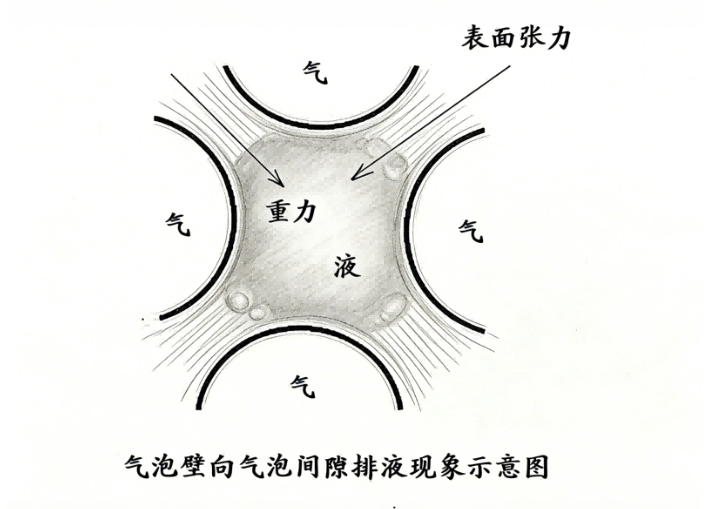
Moisture is rarely visible. A plant that runs well in a dry winter can suddenly see pinholes and soft foam in a humid summer even though the formula did not change. The tank atmosphere is the control point that prevents this seasonal drift.
Agitation, Recirculation, and Deaeration
Material conditioning is not only about temperature. Filled polyols, pigment dispersions, flame retardants, and blended polyols settle or separate if the tank is left idle. A poorly agitated tank produces a rich deposit at the bottom and a lean layer at the top, so the first pour of the morning and the last pour of the shift may not be the same formulation.
Agitation must be continuous or periodically sequenced, with an impeller design that moves the full working volume without creating a persistent vortex that draws air into the liquid. VFD-controlled agitators are useful because the correct speed depends on viscosity and fill level.
Recirculation goes a step further. By pulling material from the tank, through the metering circuit, and back to the tank or to a return line near the mixing head, the system keeps temperature and composition uniform right up to the pour point. Recirculation also reduces first-shot variation after a line has been idle, because the material in the pipes is not allowed to cool or separate.
For bubble-sensitive elastomer parts, vacuum deaeration in the tank removes entrained air before the material reaches the mixing head. Vacuum capability is not free; the tank then needs a vacuum-rated shell, proper seals, and a condenser or trap on the vacuum line to protect the pump from moisture and condensed vapor.

Where moisture, temperature drift, or incomplete conditioning has already affected part quality, the problems often appear later as dimensional change after demold. Causes Of Shrinkage In Polyurethane Foam How To Control It walks through the control points that keep shrinkage inside specification.
Construction Materials, Level Monitoring, and Safety Interlocks
Tank wetted parts must be compatible with both the polyol and isocyanate chemistry. Stainless steel is the most common choice for long service life and aggressive cleaning cycles, though the exact grade and surface finish should match the formula. Some abrasive or filled systems benefit from reinforced internals or replaceable wear components.
Seals, gaskets, valves, and sight-glass materials need separate review. A seal that is fine in a polyol tank may swell or lose integrity in contact with an isocyanate or a solvent flush. Ask the machine builder to specify the elastomer family for every wetted component, not just for the tank body.
Level monitoring is a process requirement and a safety requirement. The level sensor must distinguish between:
- Normal operating level.
- Low level, where the heater may need to be disabled to prevent a dry fire.
- High level, where transfer must stop to prevent overflow.
- Low-low level, where the metering pumps must be stopped or recirculation must be interrupted.
High- and low-level interlocks fall under the same functional safety logic used in the process industries. A high-level interlock should be independent of the normal fill control, and it should fail in a safe direction if the sensor or transmitter is lost [5].
The specification checklist below summarizes the main requirements in one place:
| Parameter | What to specify | Why it matters |
|---|---|---|
| Tank volume | Working volume plus heel | Prevents air draw and frequent transfer |
| Tank count | A-side, B-side, optional day tanks | Decouples conditioning from supply |
| Temperature range | Formula-specific band | Controls viscosity and reactivity |
| Temperature accuracy | Tighter than supplier tolerance | Prevents ratio drift |
| Heating/cooling | Jacket, immersion heater, cooling circuit | Maintains band during load changes |
| Agitation | Continuous or sequenced with VFD | Keeps fillers and blends homogeneous |
| Blanketing | Dry air or nitrogen plus vent dryer | Excludes moisture from NCO side |
| Vacuum | Only if degassing is required | Removes entrained air for bubble-free parts |
| Level controls | Low, low-low, high, independent high-high | Protects heater and prevents overflow |
| Wetted materials | Stainless steel and compatible seals | Avoids corrosion and seal failure |
Specify the Tank as a Process Module
The tank requirement is not a single line in a purchase order. It is a set of process decisions: how much material the line consumes between transfers, how narrow the temperature band must be, whether the formula is moisture-sensitive, and whether the metering pumps need recirculation to stay stable.
Before you request a machine quotation, collect six numbers: the resin system, required output in kg/min, shot weight range, tank temperature setpoint, production hours per shift, and whether you need day tanks or direct drum feed. This allows the machine builder to size the tank and metering package around your line, rather than adapting your line to a stock configuration.
For material tank and metering specifications matched to polyurethane foaming machines, contact Haifeng Polyurethane Machinery at Info@chinahaifeng.com or WhatsApp +86 135 662 96633 and include the six-number operating envelope above.
FAQ
Do I need a day tank if my foaming machine already has onboard tanks?
It depends on your line speed, shift pattern, and raw material packaging. Onboard tanks may be enough for small or intermittent production. A day tank becomes useful when drum changeover interrupts production, when materials need longer conditioning, or when the main tank volume is too small for the pour sequence. The day tank should be treated as a process tank with the same temperature, agitation, and blanketing requirements, not as an unheated buffer.
What temperature should I keep the polyol and isocyanate?
The correct setpoint comes from the material supplier and the formula. Polyols are usually held in a range that keeps viscosity manageable for the metering pumps, while isocyanates are held in a narrower band chosen to avoid excessive side reactions. The machine’s control accuracy should be tighter than the supplier’s recommended allowable drift, and the temperature sensor should be placed in the liquid, not only on the tank wall.
Can the same tank design be used for the A-side and B-side?
Often the basic tank design is similar, but the requirements differ. The isocyanate tank needs dry air or nitrogen blanketing, careful venting, and seals that resist the specific isocyanate chemistry. The polyol side may need stronger agitation for fillers and a heating capability matched to higher viscosity. Using an identical specification for both sides without checking the chemistry is a common purchasing error.
How much tank volume do I actually need?
Start with production demand, not with a catalog size. Estimate the largest continuous pour or the longest run before the next raw material transfer, add the minimum heel required to keep the agitator and sensors submerged, and then verify that the tank can heat and cool the working volume quickly enough for your shift pattern. The tank must serve the line, not the reverse.
Why does moisture in the tank cause pinholes in my parts?
Water reacts with isocyanate to form urea and carbon dioxide. That reaction consumes NCO, changes the effective mixing ratio, and releases gas that can appear as pinholes, soft foam, or density variation. A tank that breathes humid plant air can introduce enough moisture over a shift to produce these defects even when the machine settings are unchanged [1][2].
References
[1] ISOPA. MDI and TDI: Safe Handling and Storage. European Diisocyanate and Polyol Producers Association, Brussels, 2019.
[2] American Chemistry Council Center for the Polyurethanes Industry. TDI and MDI Safety Handbook. Washington, DC, 2017.
[3] ASTM International. ASTM D4878-15: Standard Test Methods for Polyurethane Raw Materials: Determination of Viscosity of Polyols. West Conshohocken, PA, 2015.
[4] International Organization for Standardization. ISO 3219:1993: Plastics — Polymers/Resins in the Liquid State or as Emulsions or Dispersions — Determination of Viscosity Using a Rotational Viscometer with Defined Shear Rate. Geneva, 1993.
[5] International Electrotechnical Commission. IEC 61511-1:2016: Functional Safety — Safety Instrumented Systems for the Process Industry Sector — Part 1: Framework, Definitions, System, Hardware and Application Programming Requirements. Geneva, 2016.
If you’re interested, check out these related articles:
Causes Of Shrinkage In Polyurethane Foam How To Control It
SRIM Explained Structural Reaction Injection Molding Basics
The Role Of Rise Time In Polyurethane Foaming
How Polyurethane Rollers Are Made From Casting To Cure
Shore A Vs Shore D Hardness In Polyurethane





