

A small drift on the A-side can leave foam soft, soles sticky, or elastomer parts brittle, even when the polyol has not changed. The problem rarely announces itself as a bad batch. It shows up as hardness scatter, longer demold times, or shrinkage after the part leaves the mold. In polyurethane, the isocyanate is the reactive anchor that builds the hard segment and drives cure, so understanding its role is less about chemistry theory and more about controlling the machine variables that keep the ratio honest.

What Isocyanate Does in the Polyurethane Reaction
Polyurethane forms when an isocyanate group reacts with a hydroxyl group on a polyol. The isocyanate group has the structure —N=C=O, and the reaction with —OH produces a urethane linkage:
R—NCO + R’—OH → R—NH—COO—R’
That linkage is the repeating backbone, but it is only part of the story. Aromatic isocyanates such as MDI and TDI also react with water, amines, and themselves under certain conditions. Water consumes two isocyanate groups, first forming an unstable carbamic acid, then an amine and carbon dioxide, and finally a urea linkage when the amine reacts with another isocyanate. That carbon dioxide is the blowing mechanism in water-blown foam.
From a production standpoint, the isocyanate side is the least forgiving part of the process. It is reactive with atmospheric moisture, temperature-sensitive, and high-viscosity at temperatures many polyols tolerate easily. A-side storage therefore requires dry nitrogen blanketing, jacketed lines, and filtration. If moisture gets in, NCO content drops, urea crystals can form, and the machine may still appear to run normally while the true index has slipped.

MDI, TDI, and Prepolymer: Choosing the Isocyanate Form
MDI and TDI account for most aromatic urethane production, but they do not play the same role.
TDI is mainly used in flexible slabstock and molded foam. It is a low-viscosity liquid, which makes it easy to meter, but its volatility and sensitizing potential require more careful handling. TDI volatility and monomer exposure are among the reasons that dedicated measurement and handling standards exist [4]. MDI is lower in vapor pressure and is the workhorse for rigid foam, elastomers, integral-skin, and many footwear applications. Modified MDI, polymeric MDI, and prepolymers made from MDI shift viscosity and reactivity to match the process.
When a processor buys an MDI prepolymer, the supplier has already reacted part of the isocyanate with a polyol. The remaining free NCO content—often expressed as a percentage on the certificate of analysis—is what the machine must meter against the B-side. The same nominal “index 100” can look very different if one prepolymer has 15% NCO and another has 23% NCO [1][2]. A machine that is not told the correct equivalent weight will deliver the wrong mass even if the pump is accurate.
Hardness changes are not usually a material-quality problem on their own; they trace back to the hard-segment content the isocyanate supplies. Shore A Vs Shore D Hardness In Polyurethane covers how to separate index effects from polyol and chain-extender effects.
The Isocyanate Index: The Main Control Lever
The isocyanate index is the ratio between the NCO equivalents delivered by the A-side and the hydroxyl equivalents delivered by the B-side, multiplied by 100. An index of 100 is stoichiometric; moving it up or down changes crosslink density, hard-segment content, cure completeness, and the amount of free isocyanate left in the part.
Index = (NCO equivalents / OH equivalents) × 100
The hydroxyl equivalents are derived from the polyol’s hydroxyl number [3], while the NCO side is taken from the prepolymer certificate [1][2]. The same formulation responds in predictable directions:
| Index range | Typical physical effect | Processing risk |
|---|---|---|
| Below 98 | Softer parts, lower crosslink density, incomplete cure | Tacky surfaces, weak heat resistance, higher compression set |
| 98–105 | Balanced properties for many elastomers and flexible foams | Narrow tolerance window for ratio and moisture |
| 105–115 | Higher hardness, modulus, and compressive strength | Shorter cream time, higher exotherm, more brittle failure mode |
| 115–130 | Improved dimensional stability in molded foam and semi-rigid parts | Greater shrinkage risk, higher internal stress |
| Above 130 | Used in highly crosslinked rigid foams; approaching some PIR behavior | High exotherm, scorch risk, and process safety concerns |
This table is a trend map, not a universal recipe. The correct index depends on the polyol functionality, chain extender, water level, and whether the part is solid or foam. A robust formulation may tolerate a five-point index movement; a highly filled or fast-curing system may not.
Some of the same ratio errors that leave parts sticky also make them shrink and lose dimension after demold. Causes Of Shrinkage In Polyurethane Foam How To Control It covers the process adjustments that reduce post-demold shrinkage.
What Ratio Drift Does to Your Finished Part
Index drift comes from either side. A B-side that pumps 2% heavy relative to the A-side lowers the practical index and gives a part that is softer, slower to cure, and more likely to creep under load. A-side overfeed raises hardness and modulus, but beyond a point it leaves unreacted NCO, which can migrate, react with moisture later, or produce a more brittle network.
In foaming, the effect is visible in cell structure and demold behavior. Excess isocyanate accelerates the gelling reaction relative to blowing, which can tighten the foam, raise density, and increase the exotherm. Too little isocyanate leaves an open, soft, or friable cell structure because the polymer cannot build enough crosslink density before the blowing reaction finishes.
For elastomers and soles, the same error appears as inconsistent Shore hardness, longer demold times, or a part that feels “dead” out of the mold. The failure may look like a curing agent problem, but the first measurement should be the delivered mass on both sides, not the raw material.
When parts come out soft or sticky, the first question is whether the machine actually delivered the programmed isocyanate mass. How To Calculate Shot Weight In Polyurethane covers the calculation and the points where pumps and flowmeters drift.
Equipment Control of the Isocyanate Side
Isocyanate control is a metering, temperature, and recirculation problem.
Positive-displacement metering pumps are standard, but pump accuracy alone is not enough. A gear or piston pump can be accurate in a test loop and still drift when viscosity changes, filter loading increases, or the return line is restricted. The solution in higher-speed machines is closed-loop correction: a flowmeter or a sensor on the pump compares commanded flow with actual flow and corrects the drive continuously. Servo-driven metering helps because a change in material viscosity has a smaller effect on delivered volume than it does on an open-loop motor running at fixed speed.
Temperature control is the second variable. Isocyanate viscosity is strongly temperature-dependent, and heat affects reaction rate at the mixing head. A-side temperatures that are too low can produce poor mixing and high residual NCO; too high can promote thermal degradation in storage. The circulating loop must keep the material moving so the entire system stays at a stable, uniform temperature, with no cold zones near the head.
Mixing energy matters once the two streams meet. High-pressure impingement mixing relies on both components arriving at the chamber at the correct pressure and volume. A small ratio error at the pump is repeated in every shot; an intermittent error from a partially blocked nozzle can look like a formulation problem but is mechanical.
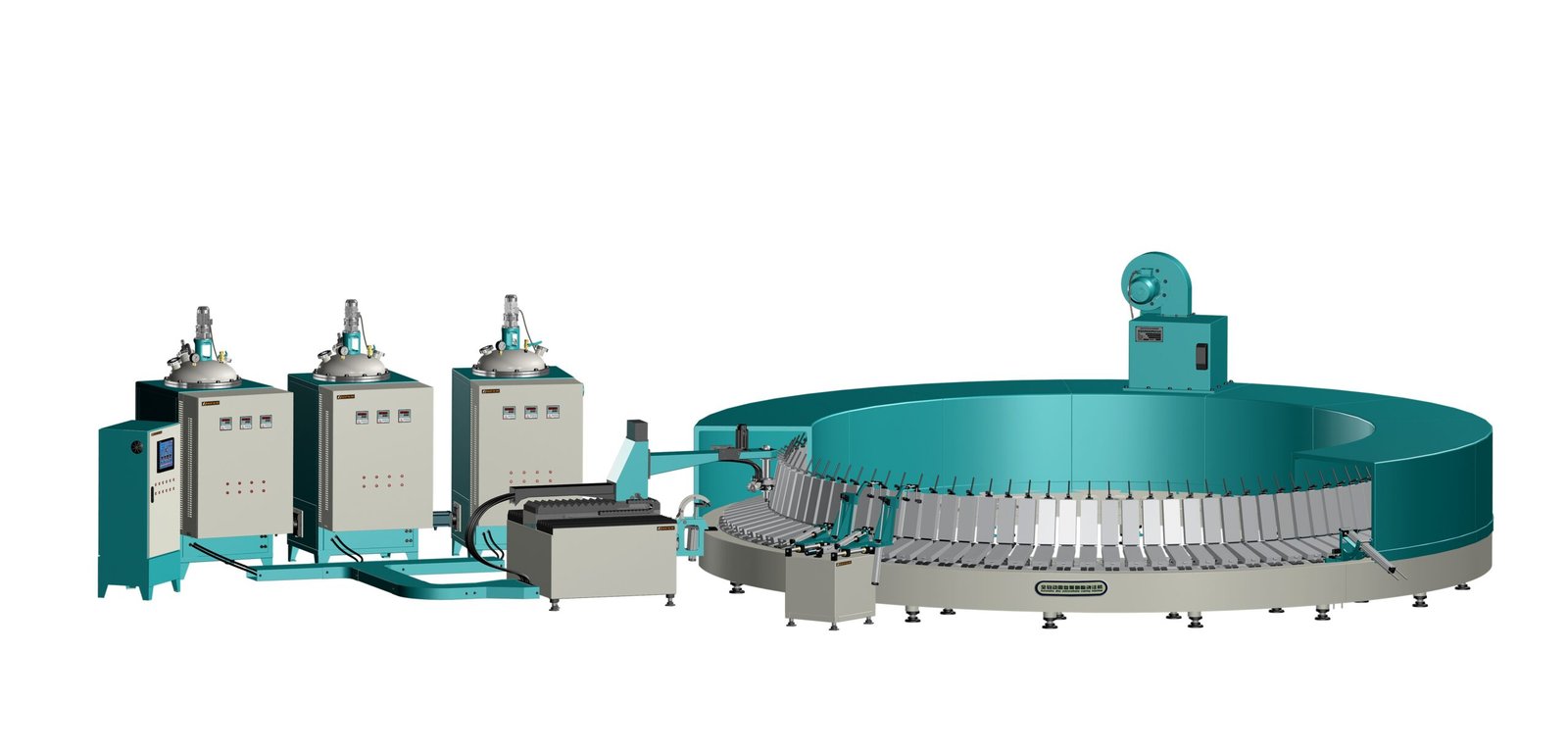
Haifeng’s equipment approach treats the A-side loop as one system: dry nitrogen protection, jacketed tank and lines, servo metering, and closed-loop ratio correction. If a processor is auditing a ratio problem, the useful data are commanded ratio, actual shot mass per side, temperature, and pressure at the mixing head. If the audit points to the machine rather than the chemistry, the metering and line-integration team can help map the failure. Send the machine model, shot weight, current A/B ratio, and the prepolymer TDS to Info@chinahaifeng.com or WhatsApp +86 13566296633, and include one demolded part for context.

Check the Ratio Before You Rebuild the Formulation
Most isocyanate-related defects are not solved by changing the raw material first; they are solved by confirming what the machine delivered.
Before you adjust the index, record these five items:
- Current NCO content from the prepolymer certificate, not the nominal grade.
- Commanded A:B ratio and actual shot mass per side from the machine log.
- A-side and B-side tank temperatures during the run.
- Mixing head pressure and the condition of the nozzle and filters.
- Demold time, hardness, and density or part mass for the last five shots.
If the recorded mass does not match the intended index, correct the metering loop first. Then make small formulation steps of two to three index points rather than large jumps.
For a ratio audit, a metering upgrade, or a turnkey line review, contact Haifeng Polyurethane Machinery at Info@chinahaifeng.com or WhatsApp +86 13566296633. Include your current machine model, shot weight, and A-side material TDS so the first response is a practical one.
FAQ
How do I know if my isocyanate index is too low?
Look for a soft or tacky surface, poor heat resistance, high compression set, or a part that takes longer to reach demold strength. Measure the actual delivered shot mass on both sides and recalculate the index from the prepolymer’s free NCO content rather than relying on the nominal grade.
Why does excess isocyanate make a polyurethane part brittle?
A higher index raises crosslink density and hard-segment content, which increases modulus, hardness, and compressive strength. Beyond the formulation’s optimum, the extra NCO can form allophanate and biuret crosslinks, reduce chain mobility, and concentrate stress, so impact and flex resistance drop. The gain in hardness stops being useful.
What is the difference between free NCO and total NCO?
Free NCO is the unreacted isocyanate content in a prepolymer, usually measured by titration and reported as a percentage. Total NCO includes isocyanate that has already reacted during prepolymer production and is not available for the main reaction. Machine settings must be based on free NCO, not total NCO.
Can I use the same isocyanate index for MDI and TDI systems?
No. MDI and TDI differ in reactivity, functionality, equivalent weight, and how they build hard segments. A TDI flexible foam may run at an index near the low end of its normal range, while a rigid MDI foam may need a higher index for dimensional stability. Always use the index recommended for the specific system and part geometry.
How does moisture affect the isocyanate side?
Water reacts with isocyanate and consumes NCO groups, changing the effective index and producing urea and carbon dioxide. Moisture entering through an unblanketed tank, a leaking line, or a faulty desiccant drier lowers the actual NCO available, so parts cure soft even when the pump ratio reads correct. The A-side tank should be kept under dry nitrogen, and the NCO value should be checked if moisture contamination is suspected.
References
[1] ISO 14896:2009, Plastics — Polyurethane Raw Materials — Determination of Isocyanate Content.
[2] ASTM D5155-14, Standard Test Methods for Polyurethane Raw Materials: Determination of the Isocyanate Content of Aromatic Isocyanates.
[3] ISO 14900:2017, Plastics — Polyols for Use in the Production of Polyurethane — Determination of Hydroxyl Number.
[4] ISO 10283:2007, Binders for Paints and Varnishes — Determination of Monomeric Diisocyanates in Isocyanate Resins.
If you’re interested, check out these related articles:
RRIM Vs RIM Which Process Suits Your Structural Part
The Role Of Rise Time In Polyurethane Foaming
What Is Semi Rigid Polyurethane Foam
Causes Of Shrinkage In Polyurethane Foam How To Control It





