

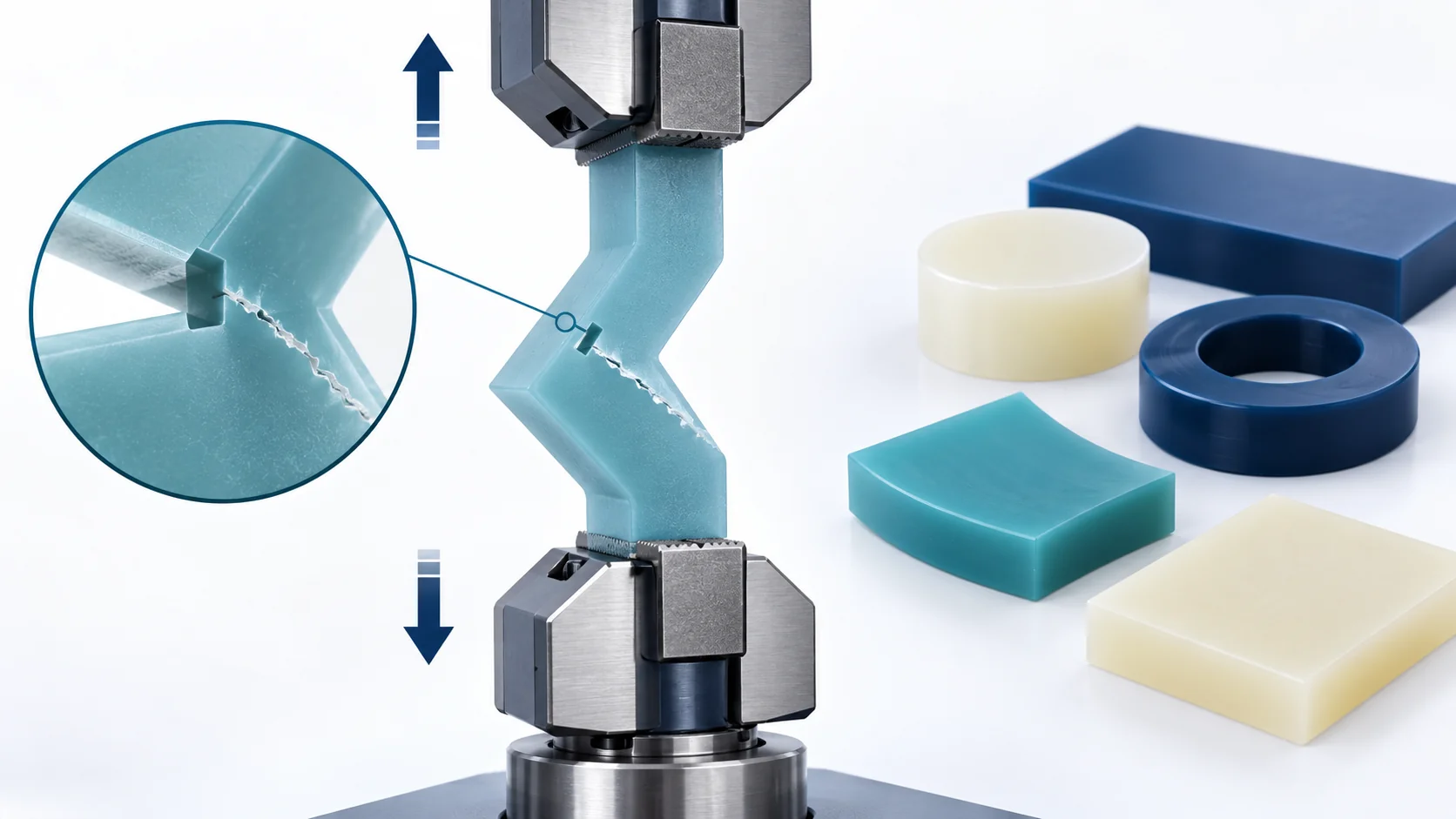
A polyurethane part that tears under load is usually exposing two problems at once: the material network did not reach its intended state, or the process left flaws that gave the crack an easy path. Tear strength is not something you fix with a single additive or a higher hardness number. It improves when formulation, mixing, metering, degassing, and cure work together to leave fewer stress concentrators in the finished part.
Tear Strength Is About Stopping Crack Growth, Not Raising Hardness
Tear strength is not tensile strength. A tensile test pulls an uncut dumbbell specimen to break, while a tear test deliberately places a cut or nick in the specimen and measures the force needed to make that cut grow. The result is reported as force per unit thickness, commonly kN/m or lbf/in [1]. The most widely used methods are ASTM D624 Die C and ISO 34-1 trouser, angle, or crescent specimens [1][2].
Two polyurethane parts with nearly identical tensile strength can show very different tear resistance because a crack tip concentrates stress in a small zone. If that zone can deform, absorb energy, and blunt the crack, tear strength stays high. If microvoids, hard particles, or incomplete cure are present near that zone, the crack advances with less force. That is why tear failures often appear in parts that pass tensile and hardness checks.
Formulation Levers That Increase Tear Resistance
Polyurethane elastomers are block copolymers built from soft segments, typically long-chain polyols, and hard segments formed by the isocyanate and a short-chain diol or amine. The hard segments associate into domains that act as reinforcement, while the soft segments provide elasticity. Tear resistance improves when the network can dissipate energy at the crack tip without brittle failure [3].
Several formulation changes can shift tear strength meaningfully:
- Polylol backbone. Polyester polyols generally provide higher tear strength than polyether polyols of comparable molecular weight because ester groups form stronger intermolecular associations and can promote strain-induced crystallization [4]. Polyethers often win on low-temperature flexibility and hydrolysis resistance, so the choice should follow the service environment.
- Hard segment content. Raising prepolymer NCO content or increasing the share of hard segments usually raises hardness, modulus, and tear strength, but only up to a processing and toughness limit. Very high hard segment levels can make the material brittle and reduce tear.
- Chain extender choice. In many elastomer systems, MOCA-cured formulations deliver higher tear and load-bearing performance than BDO-cured systems at similar hardness, while BDO often favors resilience and lower compression set. The right choice depends on cure temperature, handling, and end-use requirements.
- Crosslink density. A moderate addition of a trifunctional crosslinker such as trimethylolpropane can reinforce the network and raise tear strength. Over-crosslinking cuts elongation and can lower tear by reducing the material’s ability to blunt a crack tip.
- Moisture and additive control. Water reacts with isocyanate and creates urea and carbon dioxide. In cast or solid elastomers, that gas becomes bubbles, and each bubble is a potential crack initiator. Plasticizers, excessive internal mold release, or coarse fillers can also act as soft or weak zones.
| Formulation lever | Typical effect on tear strength | Main caution |
|---|---|---|
| Polyester polyol backbone | Tends to raise tear versus polyether | Check hydrolysis resistance in wet service |
| Higher hard segment content | Usually raises tear up to a limit | Viscosity rises and degassing gets harder |
| MOCA instead of BDO | Often improves tear and load-bearing | Needs higher cure temperature and careful handling |
| Moderate crosslinker addition | May reinforce the network | Over-crosslinking reduces elongation |
| Drier raw materials | Protects a dense, bubble-free network | Requires closed transfer and dry blanketing |
Hardness is often confused with tear. Raising hard segment content usually increases both values, but the relationship is not linear. Beyond an optimum, the network embrittles and tear strength drops even though Shore hardness keeps rising. That is why the tear value itself, not the hardness number, must be the specification.
Hardness and tear strength move together only over part of the formulation window. Shore A Vs Shore D Hardness In Polyurethane covers how the two hardness scales map to elastomer chemistry and part performance.
Process Variables That Quietly Lower Tear Strength
A correctly formulated system will still tear below capability if the process leaves internal flaws. The most common silent causes are:
- Moisture in the raw materials. Residual water creates CO₂ bubbles in a nominally solid elastomer. The bubbles may be too small to see on the surface, but they act as crack starters inside the part.
- Mixing ratio deviation. Off-ratio material can appear fully molded while leaving unreacted groups or a plasticizing excess that weakens the network. Small offsets matter because they change the planned hard segment structure.
- Entrapped air. Incomplete degassing or air drawn in during transfer leaves voids. The same is true for excessive mixing head turbulence that beats gas into the material.
- Mold and material temperature drift. Viscosity changes can shift mixing quality, fill pattern, and the final cure structure.
- Premature demold or insufficient post-cure. A part that feels hard at demold is not necessarily fully reacted. Cutting the cure short can freeze an incomplete network and lower tear strength.
- Internal shrinkage stress. As the part cools and hardens, shrinkage can leave residual stress. When a crack forms, that stored stress adds to the external load and makes crack growth easier.
Internal shrinkage is especially dangerous because the part may look dimensionally acceptable while carrying invisible stress concentrations.
Internal shrinkage leaves the part under residual stress, and a tear test will find every one of those stress concentrators. Causes Of Shrinkage In Polyurethane Foam How To Control It covers the main shrinkage mechanisms and the process controls that reduce them.
Equipment-Level Controls: Metering, Mixing, and Degassing
Equipment does not create tear strength out of nowhere, but it holds the variables that let the formulation reach its own capability. Three controls matter most:
- Metering accuracy. A casting platform built for elastomer parts may specify dynamic metering accuracy of ≤ ±0.3% full range and vacuum degassing down to -0.095 MPa. The important point is not the number alone but whether the system holds it across a full shift with warm-up, tank changeover, and different shot sizes.
- Mixing quality. High-speed dynamic mixing must produce a homogeneous reaction without pulling air into the stream. Head speed, mixing chamber design, and pour rate need to match the material viscosity and pot life.
- Temperature control. Separate tank, hose, and mold temperature control keeps component viscosity stable and lets the cure follow the intended exotherm profile. A drifting tank heater can produce the same kind of off-spec part as a weighing error.
Roller casting is a useful reference because rollers routinely require high tear and abrasion resistance while being poured into thick-section molds that punish trapped gas, uneven cure, and residual stress.
Roller casting shows how pour sequence, mold temperature, and cure schedule interact with final mechanical properties. How Polyurethane Rollers Are Made From Casting To Cure covers the process from filling to post-cure and where defects tend to originate.
If tear failures persist after moisture, ratio, and cure variables are ruled out, the next step is an equipment audit rather than another formula tweak. Send your current tear-test values, target specification, and part drawing to Info@chinahaifeng.com or WhatsApp +86 13566296633, and we can help separate formulation limits from machine-level causes before you commit to new raw materials or a line change.
A Practical Test-and-Adjust Sequence
When tear strength is a purchase-order requirement, use a structured trial sequence instead of changing several variables at once.
- Lock the test method. Specify ASTM D624 Die C or ISO 34-1 and keep the same specimen geometry, notching method, and conditioning for every comparison [1][2].
- Check raw material condition first. Confirm water content, age, and storage temperature against the supplier’s specification. Measure before reaching for a new formulation.
- Verify ratio and mixing. Confirm the machine is holding the target A/B ratio and that mixed material is visually homogeneous with no gas streaks.
- Inspect for voids. Section a sample part and look for bubbles, porosity, or density variation. A void problem is a degassing, fill, or moisture problem, not a chemistry problem.
- Change one formulation lever at a time. Shift polyol type, hard segment content, chain extender, or crosslinker level independently and record the result against a fixed cure cycle.
- Measure tear plus companions. Always record tensile strength, elongation, Shore hardness, and compression set alongside tear. This shows whether an improvement in tear has been bought with an unacceptable penalty elsewhere.
- Validate on the production line. A laboratory slab is not a molded part. Run a pilot batch through the actual mold, cure, and demold sequence before changing the specification.
Specify Tear Targets With Your Equipment Partner
Once a tear value becomes a customer requirement, put the test method and target into the part specification before production tooling is finalized. Then work backward from that number through material, mold, metering, mixing, degassing, and cure. A well-documented baseline makes the difference between a controlled adjustment and a long trial-and-error campaign.
For line-level support on metering, degassing, and elastomer casting systems, contact Haifeng Polyurethane Machinery at Info@chinahaifeng.com or WhatsApp +86 13566296633 and share your target tear strength, part geometry, and current scrap pattern.
FAQ
What is the fastest way to improve tear strength without changing the formulation?
Check moisture, mixing ratio, degassing, and cure first. Many tear failures are process flaws rather than chemistry problems. Fix entrained air, off-ratio metering, or premature demold before reformulating.
Does higher hardness always mean higher tear strength?
No. Hardness and tear strength often rise together, but over-crosslinking or very high hard segment content can make the material brittle and lower tear even as Shore hardness increases.
Which tear test should I specify?
For most polyurethane elastomer parts, ASTM D624 Die C or ISO 34-1 are the standard choices. Use the same method, specimen form, and notching procedure when comparing batches or suppliers.
Can equipment really change a material property?
Equipment cannot replace the right chemistry, but it can prevent the flaws that make good chemistry tear early. Accurate metering, effective vacuum degassing, stable temperature control, and proper mixing all protect the material’s intrinsic tear strength.
What should I record during a tear-strength trial?
Record the test method, specimen orientation, water content, A/B ratio, mixing head speed, degassing vacuum level, tank and mold temperatures, demold time, and post-cure schedule. Without those, a tear result is difficult to reproduce.
References
[1] ASTM D624-00(2020), Standard Test Method for Tear Strength of Conventional Vulcanized Rubber and Thermoplastic Elastomers, ASTM International, 2020.
[2] ISO 34-1:2022, Rubber, vulcanized or thermoplastic — Determination of tear strength — Part 1: Trouser, angle and crescent test pieces, International Organization for Standardization, 2022.
[3] Oertel, G. (ed.), Polyurethane Handbook: Chemistry, Raw Materials, Processing, Application, Properties, 2nd ed., Hanser Publishers, 1994.
[4] Ionescu, M., Chemistry and Technology of Polyols for Polyurethanes, Rapra Technology, 2005.
If you’re interested, check out these related articles:
SRIM Explained Structural Reaction Injection Molding Basics
Measuring Polyurethane Foam Resilience A Practical Test Guide
How Polyurethane Rollers Are Made From Casting To Cure
What Is Semi Rigid Polyurethane Foam





