

Most production teams treat isocyanate index as a fixed setpoint: keep it at 100, hold it constant, and assume the material will behave. In practice, index is one of the most consequential chemical variables in the formulation because it decides how much of the isocyanate–hydroxyl reaction can go beyond chain extension into crosslinking. That excess or deficit changes hardness, modulus, recovery, dimensional stability, and demold behaviour long before the part reaches final inspection.
What Isocyanate Index Actually Means
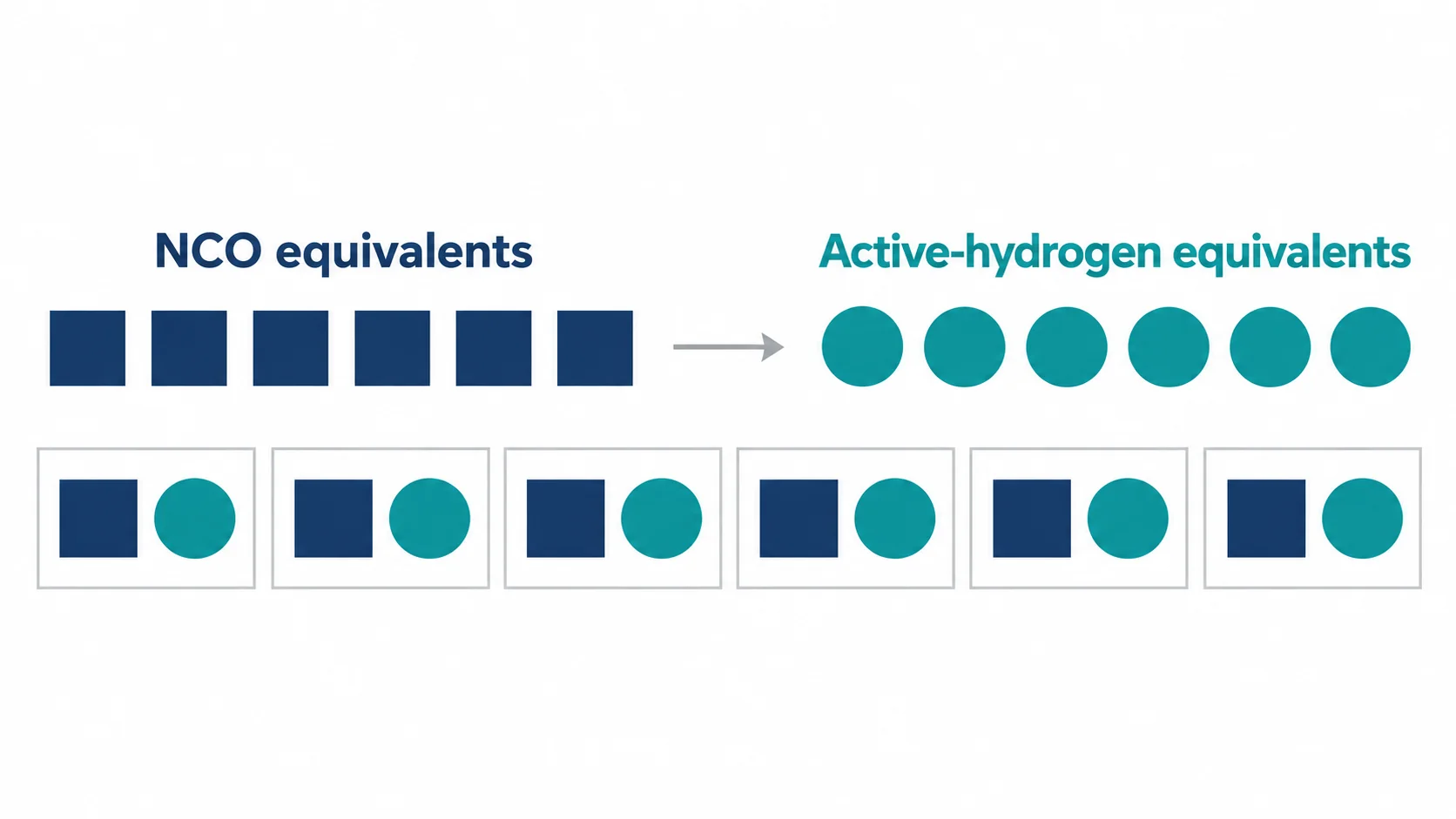
Isocyanate index, also called NCO index, compares the isocyanate equivalents actually charged to the isocyanate-reactive equivalents needed for the formula. A 100 index is stoicheometric: one NCO equivalent for every reactive hydrogen coming from polyols, chain extenders, crosslinkers, and water. Below 100, some reactive hydroxyl remains unreacted. Above 100, the excess isocyanate seeks secondary reactions, mainly allophanate and biuret formation and, at higher excess or temperature, isocyanurate trimerization [3][4].
In practice, the number is only as meaningful as the raw-material data behind it. The polyol side is derived from hydroxyl number [1]; the isocyanate side is derived from NCO content [2]. If a material lot changes and the recipe keeps using old OH or NCO values, the displayed index can remain the same while the real index shifts by several points.
The index calculation itself is simple:
Index = (Equivalents of NCO / Equivalents of reactive hydrogen) × 100
What makes it difficult on the plant floor is that both sides drift. Water entering the system, a different polyol batch, an inaccurate isocyanate assay, or a poorly calibrated metering pump can all move the effective index without a single change to the recipe screen.
Hardness, Modulus, and Recovery: What Changes When Index Moves
The general direction is predictable. As index moves above 100, the extra isocyanate adds crosslinks and hard-domain structure. Hardness and modulus rise, elongation usually falls, and the part becomes more resistant to heat softening but more likely to turn brittle. As index moves below 100, the network has fewer completed bonds: the material typically becomes softer, more recoverable, and less able to hold a precise molded shape over time.
The size of the change matters more than the direction. A one-point index drift may be invisible. A five-point drift can move a part out of specification.
| Effective index | Network effect | Hardness response | Tensile/elongation tendency | Recovery and compression set |
|---|---|---|---|---|
| 95–98 | Lower allophanate/biuret crosslinking | Softer, lower Shore A/D | Higher elongation in many elastomers | Often worse compression set |
| 100 | Baseline stoicheometry | Reference hardness | Reference balance | Reference behaviour |
| 102–105 | Slight excess NCO | Firmer surface, moderately higher modulus | Elongation begins to fall | Usually improves in microcellular foam |
| 106–112 | Stronger hard-domain network | Noticeably harder, higher modulus | Lower elongation, higher brittleness risk | Better set resistance if not overcooked |
| Above 112 | High trimer/allophanate tendency | Hard but increasingly brittle | Toughness can fall sharply | Risk of internal stress and cracking |
These are directional windows, not universal prescriptions. The base polyol, chain extender, and whether the system is water-blown all shift the absolute values. Use the table to build a trial ladder, not to replace one.
Hardness does not move in a straight line with index. Shore A Vs Shore D Hardness In Polyurethane covers how to interpret Shore A and Shore D values when crosslink density changes.
Density, Demold, and Shrinkage: The Process Side
Index is not a density dial. Foam density is controlled mainly by shot weight, mold fill, and blowing reaction. Index changes how the cell walls and polymer network behave, not how much gas is generated.
The process effects are indirect but real. A slightly over-indexed system can often build enough green strength to demold a few seconds earlier in microcellular or integral-skin parts. The trade-off is exotherm. Excess NCO releases more heat as it reacts, and thick sections that cannot shed that heat may develop core discolouration, internal stress, or brittleness even when mould temperature is stable.
Shrinkage and dimensional stability sit on both sides of the index window. Too low, and the part may show higher compression set or excessive post-mold relaxation. Too high, and the dense crosslinked network can generate internal stress while the part is still hot, pulling it away from mold walls or leaving it dimensionally tight in one axis and distorted in another.
On a microcellular rail-pad line, moving toward the lower end of the index window often made a larger difference to low-temperature recovery than increasing catalyst level alone. The part stayed firm enough for the application but stopped behaving like a rigid plate when service temperature dropped.
Index and mold shrinkage are intertwined, but not in a simple straight line. Causes Of Shrinkage In Polyurethane Foam How To Control It covers the crosslink and density factors that make over-indexed foam pull away from the mold.
Why Metering Accuracy Determines the Real Index
The calculated index is no better than the actual ratio fed to the mixing head. A one-percent metering error by mass can shift the effective index enough to erase the difference between a trial batch and a production batch. This is why index troubleshooting starts upstream of the chemist and downstream of the pump.
On high-pressure machines, impingement mixing homogenizes the two components, but it does not correct ratio. Ratio is set by pump displacement, temperature-compensated density control, and flow verification. On low-pressure lines using gear pumps or servo metering, the same principle applies: if the actual A/B mass ratio drifts, the index drifts with it.
That means the plant must treat index as a combined chemical and metering variable. The operator sees a ratio setpoint; the part sees a chemical excess. When hardness moves but the recipe does not, the first question should be whether the machine is delivering what the screen claims.
If you are seeing batch-to-batch hardness drift even after holding index constant, send the current A/B ratio, pump calibration records, and the hardness or density trend to Info@chinahaifeng.com or WhatsApp 86 13566296633. The review usually starts with whether the real index is drifting while the setpoint says it is not.

Choosing an Index Window Without Guessing
The practical way to choose an index window is to run a short ladder, not to copy a number from another product. Even when two parts use the same polyol and isocyanate, differences in wall thickness, mold temperature, and demold time reward different index levels.
A workable sequence:
- Measure the current polyol hydroxyl number and water content before building trial batches [1].
- Confirm the isocyanate content of the NCO side [2][5].
- Mix three fixed points: stoicheometric, low excess, and high excess for the candidate formula.
- Record cream time, gel time, rise or snap time, free-rise density, molded density, Shore hardness at fixed demold time, and compression set.
- Compare exotherm, demold release, and surface quality at each point.
- Select the highest index that still meets recovery and elongation, not simply the highest hardness.
The goal is balance. A window may be 100–105 for one cast elastomer and 105–112 for a dense microcellular pad. The deciding factors are usually set resistance, low-temperature recovery, and brittleness.
For parts that sit between flexible and rigid, upper boundaries matter more than the nominal index. What Is Semi Rigid Polyurethane Foam covers the narrow property window where too high an index destroys recoverability.

Common Missteps That Look Like Index Problems
Many production issues are blamed on index when the real fault is measurement or control. Before changing the formula, check the simplest sources.
Hydroxyl value drift. A new polyol lot with a slightly different OH value changes the stoicheometric demand even though the recipe screen shows the same index [1]. Measure every lot or use supplier data that is current, not assumed.
Water ingress. Moisture consumes isocyanate and changes both blowing and urea formation. A system that starts at 100 can behave like 96 by the end of a humid shift if the polyol or day tank is not protected.
Catalyst imbalance. Catalysts change reaction speed, not crosslink density. Adding more tin or amine can make a part look harder sooner, but the final network may still be underindexed and fail compression set or hydrolysis testing.
Mold temperature and fill weight. Hardness and density can shift without any index change. A cold mold or a three-percent fill variation can produce the same symptom as a two-point index error.
Old data in the machine controller. If the operator enters the same nominal mix ratio for every product but the raw materials change, the machine is faithfully delivering an obsolete formulation.
Talk to a PU Equipment Engineer
If you are trying to pin down an index window for a new part or debugging a hardness drift that follows material batches, Haifeng Polyurethane Machinery can help connect the chemistry to the machine control. Send the raw-material TDS, target hardness or density, mold type, and current defect trend to Info@chinahaifeng.com or WhatsApp 86 13566296633. The discussion usually starts from metering accuracy and real index control, not brochure numbers.
FAQ
Is a higher isocyanate index always harder?
Usually firmer, but not in a straight line. A moderate excess builds crosslinks and raises hardness. Past a certain point, the part becomes brittle rather than usefully hard, and toughness drops even though Shore hardness may still rise.
What is a common index window for different polyurethane systems?
Rigid foam is often intentionally over-indexed to promote trimerization and dimensional stability. Flexible foam and many cast elastomers stay closer to stoicheometric because elongation, resilience, and recovery are more sensitive. Microcellular parts often run a modest excess to shorten demold while retaining compression-set resistance.
Does index directly control polyurethane density?
No. Density is set mainly by shot weight, mold fill, and blowing. Index changes how the polymer network behaves and how the cell walls respond under load, but it is not the primary density dial.
How do I know whether a hardness shift is index drift or metering drift?
Track OH number, NCO content, moisture, and actual A/B mass flow at the same time as hardness and density. If hardness changes while molded density and water content stay constant, index-related drift is more likely. If density is also moving, check fill weight and pumping first.
Can extra catalyst compensate for a low isocyanate index?
Only partly. A catalyst can make the reaction reach gel or cure faster, but it does not add crosslink density. The part may feel firm sooner while still failing compression set, hydrolysis resistance, or hot recovery later.
References
- ISO 14900:2017, Plastics — Polyols for use in the production of polyurethanes — Determination of hydroxyl number. International Organization for Standardization.
- ISO 14896:2009, Plastics — Polyurethane raw materials — Determination of isocyanate content. International Organization for Standardization.
- Oertel, G., ed., Polyurethane Handbook. 2nd ed. Munich: Hanser Publishers.
- Szycher, M., Szycher’s Handbook of Polyurethanes. 2nd ed. Boca Raton: CRC Press.
- ASTM D5155-19, Standard Test Methods for Polyurethane Raw Materials: Determination of the Isocyanate Content of Aromatic Isocyanates. ASTM International.
If you’re interested, check out these related articles:
RRIM Vs RIM Which Process Suits Your Structural Part
The Role Of Rise Time In Polyurethane Foaming
SRIM Explained Structural Reaction Injection Molding Basics





