Operators usually notice a catalyst problem first in cream time. A formula that has run for weeks suddenly creams in 9 seconds instead of 18, or rise time stretches and a mold comes out short. In most water-blown polyurethane systems, the cause is not one catalyst going bad. It is the balance between two reactions shifting under a temperature change, a raw-material lot change, or a metering drift that changes the real catalyst ratio delivered to the mixing head.
Understanding that balance is the fastest way to stop chasing density, cell-structure, and demold problems one by one. Catalysts decide which reaction consumes the available isocyanate and how quickly that happens. When that balance moves, the foam changes before the operator sees a fault.

The Two Competing Reactions in Polyurethane Foaming
Every water-blown polyurethane foam is built from two exothermic reactions that compete for isocyanate groups. The blowing reaction is the reaction between isocyanate and water: it releases carbon dioxide and forms an amine intermediate, which then reacts with more isocyanate to form urea. That carbon dioxide is what expands the foam. The gelling reaction is the reaction between isocyanate and hydroxyl groups on the polyol or chain extender: it forms urethane linkages and builds polymer strength[1].
In a production setting, the operator cannot see either reaction directly. What is visible is the result: the time from pour to visible reaction, the rate of rise, the moment the surface skins over, and the final dimensional stability. Catalysts lower the activation energy of these reactions, but they do not accelerate everything equally. Some catalysts work harder on blowing, some harder on gelling, and some shift behavior as the reaction exotherm raises the material temperature.
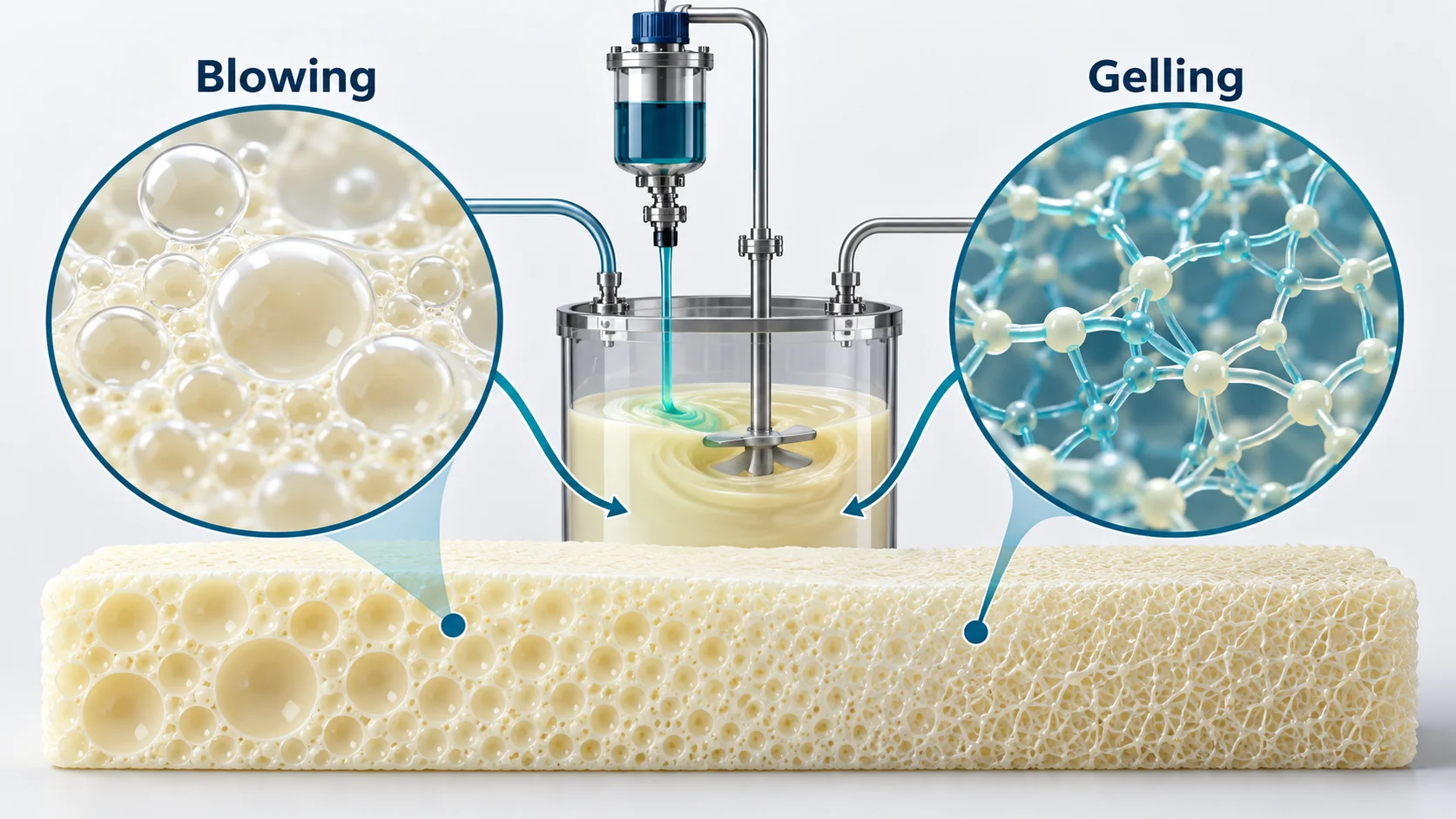
Amine vs. Organometallic Catalysts: Gelling and Blowing Drivers
Tertiary amine catalysts drive the blowing reaction. Compounds such as triethylenediamine, dimethylcyclohexylamine, and delayed-action or acid-blocked amines activate the isocyanate-water path. Their practical effect is shorter cream time, faster rise, and stronger carbon dioxide generation. Because they also catalyze the urea-forming step, they contribute to early polymer network formation, but their dominant production signal is usually faster rise and a more open cell structure[2].
Amine catalysts are also sensitive to temperature and water content. A small change in water level changes the amount of blowing reaction available for the amine to promote, which is why a water-rich formula can appear over-catalyzed even when the catalyst loading has not changed.
Organometallic catalysts drive the gelling reaction. Dibutyltin dilaurate and stannous octoate are the classic tin-based choices; bismuth and zinc carboxylates are used when tin-free systems are required. These catalysts accelerate the isocyanate-polyol reaction, building urethane linkages and final polymer strength. In production terms, they shorten gel time, firm the rising foam earlier, and usually reduce open time. Too much gelling activity closes cells before blowing is complete, which leads to shrinkage, high density, and sometimes a poorly cured core[3].
Potassium octoate sits in a separate category. In polyisocyanurate or PIR-containing rigid systems, it promotes trimerization of isocyanate into isocyanurate rings. That creates a more heat-resistant, rigid network, but it also raises exotherm and can make the reaction much less forgiving if metering is not stable.

Balancing Gel and Blow in Production
The central production task is not choosing the strongest catalyst. It is holding the gel-blow balance in a range where the foam rises completely, cells stay open enough to avoid shrinkage, and the part demolds with enough green strength.
If the blowing reaction runs ahead of the gelling reaction, gas is generated before the polymer has enough viscosity and strength to contain it. The result is usually coarse cells, split foam, blow holes, or a collapsed bun. If the gelling reaction runs ahead of the blowing reaction, the polymer network stiffens before full expansion. That produces dense, closed-cell material, heavy parts, and shrinkage as trapped gas cools.
The balance is adjusted through three levers: water level, catalyst ratio, and material temperature. Water level controls how much blowing reaction is available. The catalyst package controls how efficiently that available blowing reaction proceeds relative to gelling. Temperature raises the rate of both reactions, but it does not raise them equally; this is why a warm day can make a previously stable formula behave differently.
Catalysts set the pace of the reaction, but the operator sees that pace as rise time. > The reaction balance shows up most clearly as rise time and final cell structure. The Role Of Rise Time In Polyurethane Foaming covers how rise time links to cell formation and why it should be measured before changing any catalyst level.
| Catalyst class | Primary reaction promoted | Process signal to watch |
|---|---|---|
| Tertiary amine | Blowing and urea formation | Cream time, rise time, cell openness |
| Organotin | Gelling and urethane formation | Gel time, surface cure, demold firmness |
| Bismuth or zinc carboxylate | Gelling with hydrolysis resistance | Gel time, long-term hydrolytic stability |
| Potassium octoate | Isocyanurate trimerization | Exotherm, rigidity, heat resistance |
The evidence table above is intentionally process-level. Operators rarely diagnose a catalyst by chemistry alone. They diagnose it by watching which time moves first. If cream time and rise time both shorten but demold remains soft, the issue is more likely amine-driven blowing. If rise time barely changes but the surface firms early and the part is dense, gelling activity is the more likely driver.
Equipment-Level Factors That Amplify Catalyst Effects
A catalyst package only works correctly if the machine delivers it correctly. On low-pressure and high-pressure foaming lines, the catalyst is usually dissolved or dispersed in the polyol side. That means catalyst accuracy is tied directly to component metering accuracy, recirculation stability, and mixing-head performance.
If a metering pump drifts by half a percentage point on the polyol side, the real catalyst ratio also moves. The machine may show no alarm. The first sign is often a repeatable shift in cream time from mold to mold, or a density change that cannot be traced to temperature.
Catalyst action is irrelevant if the metering side is not delivering the intended charge. > Before changing a catalyst level, verify the machine is actually pouring the intended shot mass. How To Calculate Shot Weight In Polyurethane covers the calculation that separates ratio drift from real formulation drift.

Mixing head speed and material temperature matter just as much. Inadequate shear leaves unmixed catalyst-rich or water-rich zones, creating uneven cream, irregular cells, and localized shrinkage. Overly high shear can add nucleation air or raise material temperature, changing the effective reaction rate without any formula change. For a fixed catalyst package, stable temperature and stable mixing shear are the cheapest controls available.
At this point, the practical question is usually not which catalyst to buy. It is whether the selected catalyst ratio can be held repeatably by the existing metering and mixing setup. If you are working through a cream-time drift that cannot be traced to water or temperature, send your current formulation data, target cream and rise times, and a short video of the mixing head to Info@chinahaifeng.com. Separating a real catalyst imbalance from an equipment drift issue is faster with process data than with another lab trial alone.
Common Catalyst-Related Faults and How to Trace Them
| Fault | Likely catalyst or balance issue | First check |
|---|---|---|
| Slow cream, slow rise | Blowing reaction under-accelerated | Amine loading, water level, B-side temperature |
| Split foam, blow holes | Blowing too fast relative to gel | Amine/tin or amine/bismuth ratio, water level |
| Dense part, closed cells | Gelling too fast relative to blow | Organometallic level, mold temperature, breathing time |
| Shrinkage after demold | Gel-blow imbalance or trapped gas | Catalyst package, venting, demold time |
| Surface pinholes | Fast surface gel or unstable nucleation | Surface temperature, mixing shear, nucleating air |
The point of the table is to create a traceable sequence rather than a guess. If a fault appears, record cream time, gel time, rise time, and part weight before touching the catalyst package. Measure against the same formula and the same machine state. A single-point change in catalyst loading without that record often trades one defect for another.
Shrinkage is one fault where catalyst imbalance is frequently missed because it appears after the part has left the mold. > Shrinkage often gets blamed only on mold temperature, but gel-blow imbalance is a primary catalyst-level cause. Causes Of Shrinkage In Polyurethane Foam How To Control It covers how to trace shrinkage through formulation, density, and process variables in sequence.
Optimize Your Catalyst Package and Metering Setup
The most useful catalyst troubleshooting does not begin with adding more catalyst. It begins with measuring which reaction moved, then isolating whether the change came from raw materials, temperature, mixing, or metering. In production, a repeatable imbalance is worth more to diagnose than a one-off defect because it points to a systematic cause.
If you need help selecting a catalyst package for a water-blown, tin-free, or PIR-containing system — or if you suspect your metering equipment is not holding the ratio the formula requires — send your target cream time, gel time, rise time, density, and current machine configuration to the Haifeng Polyurethane Machinery team. Contact Info@chinahaifeng.com or WhatsApp: 86 13566296633. A short process description is enough to start the discussion.
Frequently Asked Questions
What is the difference between a gelling catalyst and a blowing catalyst in polyurethane?
A blowing catalyst accelerates the isocyanate-water reaction and promotes carbon dioxide generation, while a gelling catalyst accelerates the isocyanate-polyol reaction and builds urethane polymer strength. In practice, an amine catalyst is usually blowing-selective and an organotin, bismuth, or zinc catalyst is usually gelling-selective.
How do I know if my foam has too much gelling catalyst?
The typical signals are a firm surface early in rise, shorter gel time, higher apparent density, closed cells, and shrinkage after demolding. If the part feels heavy for the same shot weight and the cells appear fine or closed, gelling activity is the likely first thing to check.
Why does cream time change when the catalyst amount remains the same?
Cream time changes because catalyst reaction rate depends on temperature, water level, raw-material lot variation, and how accurately the catalyst is metered. A catalyst does not need to be added or removed for its effective activity to change. Temperature shifts and metering drift are the most common causes in production.
What is a balanced catalyst package?
A balanced catalyst package holds the gelling and blowing reactions in a ratio that lets the foam rise completely, stabilize the cell structure, and develop enough green strength for demolding. It is not a fixed formula. The correct balance changes with water level, mold temperature, part geometry, and the required density.
Should I use a tin-free catalyst system?
Tin-free systems are preferred when hydrolysis resistance, food-contact requirements, or environmental restrictions matter. Bismuth and zinc carboxylates can provide gelling activity with less sensitivity to hydrolysis than tin catalysts, but they can have different activity profiles and may require reformulation of the catalyst balance.
References
[1] M. Szycher, Szycher’s Handbook of Polyurethanes, 2nd ed., Boca Raton, FL: CRC Press, 2012.
[2] G. Oertel, Ed., Polyurethane Handbook, 2nd ed., Munich: Hanser Publishers, 1993.
[3] D. Randall and S. Lee, The Polyurethanes Book, New York: Wiley, 2002.
[4] ASTM D3574-17, Standard Test Methods for Flexible Cellular Materials—Slab, Bonded, and Molded Urethane Foams, ASTM International, 2017.
[5] ISO 845:2006, Cellular plastics and rubbers — Determination of apparent density, ISO, 2006.
If you’re interested, check out these related articles:
Measuring Polyurethane Foam Resilience A Practical Test Guide
The Role Of Rise Time In Polyurethane Foaming
SRIM Explained Structural Reaction Injection Molding Basics
RRIM Vs RIM Which Process Suits Your Structural Part