Production teams often treat gel time and rise time as one setting. They are two separate timers that describe different parts of the same reaction. Gel time marks when the liquid begins to behave like a load-bearing network; rise time marks when foam expansion stops. A formulation can gel quickly and rise slowly, or rise quickly and gel late, and each pattern changes cell structure, surface quality, and molded density.
The practical value of separating the two is simple: when a foam part fails, the gap between gel time and rise time usually tells you whether the problem is chemical or mechanical. That is why process engineers should record both values on every new formulation, not just the final demold time.
If your current testing only records when the part can be pulled from the mold, you are missing the two most actionable numbers. Start with a one-cup baseline on your existing line before changing catalyst levels. If the two timers are drifting but the formulation has not changed, the problem is often metering accuracy or mixing energy, not the recipe.
What Gel Time and Rise Time Actually Measure
Gel time is the elapsed time at which the reacting mixture develops enough molecular weight and crosslinking to form a coherent network. In the cup test, it is observed as stringing when a thin applicator is touched to the surface and pulled away [1]. It is not the same as tack-free time, which comes later and indicates surface cure. The distinction matters because too many operators treat stringing as “dry enough” and pull the part too early.
Rise time is the elapsed time at which free-rise foam stops increasing in height [1]. It marks the end of visible expansion, not the end of reaction. Heat generation and slow polymerization continue after rise time; strength and dimensional stability build later.

Rise time only tells part of the story. The Role Of Rise Time In Polyurethane Foaming covers how rise time shifts with formulation, catalyst ratio, and material temperature.
The Gelling Reaction and the Blowing Reaction Are Competing
The two timers exist because polyurethane foam formation runs two major reactions in parallel. The isocyanate–polyol reaction builds molecular weight and eventually forms the gel network. The isocyanate–water reaction produces carbon dioxide and drives the rise [2]. They share the same isocyanate supply, so a formulation change that speeds one reaction often shifts the other.
Gel time is controlled more strongly by the gelling reaction. Rise time is controlled more strongly by gas generation, viscosity build, and how long the cell walls can stretch. Under fixed mixing conditions, the gap between the two is one of the most useful diagnostic signals in foaming.
The catalyst package has a large effect on that gap. Tertiary amine catalysts tend to accelerate the blowing reaction, while organotin catalysts such as dibutyltin dilaurate preferentially accelerate gelation [3]. Water content, isocyanate index, material temperature, surfactant level, and mixing energy all move the two timers in different directions.
Because gel time and rise time shift together but not proportionally, changing catalysts without checking the machine is a common source of wasted batches. If you are seeing a moving gel/rise gap across shifts, send cup-test data and material temperatures to info@chinahaifeng.com or WhatsApp 86 13566296633. Our engineers can help separate formulation drift from metering or mixing-head wear.
How to Measure It on the Line
Use a clean cup of known volume and dispense material at production temperature. Record cream time, gel time, rise time, and tack-free time in the same sequence every run [1]. A thin applicator or toothpick works for gel detection; rise time is read when the foam surface stops moving upward.
Keep ambient temperature and cup temperature controlled. Repeat the same mixing speed and pour rate, or the numbers will not be comparable between shifts. A cup test performed on a bench-top mixer does not automatically predict what will happen inside a high-pressure mixing head, so treat the cup as a relative signal, not an absolute specification.
Equipment Variables That Change Both Timers
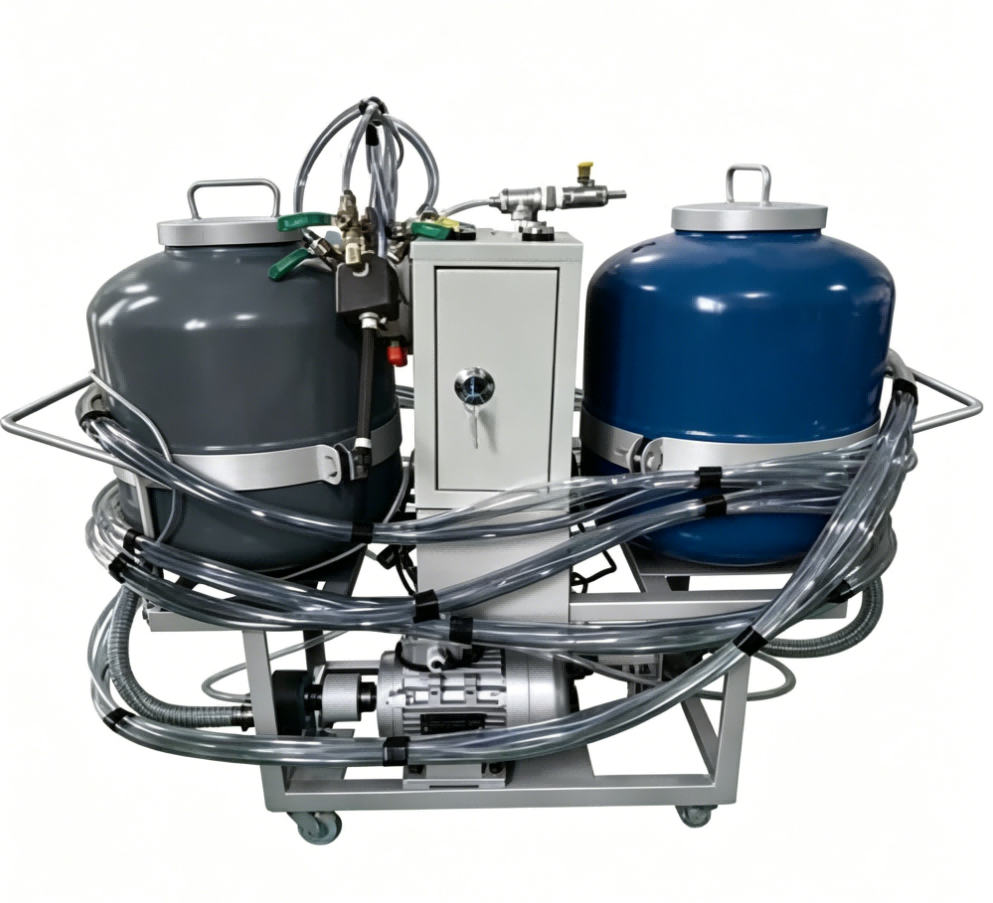
Machine condition often changes reaction timing before the formulation does. A worn metering pump or a drifting ratio shifts the effective index and water availability. Poor mixing energy leaves poorly distributed catalyst and water, which can make the cup show a different gel/rise relationship than a production pour.
Mold temperature, shot weight, and pour pattern also interact with the two timers. In a closed mold, the material must fill the cavity before gelation locks the flow path. If gel time is too short relative to shot weight and fill path, the leading edge can hesitate and leave knit lines. If rise time is too short, the part may not pack out the cavity before expansion stops.
Gel time interacts with mold filling and part mass. How To Calculate Shot Weight In Polyurethane covers the shot-weight calculation that determines whether the material still flows when the mold closes.
Reading the Numbers Together: Four Common Patterns
Four familiar patterns show up on production lines, and each points to a different correction.
| Pattern | What happens | Likely cause | Production effect |
|---|---|---|---|
| Long gel / short rise | Foam rises quickly, but cell struts stay weak | Low gel catalyst, low index, insufficient crosslinking | Coarse cells, partial collapse, later shrinkage |
| Short gel / long rise | Expansion continues against a stiffening network | High gel catalyst, high index, low water | Closed cells, high density, internal cracking |
| Balanced gel and rise | Network strength builds as CO₂ peaks | Adequate catalyst and index balance | Best starting point for stable parts |
| Late gel and late rise | Material stays fluid too long, then moves quickly | Low temperatures, under-catalyzed system | Mold overfill, sink marks, delayed demold |
None of these patterns should be used as a universal threshold. The exact gap varies with raw materials, density target, and line speed. What matters is consistency from batch to batch.
A late gel can also show up later as shrinkage. When the network forms after most of the CO₂ has been generated, cell walls have less structural support and can pull inward as the part cools. That is why shrinkage and gel time are usually discussed together in troubleshooting [2].
If the gel network sets too late or unevenly, shrinkage can appear later. Causes Of Shrinkage In Polyurethane Foam How To Control It covers the shrinkage mechanisms that trace back to gel/cure balance.
A Practical Baseline Before You Adjust the Formulation
Instead of chasing a datasheet value, record the same six variables on your line for three consecutive batches:
- Cream time, gel time, rise time, and tack-free time
- Material temperatures for both components
- Cup and mold temperature
- Shot weight and pour pattern
- Metering ratio
- Mixing head speed and pressure
Change one variable at a time. If the gel/rise gap shifts after a hardware adjustment, the formulation may not be the problem. On Haifeng polyurethane machinery, full-range dynamic metering accuracy is specified at ±0.3%, which is useful when you are trying to rule out ratio drift before changing catalyst.
Once the line is stable, use the two timers as fast feedback. A narrowing gap, a widening gap, or a moving absolute value tells you something changed before the finished part fails.
Need to Bring Gel Time and Rise Time Back into Balance?
Send us your current formulation data, cup-test times, and machine output. Our engineers will review metering accuracy, mixing head speed, temperature control, and pour pattern before you change a catalyst.
Useful information to include:
- Current cream, gel, rise, and tack-free times
- Material and mold temperatures
- Shot weight and cup volume
- Current catalyst package and index target
Contact info@chinahaifeng.com or WhatsApp: 86 13566296633.
Frequently Asked Questions About Gel Time and Rise Time
Which comes first, gel time or rise time?
In many water-blown cup tests, gel time is observed before rise time, but the order depends on formulation and catalyst balance. A strongly blowing system can still be rising while the first surface stringing appears. Record both times instead of assuming a sequence.
Does a shorter gel time always mean faster production?
No. A shorter gel time means the network forms sooner. Demold time depends on cure development, green strength, and part geometry. A part can gel quickly but still need the same or longer time to build enough strength for release.
Can rise time change without changing gel time?
Yes. Water content, surfactant level, mixing energy, and nucleation can change rise time while gel time stays nearly constant. That is why the two timers should be tracked separately.
Why are cup-test values different from machine values?
Mixing energy, component temperature control, ratio stability, and pressure differ between a bench cup and a production mixing head. The cup test is a relative diagnostic, not a substitute for machine validation.
What should I change first when gel time is too long?
Check material temperatures and metering ratio before changing catalysts. A low temperature or an iso-side ratio error can mimic an under-catalyzed gel. If those are stable, then adjust the gel catalyst in small steps.
References
[1] ASTM D7487-18, Standard Practice for Polyurethane Raw Materials: Polyurethane Foam Cup Test, ASTM International, West Conshohocken, PA, 2018.
[2] G. Oertel, Ed., Polyurethane Handbook, 2nd ed., Munich, Germany: Hanser Publishers, 1993.
[3] G. Woods, The ICI Polyurethanes Book, 2nd ed., New York, NY, USA: Wiley, 1990.
If you’re interested, check out these related articles:
What Is Spray Polyurethane Foam Composition And Application
RRIM Vs RIM Which Process Suits Your Structural Part