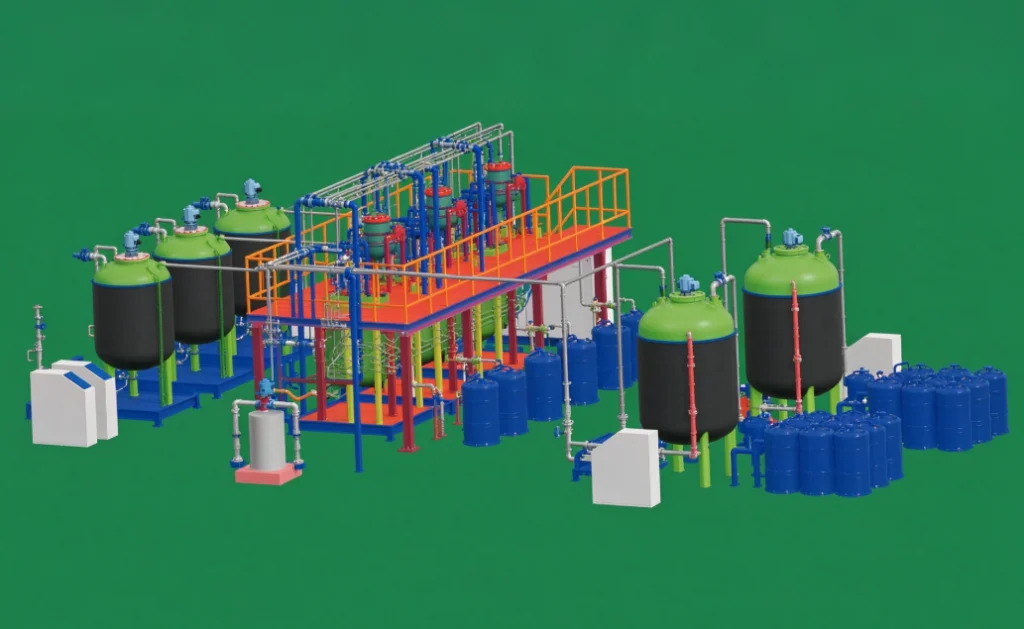
Central feed and local drums solve different supply problems, and treating the choice as a storage decision instead of a line-control decision is where many specifications go wrong. Central feed reduces drum handling and gives several stations one conditioned material loop. It does not replace the metering accuracy or mixing quality required at each machine. Local drums keep the formulation and cleaning boundary close to the station, but they transfer more work to operators and make long-run consistency harder to hold. The real question is whether the line runs one chemistry across enough stations and enough hours to justify the piping, controls, flushing volume and maintenance burden.
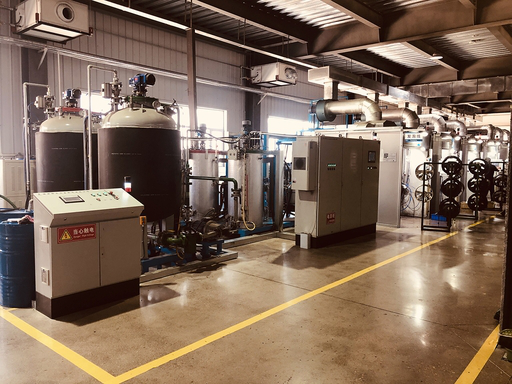
Start With Material Distribution, Not Metering
Before comparing tank farms and drum racks, separate material distribution from metering. A central feed moves conditioned polyol, isocyanate and additives to each machine. Each machine still needs its own metering pumps, servo drives or flow meters, and its own mixing head. If a specifier expects the bulk supply system to correct shot-to-shot ratio drift, the equipment requirement has been written at the wrong level. Ratio error at any station is corrected at that station’s metering loop, not by the size of the main tank.
When central feed is treated as bulk storage and delivery only, it becomes easier to scope. The central skid must provide stable temperature, enough flow for all machines running at peak, and a recirculation path that keeps each component homogeneous. Station-level metering remains independent. That separation also protects the line from a single shared pump or filter failure starving every pour point at once.
How Central Feed Changes Conditioning and Flow
A common reason to centralize is consistency. A single day tank with an automatic temperature-control loop and agitation can deliver the same viscosity to several machines, instead of several drums sitting at slightly different temperatures. On continuous lines that matters because a viscosity shift can change the effective mixing ratio and then move density, surface quality or rise behavior. The trade-off is residence time. Long unheated or poorly recirculated pipe sections can let material cool, pick up moisture or build pressure drop before it reaches the farthest station. I usually size the central feed line by the farthest machine’s peak draw plus the recirculation bypass, not by the sum of nameplate flow rates, because the machines rarely pour at the exact same moment.
A central supply also increases the time material spends at process temperature before it reaches the mixing head. If the reactivity window is already tight, that longer residence period can shift the reaction unless the formulation and temperature setpoints were validated for the full central loop.
Central feed changes how long material sits at process temperature before mixing. <The Role Of Rise Time In Polyurethane Foaming> covers the reactivity window that operators need to hold stable across stations.
Where Local Drums Still Fit Better
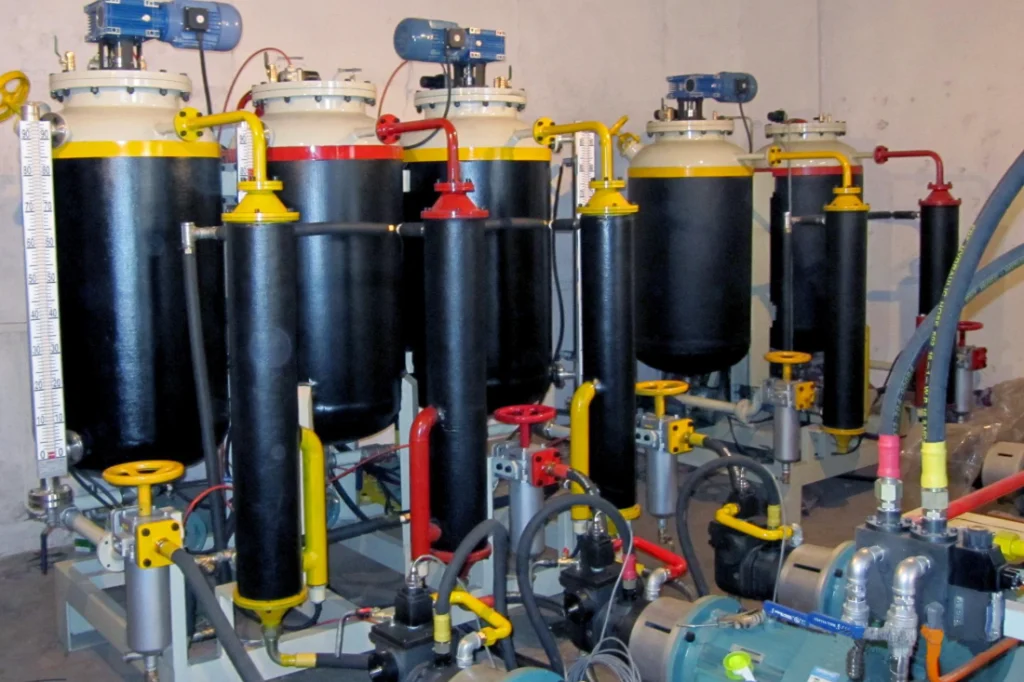
Local drums win when each machine runs a different chemistry, color, filler level or development recipe. With a drum at each station, the material path is short, the lot is easy to isolate, and a cross-contamination fault affects one machine instead of a shared manifold. That is often the better starting point for a plant doing frequent product changes, small trials or contract manufacturing.
The cost shows up in labor and consistency. Operators move drums, preheat them and swap feed lines. Two drums of the same nominal grade can still differ enough in viscosity or moisture to require machine-level correction. If the plant is not ready to enforce drum conditioning and lot control at every station, the local setup will produce its own form of drift.
Metering and Ratio Drift Across Multiple Machines
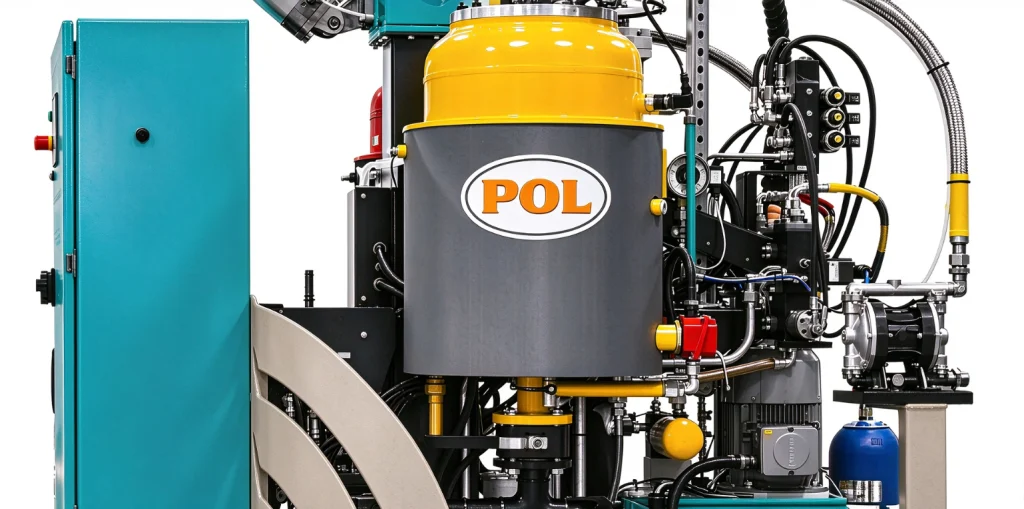
The equipment that matters most is not the storage location but the metering loop at each pour point. On a multi-machine line, ratio drift usually comes from unequal machine conditions: one feed line cold, one filter partially blocked, one pump bypass open. Central feed can reduce the material-temperature portion of that drift, but it cannot guarantee equal shot weight unless each station has its own calibrated metering or mass flow control.
A multi-machine specification should therefore ask for station-level shot records, not just a central supply pressure setpoint. I prefer a requirement that each station hold its own metering accuracy and log shot weight, recipe, ratio and temperature on every shift. Haifeng high-pressure machines, for example, can be specified with dynamic metering accuracy within plus or minus 0.3 percent of full range, but that accuracy belongs to the machine-level control loop rather than to the shared tank header.
A station-level shot check must also account for recirculated material and line pack. When a machine draws from a shared manifold, the actual delivered shot may be at a different temperature than the day tank probe reading. Use the shot weight calculation at each station instead of trusting the tank level drop.
A machine drawing from a shared manifold still has to verify the actual shot delivered at that station. <How To Calculate Shot Weight In Polyurethane> covers the calculation inputs that keep shot weight consistent when the supply layout changes.
Changeover, Cleaning and Cross-Contamination
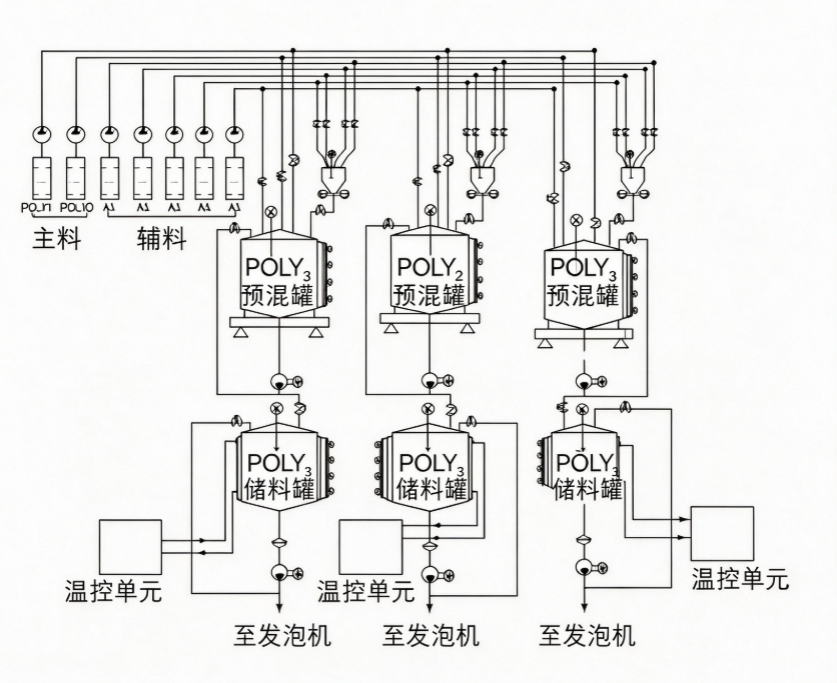
Central feed is harder to change over. The supply pipe, manifold and filter housings hold a working volume that cannot be ignored during a color or grade switch. Flushing that volume costs solvent, downtime and disposal. For frequent small-batch work, local drums avoid most of that shared volume.
A poorly controlled local-drum changeover is still a contamination source because hoses, drum pumps and return lines carry residue into the next batch. The decision depends on how often the formulations change and whether those materials are chemically incompatible. If the line changes from one color paste or filler package to another several times per shift, the cleaning burden is usually lower with local machine tanks or exchangeable feed lines. If one formulation runs for days, the shared central line becomes easier to operate and justify.
Matching the Supply Layout to the Line
The following comparison separates the conditions that push toward each layout.
| Plant condition | Central feed fits better | Local drums fit better |
|---|---|---|
| One formulation runs on three or more machines for most of a shift | Strong fit: one conditioning loop and fewer drum moves | Weaker fit: repeated drum handling breaks consistency |
| Each machine runs a different color, filler or trial recipe | Weak fit: manifold flushing and cross-contamination risk | Strong fit: the material boundary stays at the station |
| Long continuous output with limited space at the machine | Strong fit: bulk storage moves away from the pour stations | Weak fit: drum storage competes with operator access |
| Frequent small-batch or contract production | Weak fit: shared volume resists quick changeovers | Strong fit: one lot per machine is easier to isolate |
| Tight material lot traceability across the whole line | Strong fit if the skid logs tank, lot and recirculation data | Strong fit: drum lots can be recorded at each point of use |
| Limited maintenance staff for pumps, filters and piping | Weak fit: central piping adds shared failure points | Strong fit: simpler machine-level setup |
The table is not a scorecard. It is a way to see which constraint dominates the plant. Most multi-machine lines settle on a hybrid: bulk raw-material storage with local day tanks or conditioning units at each machine. That keeps bulk logistics efficient while leaving the machine-level boundary easier to isolate and clean. If a full central feed is justified, specify recirculation, heat tracing, low-point drains and pressure control at each branch from the start, not as later add-ons.
Scope the Supply Before Finalizing the Machine Plan
If you are deciding between central feed and local drums, send the plant sketch, material list, number of machines, target output per shift and expected formulation or color change frequency. Those inputs show whether the piping and cleaning cost will be recovered through labor and consistency gains. Haifeng Polyurethane Machinery can review the distribution layout together with the metering and control requirements of the full line. Contact us at Info@chinahaifeng.com or WhatsApp 86 13566296633.
FAQ
Is central feed the same as central metering?
No. Central feed moves material from one storage location to several machines. Central metering would control the A/B ratio at one point and then distribute mixed material, which is not practical for most polyurethane processes because the mixture reacts. Each machine should keep its own metering loop and mixing head.
How many machines make a central feed worthwhile?
There is no single number. The stronger test is how long the same formulation runs and how stable the material temperature must be. Three or more machines running one recipe for a full shift often justify the piping. Two machines with frequent color or filler changes usually do not.
Can one central line handle different additives or colors?
Yes, if the design includes separate additive injection, flushing paths and valving at each station. The main polyol and isocyanate lines should not carry incompatible grades without a full flush when switching. If the changes are frequent, local drum or day-tank boundaries are usually cheaper to operate.
What is the most important station-level check in a central feed system?
Shot weight and ratio. A stable bulk tank does not prove that a partially blocked filter or cold branch line has not changed the delivered ratio at one station. Record each station’s shot weight, pressure and temperature during commissioning and after every material lot change.
If you’re interested, check out these related articles:
How Polyurethane Rollers Are Made From Casting To Cure
Shore A Vs Shore D Hardness In Polyurethane
What Is Semi Rigid Polyurethane Foam
What Is Spray Polyurethane Foam Composition And Application
Measuring Polyurethane Foam Resilience A Practical Test Guide