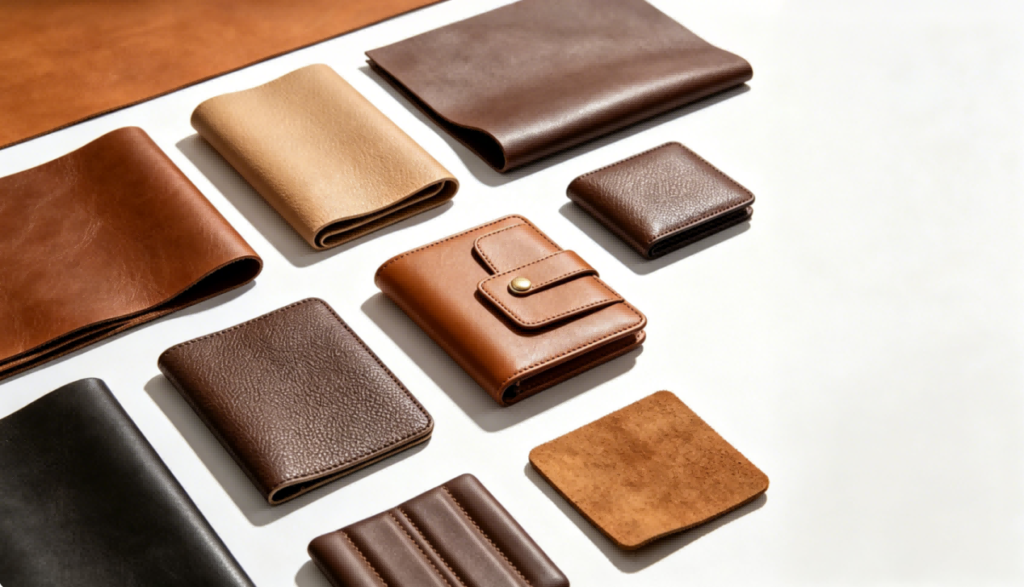
A wet-process PU leather line decides its hand feel and its defect rate in two places: the coagulation bath and the wash train. The coating head only lays down a film of PU resin dissolved in DMF. The bath is where that film becomes a porous, breathable layer, and the washing stages decide how much solvent leaves the plant inside the product or in the water. Buyers who scope these two sections last often buy a line that runs but cannot repeat. This guide sets out what to fix in the bath and wash scope before a quotation is issued, and which trial records actually show whether the scope is right.
What the coagulation bath does to the coated film
A wet line coats PU resin dissolved in DMF onto release paper or a base fabric, then immerses the still-wet film in a bath of water and DMF. Water is a non-solvent for the resin. As water enters the film and DMF leaves it, the polymer separates from solution and sets into a porous structure. That exchange, not the coating knife, produces the breathable, soft hand the product is sold on.
The speed of the exchange sets the structure. Fast precipitation at the surface builds a thin, dense skin over coarse cells underneath. Slower precipitation lets water penetrate before the skin closes, and the result is a finer, more open cell structure. Bath DMF concentration is the main lever on that rate, temperature the second, dwell time the third.
None of these three is fixed by the machine supplier alone. The resin type, the solids content, the wet add-on and the hand feel you are targeting define a window, and the bath has to be adjustable enough to hold that window across a full shift.
How many coagulation stages the bath really needs
A single bath will coagulate a film. It will also drift. As production continues, the bath gains DMF from the film and loses water into it, so the concentration that gave the right skin at the start of the shift is not the concentration four hours later. Two or three tanks with independent overflow and circulation give you a gradient you can hold, and a place to correct it when the film moves away from the target.
| Stage | Job in the film | Main control | What it cannot fix |
|---|---|---|---|
| First bath, highest DMF | Slows surface precipitation so the skin stays thin | DMF concentration, temperature, dwell time | A resin whose viscosity will not run on the coater |
| Second bath | Completes bulk coagulation and fixes the cell structure | Concentration step-down, circulation rate | Skin defects already formed in the first bath |
| Final bath or setting tank | Brings the film to a handleable, non-tacky state | Temperature, dwell time, water quality | Residual solvent, which belongs to the wash train |
Check concentration by refractive index or density against a calibration chart, and log it with temperature and circulation rate rather than judging the bath by colour or by feel. Ask a supplier for the number of separately pumped and separately drained tanks, not the number of chambers inside one tank. Chambers in a single tank share one liquid volume, and the gradient collapses as soon as the line stops.
Washing scope and where the residual DMF goes
Coagulation leaves DMF in the film and pushes more of it into the bath. Washing is a counter-current extraction: clean water enters at the last stage, moves back toward the first, and the film meets progressively cleaner water. Stage count, water temperature, flow ratio and dwell time decide how much solvent leaves with the film instead of staying in it.
Washing is also where the plant’s solvent balance is settled. Every kilogram of DMF that leaves in the wash water has to be recovered or treated. If the recovery unit is sized only for bath overflow, the wash water becomes the bottleneck and the line runs below its nominal speed to keep the balance.
Ask for the number of wash tanks, whether the flow is counter-current or cascade, how water temperature is controlled, whether each stage has a flow meter, and whether recovery capacity is stated in kilograms of DMF per hour at your production rate. Without those five answers, the wash train is a box with a price on it.
Matching line speed and add-on to bath length
Dwell time is the immersed path divided by line speed. If the film is under the bath surface for 20 m and the line runs at 12 m/min, dwell is 100 seconds; raise the speed to 16 m/min and the same bath gives 75 seconds. In formula form, dwell in seconds equals immersed length in metres divided by line speed in metres per minute, multiplied by 60. If the film needs 100 seconds to reach the structure you want, the bath has to be longer or the line slower. No control setting replaces that length.
Solvent load follows the same logic. Wet add-on in g/m² multiplied by line speed and coating width gives the rate at which DMF enters the bath. If overflow and recovery cannot keep pace with that rate, concentration climbs through the shift and the skin changes by itself. This is why add-on, width and maximum continuous speed belong in the same specification as the bath volume.
Wet add-on is a metering question before it is a coating question, because the same knife gap delivers a different weight when resin viscosity or line speed shifts. <How To Calculate Shot Weight In Polyurethane> covers how shot weight is calculated from flow rate and cycle time, which is the same arithmetic that keeps a coating weight repeatable.
Where wet-process scope differs from water-based and solvent-free lines
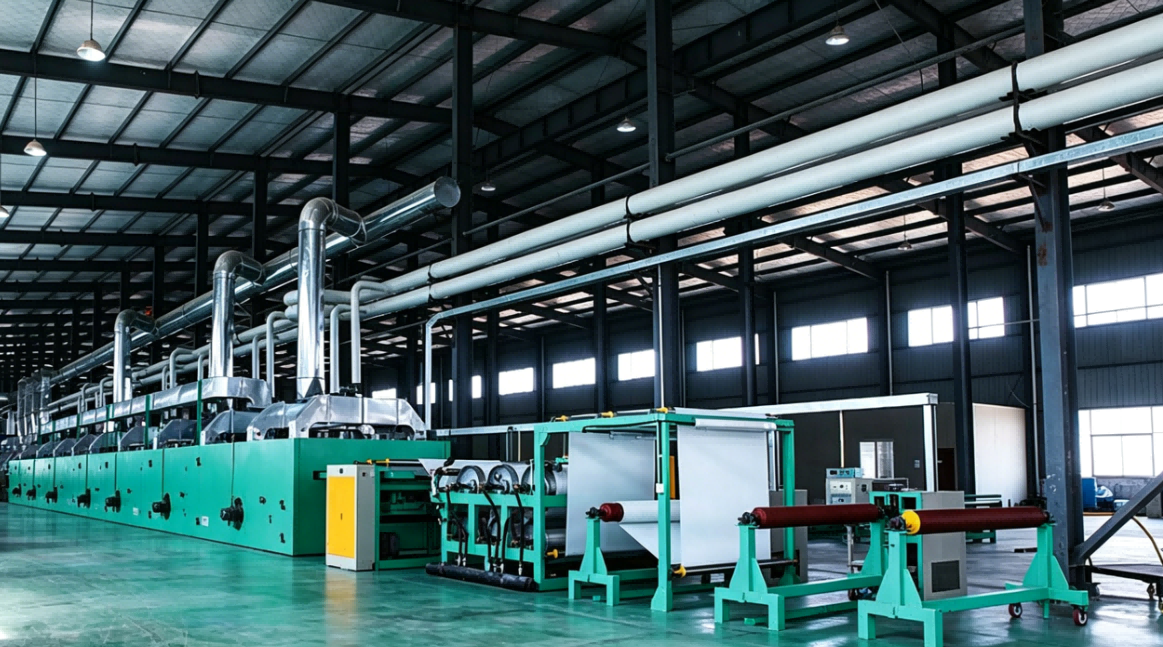
Buyers comparing routes often compare them as if the same equipment list applied to all three. It does not. In a wet-process line, the coater is a small part of the footprint. The bath train, the wash train, the recovery unit and the oven set the utility load and decide the capacity you actually get. In a water-based line there is no coagulation bath, and oven length and air handling carry the duty. In a solvent-free line, metering accuracy and temperature control do the work.
| Route | What turns the coating into a film | Scope items that decide capacity | Common scoping mistake |
|---|---|---|---|
| Wet-process with DMF | Water and DMF exchange in the coagulation bath, then washing | Bath stages, wash stages, solvent recovery, oven drying | Sizing the coater first and the bath last |
| Water-based dispersion | Water evaporates in the oven, with no coagulation bath | Oven length and air handling, web tension | Buying a wash train for a process with no solvent to wash out |
| Solvent-free two-component | Metered A and B react and cure | Metering accuracy, temperature control, cure length | Expecting a coater upgrade alone to raise output |
The practical consequence is that a wet-process quotation should be read from the bath outward. If the stage count, the dwell time and the recovery capacity are not stated, the rest of the quotation is a coating machine with an unspecified process attached to it.
What a coagulation and washing trial should prove
Run the trial with the customer’s own resin and substrate, at a production speed, and record per stage: DMF concentration, temperature, measured dwell time, wet and dry film weight, thickness, a cross-section of the cell structure, residual solvent, and shrinkage after the oven. Compare hand feel against a reference swatch, not against a verbal description. A trial on one resin lot, one release paper and one speed band does not transfer to a different resin or a heavier add-on, and it should not be presented as if it does.
Record the same parameters per batch rather than per shift. On a synthetic leather project in Turkey, our team supplied three pouring lines where stable density and hand feel only became repeatable once closed-loop temperature control and multi-formula storage were tied to batch records, and the records were what carried the European brand audit afterward. The equipment supported the result; the recorded parameters proved it.
Film that leaves the wash train is still full of water, and the way it gives up that water in the oven decides whether thickness and width hold. <Causes Of Shrinkage In Polyurethane Foam How To Control It> covers the mechanisms behind shrinkage in PU foam, several of which also act on a coagulated film as it dries.
Which details to fix before you request a quotation
A wet-process scope cannot be quoted from a line speed and a width. Six fields carry most of the decisions, and a supplier who asks for them is telling you something about how the line will be built.
| Field | What to state | Why it changes the scope |
|---|---|---|
| Resin and solids | Polymer type, solids content in DMF, viscosity at coating temperature | Sets the precipitation window and the bath concentrations that hold it |
| Add-on and width | Wet and dry g/m², coating width, tolerance | Sets the solvent load the bath and recovery must carry |
| Substrate | Release paper grade and reuse count, or base fabric weight and stretch | Sets tension control and whether the film is cast or impregnated |
| Speed and dwell | Operating band in m/min and minimum dwell in seconds | Fixes the immersed bath length that no control setting can replace |
| Bath and wash stages | Number of independently drained tanks, overflow and circulation per tank, water temperature control | Determines whether the gradient can be held across a shift |
| Solvent target and recovery | Residual DMF target from the customer’s restricted substances list, recovery capacity in kg per hour at maximum speed | Connects the wash train to the plant’s solvent balance |
Compare that against a typical enquiry line. Reject this: “One wet-process PU leather line, 15 m/min, 1.5 m wide.” Replace it with: PU resin at the stated solids in DMF; wet add-on A to B g/m² and dry add-on C to D g/m²; release paper grade and reuse count; three coagulation tanks with independent overflow and temperature control; five counter-flow wash stages with flow meters; recovery capacity in kg DMF per hour at maximum line speed; residual solvent target taken from the customer’s list.
The second version is longer to write and much shorter to argue about later, because every item on it can be checked at acceptance instead of discovered during commissioning.
Send the film spec before the bath layout is drawn
Before a bath layout is fixed, send the resin system and solids content, the wet and dry add-on, the coating width, the speed band, the substrate or release paper grade, and the residual solvent target your customer’s restricted substances list requires. With those, Haifeng Polyurethane Machinery can size coagulation stages, wash stages and recovery capacity against your real production rate instead of a nominal line speed, and tell you which parts of an existing line can be reused. Email Info@chinahaifeng.com or message WhatsApp 86 13566296633.
FAQ
Does a wet-process line have to recover the DMF it washes out?
The solvent has to go somewhere. Wash water carries DMF out of the film, and whether that water can be discharged is decided by your permit and local limits, not by the machine supplier. Recovery by distillation returns DMF to a reusable specification and keeps the wash water in a loop rather than in a treatment bill. The scope question is capacity: state it in kilograms per hour at maximum line speed, not simply that a recovery unit is included.
How many wash stages are enough?
It depends on the residual solvent target, water temperature, flow ratio, dwell time and film thickness. Measure residual solvent after each stage during the trial rather than after the whole train, because that is what tells you which stage is doing the work. Raising water flow also raises the load on recovery or treatment, so more flow is not automatically the cheaper correction. Most layouts use three to five counter-current stages, but the number that matters is the one your trial measures.
Can one line run both wet-process and water-based recipes?
The coating head and web handling may be shared, but the bath and wash train exist because a solvent has to be extracted. A water-based recipe needs oven capacity and air handling instead, and running both on one line means cleaning between products and managing solvent cross-contamination. Decide which route the line is built for before the layout is drawn; converting later is a rebuild, not an adjustment.
Which trial result should I look at first?
Residual solvent and a cross-section of the cell structure. A film with good hand feel but residual solvent above the customer’s limit fails the audit, and a clean residual with a dense skin over coarse cells fails the product. Check thickness and width after the oven as well, since drying is where a coagulated film moves. Hand feel comes after those three, compared against a reference swatch rather than a description.
If you’re interested, check out these related articles:
RRIM Vs RIM Which Process Suits Your Structural Part
Causes Of Shrinkage In Polyurethane Foam How To Control It
What Is Spray Polyurethane Foam Composition And Application