

In Haifeng PU foaming documentation, the polyol blend is the A-side and the isocyanate is the B-side. The polyol blend contains the approved polyols, catalysts, blowing agents, surfactants and other additives. Some external suppliers call this blend the B-side; this article uses Haifeng’s convention. Blend preparation and conditioning must be coordinated with metering, mixing and the material recipe.
What the A-Side Actually Is
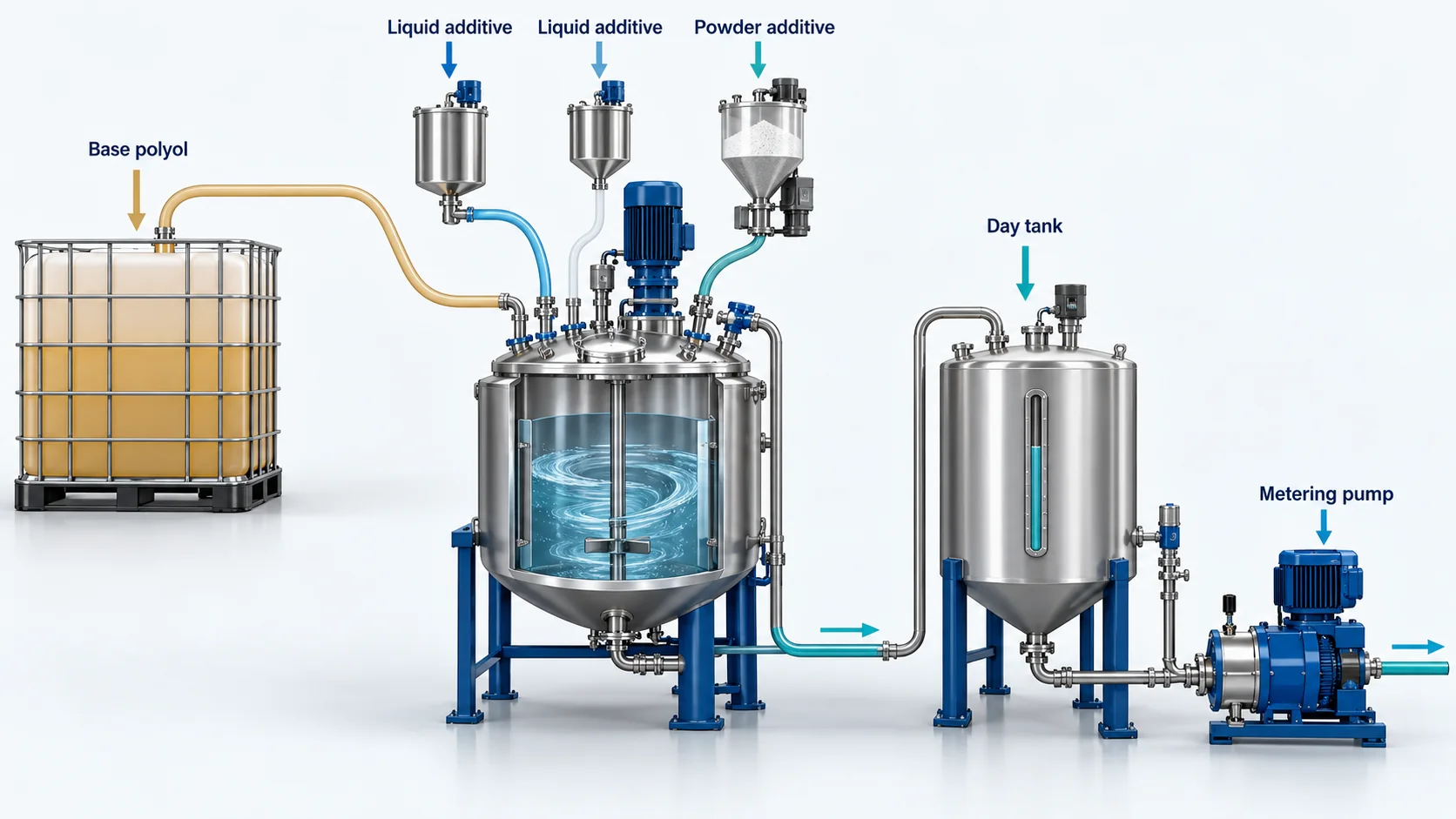
The A-side is not one liquid. It is a formulation. The backbone is usually one or more polyether or polyester polyols selected by functionality and molecular weight. Chain extenders and crosslinkers are added to build hard segments and network structure; catalysts are added to balance the gel reaction and the blowing reaction; surfactants stabilize cells in foam and improve substrate wetting; water or physical blowing agents generate gas; additives such as flame retardants, pigments, or fillers tailor cost and properties [2][3].
The polyol blend’s hydroxyl number, water and other reactive ingredients determine its isocyanate demand at the selected index. Foam and cast-elastomer formulations must be reviewed separately. A CPU prepolymer/curative system is not simply the same A-side polyol blend used for foaming.
How the A-Side Drives Reactivity and Process Timing
Catalysts do not change the final chemistry; they change when reactions happen. The A-side catalyst package selects the gel/blow balance. A stronger gel catalyst accelerates urethane formation and viscosity build; a stronger blowing catalyst accelerates water-isocyanate CO2 generation; a balanced system lets foam rise, stabilize, and cure without collapse or excessive internal pressure [3][4].
Reactivity is measured in cup tests on the mixed B-side/A-side system: cream time, gel time, rise time, and tack-free time [4]. If the A-side is consistent, these times are consistent. If the A-side drifts because a polyol lot changed or a catalyst was let down incorrectly, the line operator usually sees it first as variable rise or longer demold.
Water is part of the A-side in most flexible foams and many microcellular systems. It reacts with isocyanate to produce amine, urea, and CO2, so it is simultaneously a chemical blowing agent and a chain-extension contributor [5]. For rigid foams, physical blowing agents or low-boiling liquids often share the blowing duty, and the surfactant package must be compatible with the nucleation behavior of the selected agent [6].
When a A-side is reformulated for faster demold, rise time and gel time usually move together only if the catalyst package is balanced. <The Role Of Rise Time In Polyurethane Foaming covers how rise-time measurement separates blowing from gel on the line.
Viscosity, Temperature, and Metering Accuracy
Viscosity is the A-side property that a metering pump feels directly. Polyol blends range from low-viscosity, unfilled systems to high-viscosity, filler-loaded formulations. Rotational viscometry under controlled shear is the standard way to characterize this before equipment selection [7]. We ask for viscosity at processing temperature, not just at room temperature, because the difference can be large.
Control the unmixed polyol blend to the supplier-approved storage and processing conditions. Heating changes viscosity and may affect blend stability or foaming-agent behaviour. Pot life refers to the mixed reactive system; it does not define the shelf life of the unmixed day-tank contents.
Machines designed for filled or high-viscosity A-side use positive-displacement gear pumps or lance/piston metering rather than relying on gravity or low-shear transfer. The recirculation loop design matters as much as the pump: it must keep solids suspended without entraining air, and it must not add so much shear that the blend heats itself.
Ratio Sensitivity: Small Errors, Large Property Shifts
The A/B ratio is not a tolerance to be met at the control panel alone; it is the product of two metered streams that change with pressure, temperature, viscosity, and pump condition. Because the A-side contains the reactive package, any unaccounted change in A-side composition shows up as an index shift even when the B-side pump is perfect.
Hydroxyl number and water content define how much isocyanate the A-side demands [1]. If the A-side has more water than the formulation assumes, the system consumes more isocyanate, generates more CO2, and can produce lower density, coarser cells, and higher urea content [5]. If it has less reactive polyol or a lower effective hydroxyl value, the system may be over-indexed and become harder, more crosslinked, or more brittle than intended.
On production parts, we rarely see a ratio failure as an alarm. We see it as density scatter across a shift, hardness variation between cavities, or parts that feel acceptable at demold and then change dimension after cooling [8].
Ratio errors often appear later as dimensional instability rather than as an immediate mixing fault. <Causes Of Shrinkage In Polyurethane Foam How To Control It covers how formulation and process variables drive post-cure size change.
A-Side Storage, Conditioning, and Line Design
A-side handling is ignored more often than B-side handling because polyols are seen as benign. That is a costly assumption. Polyether and polyester polyols can absorb moisture, degrade under heat and oxidation, settle filler, or lose catalyst activity over time. Moisture in the A-side is especially dangerous because it is a reactant, not just a contaminant [6].
On a well-built line, the A-side system includes dry-air or nitrogen blanketing on tanks, slow agitation sufficient to keep fillers dispersed without turning the tank into an air trap, filtered recirculation through the machine, and jacket or coil temperature control. High-viscosity blends may need heated tracing from the tank to the metering pump; low-viscosity blends may need careful deaeration to avoid unmetered gas volume in the pump.
Select tank volume and turnover from consumption, unmixed-blend stability and the supplier’s storage requirements. Mixed-system pot life limits dispensing after the streams meet, rather than setting the storage duration of a separate polyol tank.
Matching the A-Side to the Machine, Not the Other Way Around
A polyol-blend change affects viscosity, filler handling, seals, metering and mixing as well as chemistry. In a CPU line, changing MOCA to BDO changes the curative stream and may require a different recipe, heating arrangement and cleaning procedure; it should not be described as an ordinary foaming-polyol substitution.
Before changing the A-side, recalculate shot weight under the new density and mold volume; otherwise the machine may pour the wrong mass even when the ratio is correct.
Before changing the A-side, recalculate shot weight under the new density and mold volume; otherwise the machine may pour the wrong mass even when the ratio is correct. <How To Calculate Shot Weight In Polyurethane covers the shot-weight formula and correction steps.
When a customer reformulates for a new material or supplier, we treat the A-side TDS as a machine specification, not a footnote. Send the hydroxyl number, water content, viscosity curve, filler loading, target density, shot weight, and present line speed. We will check whether the metering pump, mixing head, and temperature-control loop can hold the required ratio window before you buy raw material, not after it arrives. Contact Info@chinahaifeng.com or WhatsApp 86 13566296633 with “A-side review” in the message.
A Practical A-Side Review Checklist
- Confirm hydroxyl number, acid number, and water content for every new lot before charging [1].
- Record viscosity at processing temperature, not only room temperature [7].
- Check filler settling, agglomeration, or abrasive content before selecting pump type.
- Keep day-tank temperature inside the range the catalyst and blowing package can tolerate.
- Verify recirculation does not add excessive heat or entrain air.
- Recalculate shot weight and A/B ratio after any density, index, or mold-volume change.
- Run a cup test for cream, gel, rise, and tack-free time on each A-side batch [4].
- Quarantine formulation changes instead of letting them reach production without trial.
If a A-side formulation drifts outside the machine’s working window, the symptoms usually look like bad product, not bad equipment. If you are seeing density scatter, short shots, demold variation, or mix-end fouling after a material change, send the A-side TDS and a note on what changed. We can quickly identify whether the issue is chemistry, conditioning, or the metering and mixing loop. Email Info@chinahaifeng.com or WhatsApp 86 13566296633.
Frequently Asked Questions
What is the difference between the B-side and A-side in polyurethane?
The B-side is the isocyanate stream, which is usually stored as a single reactive component. The A-side is the formulated polyol side: polyols, chain extenders, catalysts, blowing agents, surfactants, and additives. The A-side carries most of the process chemistry and is where formulation changes usually happen.
Can I use the same A-side for foam and elastomer?
Not automatically. Foam formulations contain water or physical blowing agents and surfactants for cell formation, while solid or microcellular elastomers often use different chain extenders, lower water content, and different viscosity targets. The same pump and mixing head may work for both, but temperature, ratio, and shot-size settings will differ.
What is the most common A-side mistake on production lines?
Treating the A-side as a fixed liquid while changing polyol lots or suppliers without rechecking hydroxyl number, water content, and viscosity. That can shift the isocyanate index, produce density or hardness drift, and make the machine look inaccurate when the real problem is raw-material variation.
How does water in the A-side affect the machine?
Moisture is reactive, so it contributes to CO2 generation and consumes isocyanate. Too much water changes flow-related density and can create internal pressure, coarse cells, or shrinkage. It can also contaminate the blend in storage, so dry-air or nitrogen blanketing and filtered recirculation are common protections.
Does A-side viscosity determine which metering pump I need?
Yes, in combination with temperature. High-viscosity or filled A-side systems typically require positive-displacement metering such as gear pumps, lance systems, or piston metering, plus heated lines and proper recirculation. Low-viscosity systems are easier to move but still need air removal and stable flow control.
References
- ISO 14900:2017, Plastics — Polyols for use in the production of polyurethane — Determination of hydroxyl number, International Organization for Standardization.
- Ionescu, M., Chemistry and Technology of Polyols for Polyurethanes, 2nd ed., Smithers Rapra Technology, 2016.
- Oertel, G., Polyurethane Handbook, 2nd ed., Hanser Publishers, 1993.
- ASTM D7487-18, Standard Practice for Polyurethane Raw Materials: Polyurethane Foam Cup Test, ASTM International.
- Herrington, R. and Hock, K., Flexible Polyurethane Foams, 2nd ed., The Dow Chemical Company, 1997.
- Eaves, D., Handbook of Polymer Foams, Rapra Technology, 2004.
- ISO 3219:1993, Plastics — Polymers/resins in the liquid state or as emulsions or dispersions — Determination of viscosity using a rotational viscometer with defined shear rate, International Organization for Standardization.
- ISO 845:2006, Cellular plastics and rubbers — Determination of apparent density, International Organization for Standardization.
If you’re interested, check out these related articles:
Shore A Vs Shore D Hardness In Polyurethane
How Polyurethane Rollers Are Made From Casting To Cure
RRIM Vs RIM Which Process Suits Your Structural Part





