

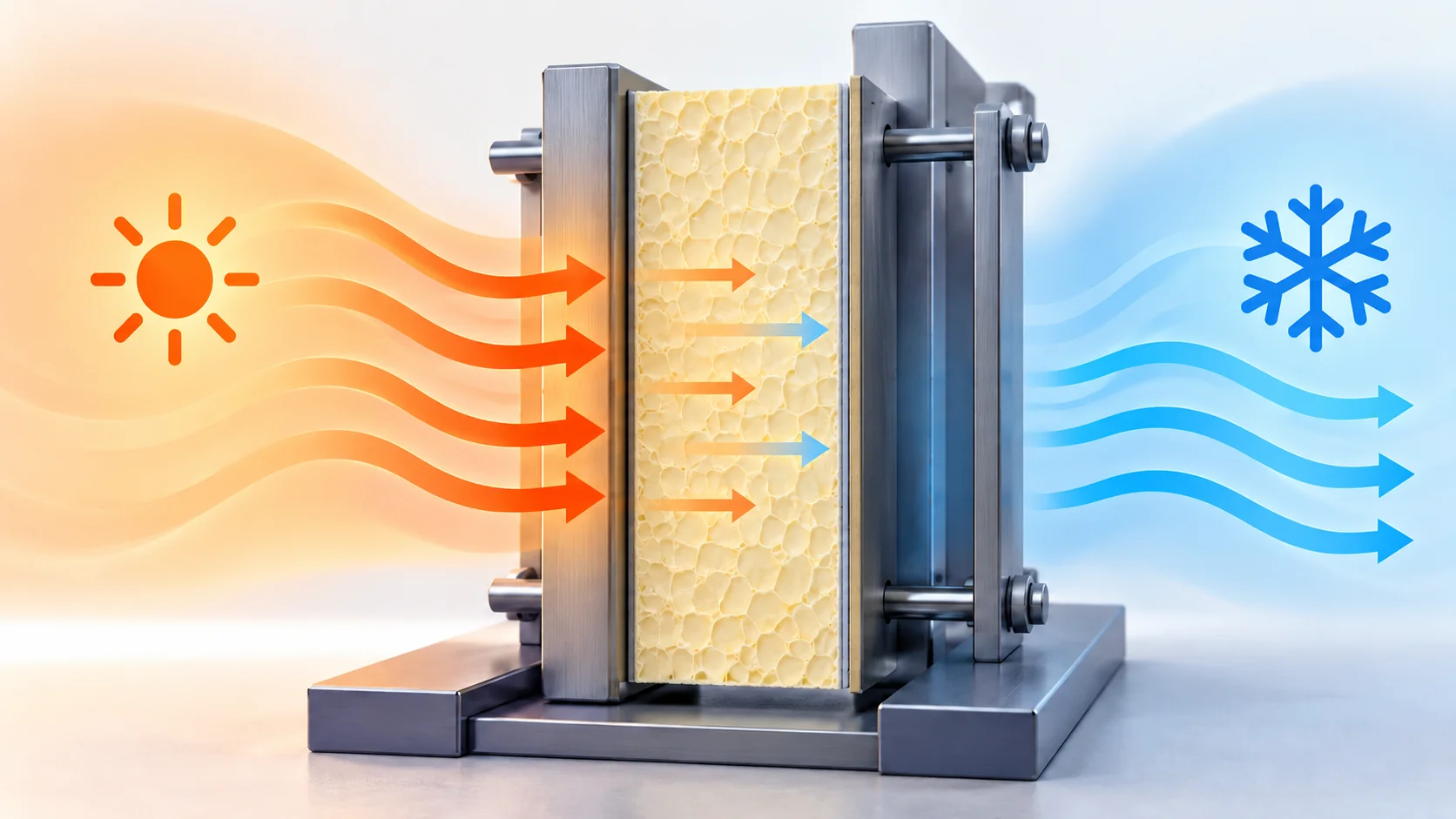
A panel line can be in spec for density and still lose insulation performance because the cell gas diffused faster than expected. Thermal conductivity is the number that captures that failure. For rigid polyurethane (PUR) and polyisocyanurate (PIR) insulation, new closed-cell foam is typically reported in the 0.022–0.028 W/(m·K) range, while the aged or declared value is usually higher [1], [2]. The difference between those two numbers is where energy losses and compliance disputes appear.
What the K-Value Actually Describes
Thermal conductivity, written as λ in most datasheets, tells you how much heat moves through 1 meter of material for every 1 K temperature difference across it. The unit is W/(m·K). A lower number is better because less heat escapes or enters.
But λ is not the same as U-value or R-value. U-value includes the whole building element: insulation thickness, surface films, and thermal bridges. R-value is thermal resistance. The basic relation is:
R = thickness / λ
and
U = 1 / R
A 100 mm thick foam core with λ of 0.025 W/(m·K) gives an R-value of about 4.0 m²·K/W before adding surface resistances. That surface correction matters for thin panels [3]. This is why chasing only the raw K-value without fixing thickness or installation quality can produce a specification that does not match the built performance.
How the K-Value Is Measured
Most polyurethane insulation data is generated by heat flow meter or guarded hot plate methods. ASTM C518 and ISO 8301 are the common heat flow meter procedures [1], [4]. A sample is conditioned, placed between hot and cold plates at a set mean temperature, and the steady-state heat flux is measured.
Three measurement details change the result:
- Mean temperature: λ rises with temperature, so a value measured at 10 °C cannot be compared directly with one measured at 40 °C.
- Sample condition: freshly foamed specimens still retain low-conductivity blowing agent that will later diffuse out.
- Aged value: European building datasets use a declared lambda that includes an aging and safety margin, not the best initial test result [2].
A spray-applied insulation roof adds field variability that board-stock testing cannot capture. Thickness per pass, substrate temperature, wind, and gun movement all change cell structure and gas retention.
Spray-applied rigid foam is a field-built insulation system rather than a uniform board, so thickness and cell gas retention vary with ambient conditions. What Is Spray Polyurethane Foam Composition And Application covers how the A-side/B-side chemistry and application conditions change the final foam.
What Drives Thermal Conductivity in Rigid PU Foam
Blowing Agent and Cell Gas
A closed polyurethane cell conducts less heat than the polymer cell wall. Much of the thermal resistance comes from the stationary gas in the cell, not the polyurethane itself. Cyclopentane, HFOs, and similar blowing agents have lower thermal conductivity than air, which is why fresh foam can test near 0.022 W/(m·K).
Over time the blowing agent diffuses out and air diffuses in. Air has a higher λ than most closed-cell blowing gases, so the K-value drifts upward. This is a material-aging process, not a manufacturing defect [2]. The faster the diffusion, the larger the gap between initial and declared performance.
Cell Size, Closed-Cell Content, and Density
Smaller cells reduce radiation transfer across the foam. Closed-cell content above roughly 90% is typical for low-λ rigid insulation because open cells allow gas movement and can hold moisture [2]. If closed-cell content drops, thermal conductivity rises even when the foam looks dense and uniform.
Density has a practical window. Too low, and cell walls become thin and mechanically weak, allowing collapse or poor dimensional stability. Too high, and solid polymer conduction increases because there is more polyurethane material per unit volume. Most insulation optimization happens inside a relatively narrow density band, and the process determines whether cells form consistently inside that band.
Rigid insulation sits at one end of the PU stiffness range, and semi-rigid formulations trade some of that compressive behavior for flexibility. What Is Semi Rigid Polyurethane Foam covers what separates semi-rigid from rigid systems and where the transition matters.
Moisture and Aging
Moisture always moves the K-value in the wrong direction. Water has much higher thermal conductivity than stagnant air, and adsorbed moisture also displaces gas at the cell wall. A panel that develops microcracks, poor adhesion, or dimensional movement will admit moisture into the core.
Shrinkage is one of the main entry points for that failure. If the foam pulls away from a metal facing or pipe wall, a thin air gap forms, and the effective insulation resistance drops faster than any K-value model predicts.
Moisture uptake and dimensional movement both reduce effective insulation performance in enclosed metal panels or pipe insulation. Causes Of Shrinkage In Polyurethane Foam How To Control It covers how shrinkage changes cell structure and which process controls manage it.
Process Variables That Show Up in the K-Value
The best formulation still needs a stable foaming line. A small ratio deviation changes reaction completeness, density, and cell formation. A mixing pressure drop produces coarse or uneven cells. A temperature shift changes viscosity and nucleation, so the same recipe can produce different lambda values on different days.
This is where metering and mixing control matter more than nominal throughput. On a high-pressure insulation machine, hold two-component ratio within ±0.3%, keep mixing pressure in the design range, and record the result shot by shot. On the HF-HPM-2A2B-ColdRoom, for example, mixing is designed for an 10–18 MPa band with dynamic metering and multi-formula storage. That does not make a panel colder by itself; it makes the cell structure repeatable enough for the K-value test to mean something across a full production run.
If you are trying to reduce K-value spread across a panel line or pipe insulation process, send the line speed, panel or pipe dimensions, target λ, current blowing agent, and current scrap rate to Info@chinahaifeng.com. This is usually a metering and laydown problem first, not a raw-material negotiation.
Specifying Insulation Without Buying a Bad Number
When comparing suppliers, ask for the following in the same report format:
- Thermal conductivity measured per ASTM C518 or ISO 8301, not an unstated in-house method.
- The mean temperature at which λ was measured.
- The declared aged value and the aging method, not only a fresh-foam result.
- Closed-cell content and foam core density, not just overall board weight.
- Dimensional stability under heat, cold, and moisture aging.
- Face adhesion or substrate adhesion for sandwich panels and pipe insulation.
A supplier that reports only one favorable K-value without test conditions has not given you a specification. A proper value is repeatable, temperature-labeled, and tied to a recognized test method [1], [2], [4].
Need to Engineer Out K-Value Drift?
The lowest advertised lambda does not help if the cell structure varies from center to edge of the panel or if the blowing agent diffuses faster than the design assumes. Haifeng works on metering accuracy, mixing pressure, flow control, and line integration so the foam delivered to the mold keeps consistent gas content and cell size from first shot to last.
Send an inquiry with these basic inputs:
- Line speed or required output
- Panel, pipe, or cavity geometry and thickness
- Target foam density and λ
- Current blowing agent and flame-retardant requirement
- Current scrap rate or failed area
Email: Info@chinahaifeng.com
WhatsApp: +86 13566296633
Thermal Conductivity of Polyurethane Insulation FAQ
What is a good thermal conductivity for polyurethane insulation?
Fresh closed-cell rigid boards commonly fall between 0.022 and 0.028 W/(m·K). Declared values for building applications are often slightly higher after aging corrections and safety margins are applied [2].
How does polyurethane compare with mineral wool or EPS?
Rigid PU and PIR generally offer lower thermal conductivity at a given thickness than typical EPS or mineral wool products. A comparison is only valid at the same mean temperature and moisture condition [2], [5]. Installation and air-tightness can change the ranking in a real wall or roof assembly.
Why does the K-value get worse over time?
The low-conductivity blowing agent in the cells slowly diffuses out while air or moisture diffuses in. Cell changes, shrinkage, and face-separation effects add further losses. This is built into declared lambda values through aging tests [2], [5].
What thickness is required to hit a U-value?
Use R = thickness / λ and add the resistance of surface films and facings. For example, with λ = 0.025 W/(m·K), 100 mm of foam gives an R-value of about 4.0 m²·K/W. The required thickness depends on the building regulation target, the panel facings, thermal bridges, and installation quality [3].
References
[1] ASTM International. ASTM C518-21, Standard Test Method for Steady-State Thermal Transmission Properties by Means of the Heat Flow Meter Apparatus. West Conshohocken, PA: ASTM International, 2021.
[2] European Committee for Standardization. EN 13165:2012+A2:2016, Thermal insulation products for buildings — Factory made rigid polyurethane foam (PUR) products — Specification. Brussels: CEN, 2016.
[3] European Committee for Standardization. EN ISO 6946:2017, Building components and building elements — Thermal resistance and thermal transmittance — Calculation methods. Brussels: CEN, 2017.
[4] International Organization for Standardization. ISO 8301:1991, Thermal insulation — Determination of steady-state thermal resistance and related properties — Heat flow meter apparatus. Geneva: ISO, 1991.
[5] ASHRAE. ASHRAE Handbook—Fundamentals. Atlanta: ASHRAE, 2021.
If you’re interested, check out these related articles:
The Role Of Rise Time In Polyurethane Foaming
Causes Of Shrinkage In Polyurethane Foam How To Control It
How To Calculate Shot Weight In Polyurethane
What Is Spray Polyurethane Foam Composition And Application
Measuring Polyurethane Foam Resilience A Practical Test Guide





