

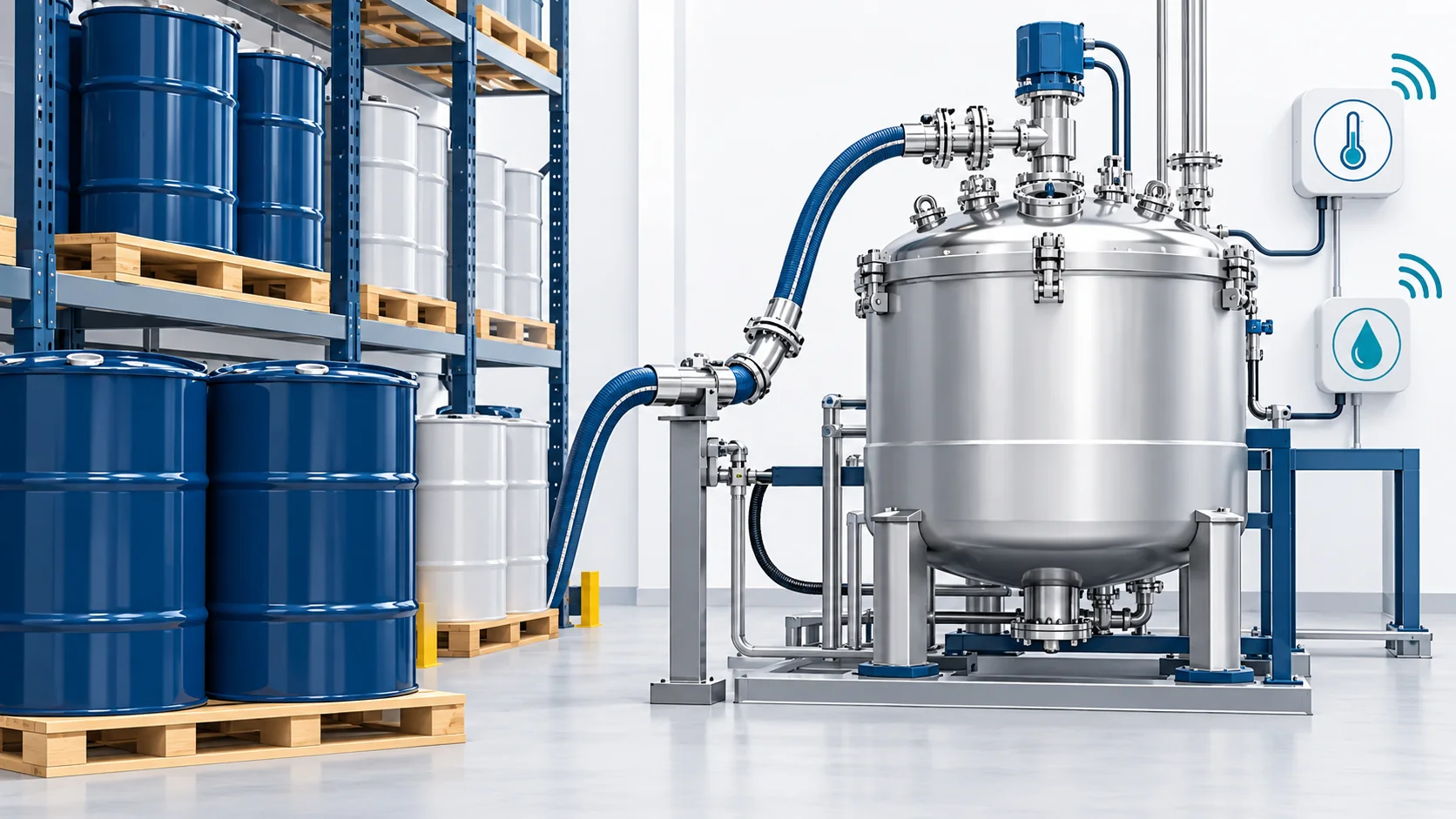
Most polyurethane defects that look like machine problems actually begin before the material reaches the metering pump. A polyol drum left with a loose bung on a humid shift, a tote of MDI parked next to a steam line, or an opened catalyst container left overnight can change reaction behavior enough to move foam density, hardness, or cure out of tolerance. Storage is often treated as warehouse work, but in polyurethane processing it acts as a slow process variable that changes the formulation over time.
Why Raw Material Storage Is Part of Process Control
Polyurethane chemistry is sensitive to both water and heat. The isocyanate side reacts with water, and if moisture is present, that reaction happens whether the processor intends it or not. The water-isocyanate reaction consumes reactive NCO groups, forms urea by-products, and releases carbon dioxide, which shifts the effective stoichiometry and creates gas where the part should be solid [1]. This can appear as soft foam, dense or uneven cells, shrinkage after demold, porosity, or pinholes. When the same formula runs well in dry weather and drifts during humid months, raw-material moisture is usually the first place to look.
A moisture gain is not just a quality problem; it is a formulation change. Water entering the polyol side changes isocyanate demand and makes density control less repeatable. This is why incoming-material checks should be treated with the same seriousness as machine calibration. Before changing the formulation, walk the material storage area and record what has changed: open containers, condensation, outdoor storage, or new suppliers with different packaging.
Moisture that enters the A-side or B-side before processing can later show up as dimensional change, soft spots, or inconsistent cell structure. Causes Of Shrinkage In Polyurethane Foam How To Control It covers how water contamination and process temperature changes affect final foam dimensions.
Moisture Control Comes Before Temperature Control
For most lines, moisture control is the highest-value storage upgrade. Polyols are hygroscopic, and isocyanates react with water. Opened drums, uncovered tote openings, and breather vents without dryers are the common entry points.
Practical storage rules include the following:
- Keep drums and totes sealed until material reaches process temperature.
- Purge opened isocyanate drums with dry nitrogen or dry air after each use [2].
- Use desiccant breathers on day tanks and bulk storage vents.
- Transfer material with a dedicated pump and closed hose, not by pouring from an open drum.
- Include a moisture check in incoming inspection for polyol blends.
- Label every opened container with the date and number of times it has been opened.
This level of control matters because even small water uptake affects the A/B ratio. The process may still produce foam, but the foam can be off-spec in ways that are difficult to trace later.
Temperature Windows for Common Raw Material Families
Storage and processing are different operating states. Use the actual grade TDS/SDS for warehouse limits, shelf life and conditioning; do not use a molten-curative working temperature as a long-term storage limit.
| Material Family | Typical Holding Range | Main Storage Risk | Handling Note |
|---|---|---|---|
| Polyether/polyester polyols | 20–30 °C | Moisture pickup and viscosity rise | Pre-warm gradually before metering |
| MDI grades and MDI prepolymers | Grade-specific supplier storage limits | Cold crystallization and skinning | Follow the grade’s crystallisation, warming and shelf-life instructions |
| TDI | 20–30 °C | Freezing or dimerization at extreme temperatures | Keep sealed and avoid local hot spots |
| Amine curatives such as MOCA | Supplier-specified storage conditions | Exposure, contamination and incorrect conditioning | Store as supplied; melt and hold for use only to the actual grade TDS/SDS |
| Diol chain extender: BDO | Supplier-specified storage conditions | Crystallisation and moisture pickup | Condition the material for liquid delivery; keep storage and processing limits separate |
| Catalysts and silicone surfactants | 10–30 °C | Hydrolysis and activity loss | Use small containers and keep caps tight |
Use these ranges as starting points, not as a contract specification. The material supplier’s TDS always takes precedence.
Drum, Tote, and Tank Handling Rules
Storage temperature only works if containers stay closed and separated. A common failure is keeping all raw materials on the same rack while one transfer pump moves between lines.
- Dedicate hoses, pumps, and lance tubes to A-side and B-side service. Cross-contamination between polyol and isocyanate creates solid reaction products in fittings.
- Use secondary containment under isocyanate containers.
- Use first-in, first-out rotation and mark arrival and opening dates.
- Set drum stock levels so material turns before shelf life expires. A half-empty tote that sits for months becomes a moisture risk.
The right drum or tote size depends on actual consumption per mold cycle, including the material held in the mixing head and transfer lines. How To Calculate Shot Weight In Polyurethane covers the calculation and the common sources of over-purchasing and dead stock.
Conditioning, Recirculation, and Returned Material
Before charging, raw material should be conditioned to processing temperature in a controlled way. Local heat from a flame or band heater can damage heat-sensitive components and create inconsistent viscosity from drum to drum. A temperature-controlled preheating oven or a recirculating tank holds material in a narrower window and gives the metering pumps a stable feed. When a machine uses day tanks, recirculation should be gentle and temperature controlled.
Returned or leftover material should not be casually poured back into a fresh drum. If material has been sitting in an open container, check for skin formation, gel particles, cloudiness, or unexpected viscosity. For isocyanate, confirm NCO content; for polyol, confirm moisture. If there is any doubt about contamination, segregate the container and keep it out of production material [4].
Reactivity shifts are often the earliest sign that a raw material has picked up moisture or sat past its useful storage limit. The Role Of Rise Time In Polyurethane Foaming covers what changed rise time means on the production floor and how to read it.
Storage-to-machine review: If you are sizing preheating ovens, day tanks, recirculation loops, or drum handling for a new or rebuilt line, send your material list and current storage layout to Info@chinahaifeng.com. The contact below is the fastest route for a line-specific discussion.
Discuss Your Storage and Conditioning Plan
Haifeng Polyurethane Machinery engineers work with processors to match raw-material storage, temperature conditioning, and recirculation to the actual formulation and output. If you are changing material suppliers, adding a high-output line, or trying to reduce moisture-related scrap, contact:
- Email: Info@chinahaifeng.com
- WhatsApp: 86 13566296633
Frequently Asked Questions
How long can polyurethane raw materials be stored?
Shelf life varies by material family and container condition. Unopened polyols may remain acceptable for 6–12 months in clean, dry storage, but opened isocyanate containers have a much shorter useful life once exposed to plant air. The material TDS and opening-date labels are more reliable than a general rule [4].
Can polyol and isocyanate drums be stored in the same room?
They can share a room if segregated, sealed, and protected against cross-transfer, but physical separation and secondary containment are safer. The real hazard is not simply proximity; it is using a wet or shared transfer device between the two sides.
What happens if MDI crystallizes during storage?
MDI can solidify or crystallize when stored too cold. Warm it slowly in a controlled oven or heated cabinet, and avoid direct flame. Some grades require gentle rolling or recirculation after warming. If the material does not clear, contact the supplier rather than forcing it through filters or pumps.
What is the best storage temperature for polyurethane raw materials?
Most polyurethane components are held in the 20–30 °C range, but specific isocyanate grades and solid chain extenders need different targets. The table above provides starting points, and the supplier’s TDS remains the final authority [3].
Do I need to dry polyols before charging?
Not automatically. Check moisture first. If the polyol exceeds the formulation limit, vacuum dehydration or a dry-air stripping step may be needed before charging. Drying should be done at a temperature compatible with the polyol and its additives because excessive heat can degrade the blend [5].
References
[1] C. Hepburn, Polyurethane Elastomers, 2nd ed. London: Elsevier Applied Science, 1992.
[2] M. Szycher, Szycher’s Handbook of Polyurethanes, 2nd ed. Boca Raton, FL: CRC Press, 2012.
[3] Center for the Polyurethanes Industry, “Working with MDI and TDI: Safe Handling and Storage,” American Chemistry Council, Washington, DC, 2020.
[4] ISO 14896:2009, Plastics — Polyurethane raw materials — Determination of isocyanate content.
[5] ISO 25761:2014, Plastics — Polyols for use in the production of polyurethanes — Determination of basicity.
If you’re interested, check out these related articles:
How To Calculate Shot Weight In Polyurethane
Shore A Vs Shore D Hardness In Polyurethane
SRIM Explained Structural Reaction Injection Molding Basics
Causes Of Shrinkage In Polyurethane Foam How To Control It





