Polyurethane production problems often get blamed on metering calibration, but a less obvious cause is uneven contact between the polyol and isocyanate streams before they reach the pour point. The applications of static mixers in polyurethane processing span low-pressure casting, high-pressure foaming, spray, and sealant dispensing, but their value depends on correct placement and sizing. When the ratio is correct but the mixing is not, the result can be streak lines, localized soft or hard areas, and inconsistent physical properties from shot to shot.
What a Static Mixer Does in a Polyurethane Line
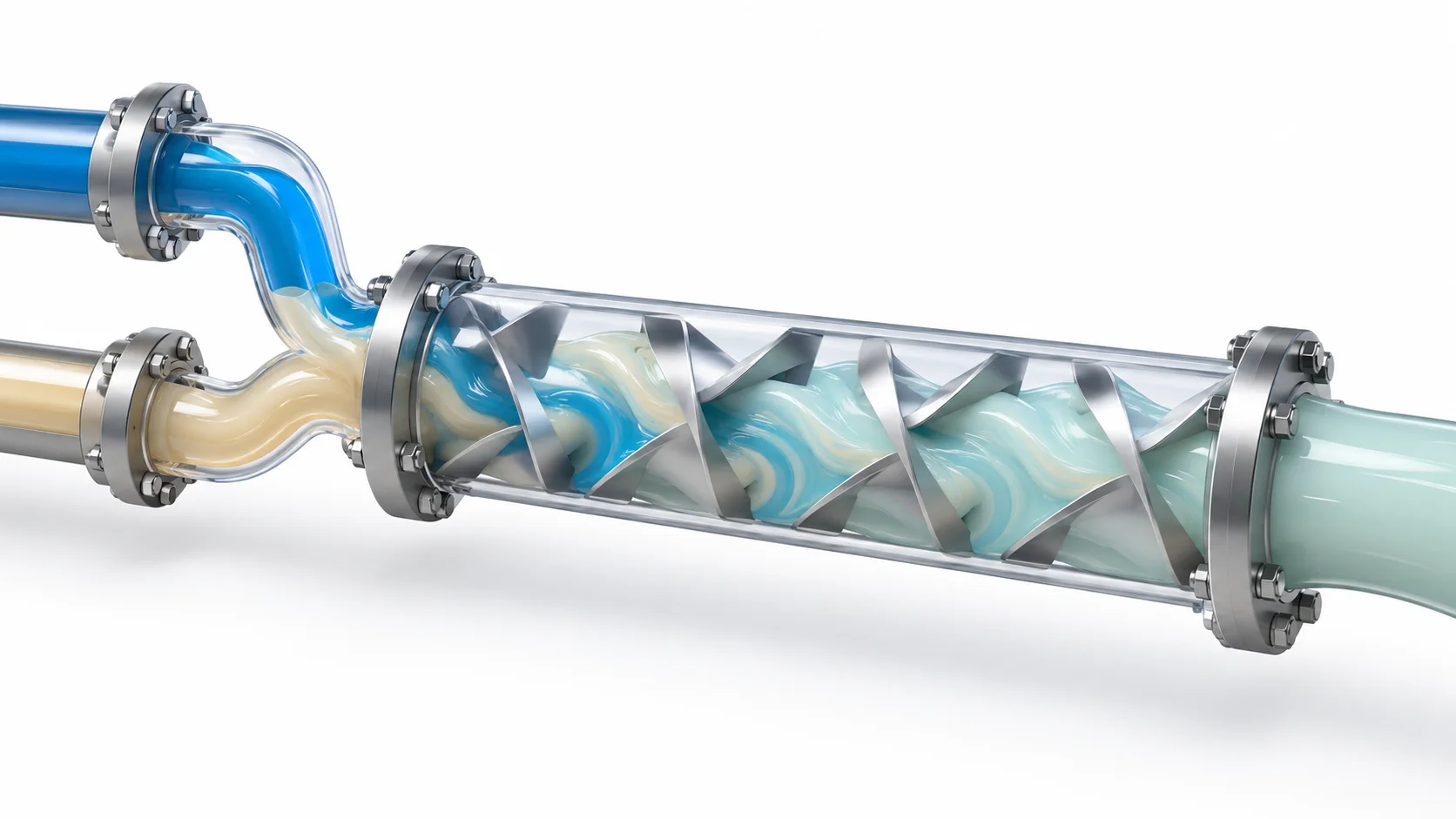
A static mixer uses fixed internal elements to divide, rotate, and recombine the fluid stream as it moves through a pipe or dispense nozzle. In laminar flow, repeated splitting multiplies the interfacial area between two or more components and shortens the distance over which they diffuse and react. For polyurethane, more uniform contact between the isocyanate side and the polyol side reduces local stoichiometric imbalance, which can otherwise create uncured pockets or uneven hard-segment formation [1].
Unlike a dynamic mixer, a static mixer does not shear material with a rotating blade. It derives its energy from line pressure. That makes it especially useful in continuous or intermittent polyurethane dispensing where simple construction, predictable cleaning, and repeatable mixing matter more than high shear.
Where Static Mixers Are Used in Polyurethane Processing
Low-Pressure Pouring and Elastomer Casting
In low-pressure machines used for rollers, wheels, seals, and small elastomer parts, the metering pumps deliver the polymer and chain extender at a controlled ratio, but the final degree of mixing depends on what happens between the pump and the mold. A static mixer in the dispense path or nozzle conditions the stream before it reaches a dynamic mixing chamber. It is generally more effective when viscosity is moderate, the shot is short enough to avoid long residence time, and the formulation does not contain coarse fillers that could clog the elements.
In roller casting, mixing quality shows up later as surface finish and hardness consistency across the roller face. <How Polyurethane Rollers Are Made From Casting To Cure> covers the pour-to-cure sequence where mixer performance matters most.
High-Pressure Foaming and Recirculation Lines
In high-pressure machines, primary mixing occurs at the impingement point inside the mix head. A static mixer is generally not substituted for that impingement step. Its more practical role is upstream: homogenizing a premixed component, dispersing a liquid additive, or keeping a recirculating stream uniform so the material arriving at the head is the same composition every time. This is particularly relevant for color pastes, catalysts, and water-blown formulations where small additive streams must remain evenly distributed.
RIM and RRIM Feed Conditioning
Reaction injection molding and reinforced RIM systems run at higher viscosity and often contain glass fiber or other reinforcement. In these processes, the static mixer can pre-disperse additives or condition the material before final impingement, but it must be selected carefully because fiber loading and viscosity directly affect pressure drop and the risk of settling [2].
When a part combines structural loads with fast cure, mixing hardware determines how evenly fiber and resin reach the mold. <RRIM Vs RIM Which Process Suits Your Structural Part> covers the process differences that influence mixer and head selection.
Spray and Continuous Panel Lines
Spray guns and continuous sandwich panel lines depend on consistent ratio at the moment of application. Static mixers mounted near the gun or within a dispense manifold can help distribute blowing agents, catalysts, and other low-viscosity additives into the main stream. Disposable plastic mixers are common where short shots and frequent shutdowns make cleaning impractical; fixed metal elements are more common where output is continuous and the fluid is clean.
Adhesive, Sealant, and Potting Applications
Cartridge-based polyurethane adhesives and potting compounds often use a disposable static mixer attached to the dispense tip. The same logic applies: the mixer brings the two components into uniform contact before curing. In these low-flow, longer-pot-life systems, the main selection concerns are dead volume, dispense accuracy, and the amount of material left inside the mixer after the shot.
Selecting a Static Mixer for a Polyurethane Application
The right mixer is not simply the longest or the smallest one that fits. Five factors dominate.
- Element count and mixer length: More elements create more mixing but also more pressure drop and longer residence time. Select the minimum element count that gives acceptable homogeneity for the formulation, not the maximum available.
- Diameter versus flow rate: An oversized mixer leaves material moving slowly and extends residence time; an undersized mixer raises backpressure and may overload the metering pumps. Match the mixer diameter to the actual discharge rate and viscosity at process temperature.
- Viscosity and temperature: Polyurethane component viscosity changes sharply with temperature. A mixer selected at room temperature may behave differently at 45 °C or 60 °C. Use viscosity data at the working temperature, not the storage temperature [3].
- Pot life and shot size: In short-shot casting, the material inside the mixer must be displaced before it reacts. If the mixed volume in the element is too large relative to the shot, the first part of the shot may contain material that has already begun to crosslink.
- Cleanability and wear: Filled or abrasive systems can rapidly erode plastic elements and tight clearance points. Fixed stainless-steel elements and a purge-compatible design are usually more practical when the same line runs multiple shifts.
If you are integrating a static mixer into an existing low-pressure casting or high-pressure foaming line, the immediate questions are how much backpressure the metering system can tolerate and how long mixed material remains inside the element. Contact the engineering team at Info@chinahaifeng.com or WhatsApp +86 13566296633 with your viscosity at process temperature, current flow rate, and shot weight for a direct equipment recommendation.
Common Integration Mistakes
Several recurring problems come from mixer placement, not the mixer itself.
- Placing the mixer too far from the pour point: This adds residence time and lets the mixed stream begin to react before discharge.
- Ignoring pressure drop: A mixer that raises backpressure can shift the effective metering ratio, especially with gear pumps, because each component sees a different system curve.
- Leaving stagnant material in the element: Without a purge sequence, the next shot can push partially reacted material into the mold and create soft or brittle defects.
- Choosing one mixer for all formulas: A filled elastomer and a clear low-viscosity sealant usually need different element counts and diameters, even on the same machine.
- Using storage-temperature viscosity for sizing: Process conditions, not laboratory conditions, determine the correct selection.
Talk to a Polyurethane Equipment Engineer
Static mixer selection fits into a larger question of metering stability, pouring accuracy, and line layout. If you are seeing mixing-related defects, provide the following in an inquiry:
- Polyurethane system type and filler content
- Viscosity of each component at process temperature
- Current flow rate or shot weight
- Existing pipe diameter and available pressure budget
- Pour cycle time and whether the line runs continuously or intermittently
Contact Haifeng Polyurethane Machinery at Info@chinahaifeng.com or WhatsApp +86 13566296633.
Frequently Asked Questions About Static Mixers in Polyurethane
Is a static mixer a replacement for a dynamic mixer?
Not in every case. A dynamic mixer can provide higher shear and is often better for highly filled or high-viscosity materials that need mechanical energy input. A static mixer is a practical choice for homogeneous low- to medium-viscosity streams, short-shot dispensing, and locations where sealing a rotating shaft is difficult.
Why does a static mixer increase backpressure?
Fixed elements force the fluid through alternating channels, which consumes line pressure. The loss increases with flow rate, viscosity, and the number of elements. If the backpressure is too high relative to the pumping capacity, the metered ratio can change.
Can static mixers be cleaned, or are they disposable?
Both options exist. Metal elements that can be removed and flushed suit continuous production and filled materials. Disposable plastic mixers are common for adhesives, sealants, and small-batch potting where quick changeover matters and material loss is acceptable.
How long should a static mixer be?
Longer is not automatically better. The correct length depends on the mixing difficulty of the system, additive concentration, and acceptable residence time. Manufacturer L/D recommendations should be used as a starting point, then confirmed on the actual production fluid.
References
[1] E. L. Paul, V. A. Atiemo-Obeng, and S. M. Kresta, Handbook of Industrial Mixing: Science and Practice. Hoboken, NJ, USA: John Wiley & Sons, 2004.
[2] C. W. Macosko, RIM: Fundamentals of Reaction Injection Molding. Munich, Germany: Hanser Publishers, 1989.
[3] G. Oertel, Polyurethane Handbook. Munich, Germany: Hanser Publishers, 1994.
If you’re interested, check out these related articles:
How To Calculate Shot Weight In Polyurethane
RRIM Vs RIM Which Process Suits Your Structural Part
What Is Spray Polyurethane Foam Composition And Application
The Role Of Rise Time In Polyurethane Foaming