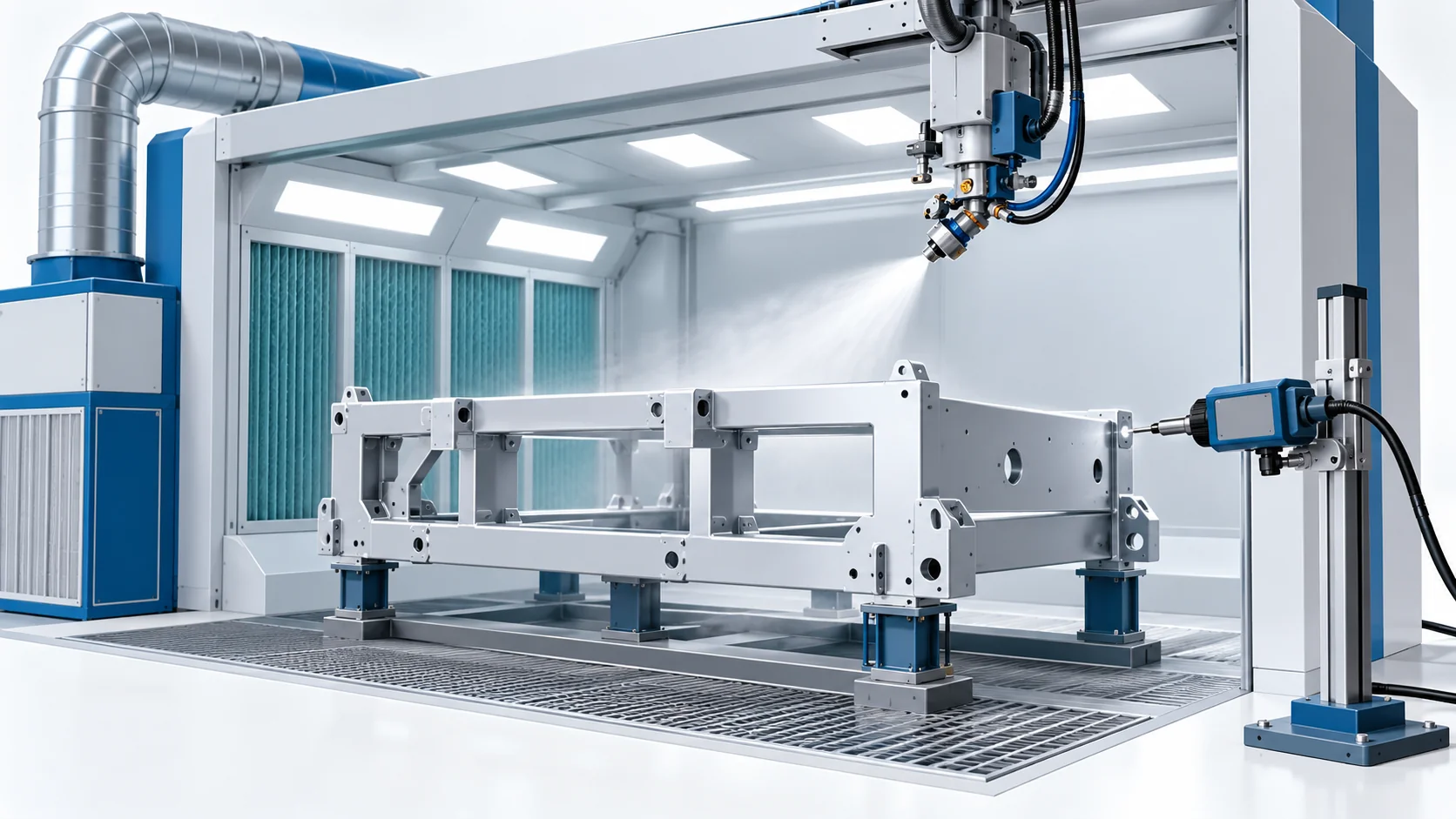
[Haifeng Process Standards Quick Reference]
Haifeng polyurethane equipment operates for extended periods in humid, chemically corrosive environments and under temperature cycling. Coating quality directly affects appearance retention, corrosion protection, and safety. A 10 μm deviation of pretreatment roughness from the specified range can reduce coating adhesion by about 15%–25%. If dry-film thickness is 20 μm below design, coating life in a C4 environment can fall by more than 30%. The coating on pipeline welds and tank exterior walls must have zero pinholes to eliminate corrosion initiation points.
Key process parameters at a glance:
| Parameter | Haifeng standard | Industry reference | Related equipment performance indicator |
| Surface-preparation rust-removal grade | Sa 2.5 (ISO 8501-1) | Sa 2.5 | Coating adhesion ≥6.0 MPa |
| Surface roughness (Rz) | 40–70 μm | Rz 30–75 μm | Provides mechanical anchoring for coating |
| Surface dust cleanliness | ≤Grade 2 (ISO 8502-3) | ≤Grade 3 | No pinholes or craters in coating |
| Soluble chloride content | ≤50 mg/m² | ≤100 mg/m² | Suppresses electrochemical corrosion |
| Spray-booth temperature | 15–30°C | 15–35°C | Paint flow and curing quality |
| Spray-booth relative humidity | 40%–65% | 50%–70% | Prevents blushing and loss of adhesion |
| Substrate temperature above dew point | ≥dew point + 3°C | ≥dew point + 3°C | Prevents blistering and pinholes |
| Controlled airflow in spray booth | 0.38–0.67 m/s (enclosed booth) | 0.38–0.67 m/s | Paint-mist removal efficiency ≥98% |
| Spray-booth cleanliness | ISO Class 7 (Class 100,000) | Class 100,000 | Coating particles ≤1 per dm² |
| Primer dry-film thickness (epoxy zinc-rich) | 60–80 μm | 60–80 μm | Corrosion-protection life ≥15 years (C4) |
| Intermediate coat dry-film thickness (epoxy micaceous iron oxide) | 100–120 μm | 100–120 μm | Blocks penetration of corrosive media |
| Topcoat dry-film thickness (aliphatic polyurethane) | 60–80 μm | 60–80 μm | Weatherability ≥10 years |
| Total coating dry-film thickness (C4) | 240–280 μm | ≥240 μm (C4 high durability) | Complete machine corrosion class ISO 12944 C4 |
| Adhesion (cross-cut test) | ≤Grade 1 | ≤Grade 2 | No coating detachment or peeling |
| Adhesion (pull-off test) | ≥6.0 MPa | ≥4.0 MPa | Ensures coating bond strength |
| Color deviation (ΔE) | ≤1.5 | ≤2.0 | Consistent brand appearance |
1. Scope
1.1 Applicable operations
This SOP applies to the following coating operations for Haifeng polyurethane equipment:
| Coated component | Typical material | Surface preparation | Coating system | Corrosivity category |
| Steel frame | Q235B / Q345B | Sa 2.5 abrasive blasting + epoxy primer | Epoxy zinc-rich primer + epoxy micaceous iron oxide intermediate coat + polyurethane topcoat | ISO 12944 C3 |
| Tank exterior and support structure | Q235B / 304 | Sa 2.5 abrasive blasting + epoxy primer | Epoxy zinc-rich primer + epoxy micaceous iron oxide intermediate coat + polyurethane topcoat | ISO 12944 C4 |
| Electrical-cabinet enclosure | Cold-rolled steel/galvanized sheet | Phosphating + electrophoretic primer | Epoxy primer + polyurethane topcoat | ISO 12944 C3 |
| Pipeline support | Q235B | Sa 2.5 abrasive blasting | Epoxy zinc-rich primer + polyurethane topcoat | ISO 12944 C3 |
| Sheet-metal guard | Cold-rolled steel | Phosphating | Epoxy primer + polyurethane topcoat | ISO 12944 C2 |
2. Preparation and Pretreatment Accuracy Control
2.1 Check technical documents and materials
| No. | Item to check | Accuracy requirement | Acceptance criterion |
| 1 | Coating process card | Coating system, film thickness, and color standard included | Matches equipment technical requirements |
| 2 | Paint product data sheet | Application parameters, mixing ratio, and pot life included | Within shelf life |
| 3 | Paint batch inspection report | Solids content, density, and viscosity included | Matches product data sheet |
| 4 | Color panel standard | Customer-approved color code (ΔE ≤1.5) | Current and visually confirmed |
| 5 | Paint viscosity | As required for the paint (No. 4 cup) | Measured value recorded |
2.2 Control pretreatment accuracy (critical operation)
Pretreatment quality is the primary factor determining coating-protection life. Before coating, steel must be cleaned to Sa 2.5 (near-white metal): the surface must be free of visible oil, grease, dirt, mill scale, rust, paint, and other contaminants. Any remaining marks may only appear as slight spots or streaks.
2.2.1 Abrasive-blasting parameters
| Parameter | Haifeng standard | Control measure |
| Abrasive type | Steel shot/grit (G18–G25) | Screen regularly and remove dust |
| Abrasive cleanliness | Free of oil, water, and salts | Sample-check every shift |
| Compressed-air pressure | 0.6–0.8 MPa | Monitor with pressure gauge |
| Blasting distance | 150–250 mm | Follow operating procedure |
| Blasting angle | 60°–75° | Avoid perpendicular impact |
2.2.2 Control the interval after pretreatment
Abrasive-blasted steel oxidizes and flash-rusts quickly when exposed to air. Haifeng sets these maximum intervals before coating:
| Ambient relative humidity | Maximum interval from blasting to coating |
| ≤60% | ≤4 hours |
| 60%–80% | ≤2 hours |
| >80% | ≤1 hour; reconfirm surface condition |
If the interval is exceeded, abrasive-blast the surface again. Wiping or sanding is not an acceptable substitute.
2.3 Control paint mixing accuracy
| Parameter | Haifeng standard | Control measure |
| Mixing ratio | Strictly follow product data sheet (Part A:Part B) | Weigh on electronic scale, accuracy ±1 g |
| Mix uniformity | Mix ≥3 minutes; no streaking | Mechanical mixing |
| Pot life | As specified (typically 4–6 h at 25°C) | Monitor with timer; discard after expiry |
| Application viscosity | As required for paint (No. 4 cup) | Measure and record each batch |
| Induction time | As specified (typically 5–15 min) | Monitor with timer |
Use mixed paint within its specified pot life. A common cause of coating defects is continuing to spray long after hardener has been added and the usable time has expired.
3. Structured Coating Workflow
3.1 Mask and protect
Precisely mask areas that must not be coated before spraying:
| Area to mask | Masking material | Accuracy requirement |
| Flange sealing face | High-temperature tape and protective cover | Neat edge; no paint ingress |
| Threaded/mounting holes | Silicone plugs/bolts | No paint residue inside holes |
| Sensor mounting face | Peelable coating and tape | Masking-boundary straightness ≤2 mm |
| Nameplate/markings | High-temperature tape | Fully masked with no exposed edges |
| Electrical connectors | Dedicated protective cap | Preserve ingress-protection rating |
Remove masking after the coating is touch-dry but before it fully cures (typically 10–30 minutes after spraying). At this point, the coating has enough strength while its edges can still be removed without tearing.
3.2 Spray application
3.2.1 Control spraying parameters
| Parameter | Haifeng standard | Control measure |
| Spray-gun distance | 200–300 mm | Follow operating procedure |
| Spray-gun angle | Perpendicular to work surface | Deviation ≤15° |
| Gun travel speed | 300–600 mm/s | Move uniformly |
| Pass overlap | 50% (each pass covers half of previous pass) | Cross-spray |
| Air pressure (air spray) | 0.3–0.5 MPa | Monitor with pressure gauge |
| Number of coats | 2 primer, 2 intermediate, 2 topcoat | Follow coating system |
| Flash-off interval between coats | As specified (typically 10–30 min at 23°C) | Monitor with timer |
3.2.2 Coating system and film-thickness control
Haifeng uses a three-coat system with dry-film thickness requirements selected for the corrosivity category:
| Coat | Paint type | Haifeng dry-film thickness (C3) | Haifeng dry-film thickness (C4) | Number of passes |
| Primer | Epoxy zinc-rich primer | 60–80 μm | 60–80 μm | 2 |
| Intermediate coat | Epoxy micaceous iron oxide | 80–100 μm | 100–120 μm | 2 |
| Topcoat | Aliphatic polyurethane | 60–80 μm | 60–80 μm | 2 |
| Total dry-film thickness | — | 200–260 μm | 220–280 μm | — |
3.2.3 Coat special areas
| Area | Coating requirement | Accuracy standard |
| Welds and heat-affected zones | Stripe-coat with primer | Stripe-coat at least 50 mm on each side of weld |
| Edges and corners | Stripe-coat or apply extra spray | Film thickness ≥120% of standard |
| Bolt-joint faces | Coat or mask as required for assembly | Mating faces must retain electrical conductivity |
| Pipeline supports | Fully coat undersides and backs | No missed areas; uniform thickness |
| Marking areas | Apply as required after topcoat | Color difference ΔE ≤1.5 |
3.3 Control curing and drying
| Curing stage | Haifeng standard | Ambient condition |
| Touch-dry | As specified (typically ≤30 min at 23°C) | Ventilated; temperature ≥15°C |
| Hard-dry | As specified (typically ≤24 h at 23°C) | Prevent dust contamination |
| Full cure | 7 days at 23°C; accelerated cure as specified | Temperature ≥15°C; humidity ≤75% |
| Forced drying, if used | 60–80°C for 30–60 min | Follow paint product requirements |
Do not move, assemble, or apply mechanical loads to the workpiece before the coating is fully cured. For accelerated curing, confirm the oven temperature does not exceed the paint manufacturer’s limit; excessive baking can embrittle the coating.
4. Key Parameters for Coating Accuracy
| No. | Accuracy category | Parameter | Haifeng standard | Inspection tool | Frequency |
| 1 | Pretreatment | Rust-removal grade | Sa 2.5 | Visual comparison with ISO 8501-1 | 100% inspection |
| 2 | Pretreatment | Surface roughness (Rz) | 40–70 μm | Comparator coupon/roughness tester | Sampling (≥3 points per batch) |
| 3 | Pretreatment | Surface dust cleanliness | ≤Grade 2 | Tape test (ISO 8502-3) | 100% inspection |
| 4 | Paint control | Mixing-ratio deviation | ±1% by weight | Electronic scale | Each batch |
| 5 | Paint control | Application-viscosity deviation | ±5 seconds (No. 4 cup) | Viscometer | Each batch |
| 6 | Film-thickness control | Primer dry-film thickness | 60–80 μm (C3/C4) | Magnetic thickness gauge | After each coat |
| 7 | Film-thickness control | Intermediate dry-film thickness | 80–100 μm (C3)/100–120 μm (C4) | Magnetic thickness gauge | After each coat |
| 8 | Film-thickness control | Topcoat dry-film thickness | 60–80 μm (C3/C4) | Magnetic thickness gauge | After each coat |
| 9 | Film-thickness control | Total dry-film thickness | 200–260 μm (C3)/220–280 μm (C4) | Magnetic thickness gauge | 100% inspection |
| 10 | Appearance | Color difference (ΔE) | ≤1.5 | Colorimeter | Sampling inspection |
| 11 | Appearance | Gloss deviation | ≤5 GU (60°) | Gloss meter | Sampling inspection |
| 12 | Coating performance | Adhesion (cross-cut) | ≤Grade 1 | Cross-cut tool and tape (GB/T 9286) | Each batch |
| 13 | Coating performance | Adhesion (pull-off) | ≥6.0 MPa | Pull-off tester (GB/T 5210) | Each batch |
5. Common Problems and Process Pitfalls
5.1 Uncontrolled pretreatment roughness causes poor adhesion
Symptom: Adhesion-test results fall below standard (cross-cut worse than Grade 2 or pull-off below 4.0 MPa), and the coating peels after mechanical impact or temperature cycling.
Root cause: Surface roughness after blasting is outside the specified range. If it is too low (Rz <30 μm), mechanical anchoring between coating and substrate is insufficient. If too high (Rz >75 μm), coating over surface peaks is too thin; peaks become stress concentrations and corrosion-initiation points. Incorrect abrasive size, unstable compressed-air pressure, or excessive blasting distance can all shift roughness out of range.
Corrective actions:
1. After blasting each batch, use comparator coupons to confirm roughness is Rz 40–70 μm.
2. Select abrasive size according to sheet thickness and coating system; screen regularly to remove fractured abrasive.
3. Keep compressed-air pressure stable at 0.6–0.8 MPa. Stop and inspect if pressure fluctuates by more than 0.1 MPa.
4. Maintain blasting distance at 150–250 mm and angle at 60°–75°.
5.2 Excessive humidity causes blushing and loss of adhesion
Symptom: A milky haze appears on the coating, gloss decreases, and adhesion tests fail.
Root cause: When relative humidity in the spray environment exceeds 70%, solvent evaporation absorbs heat and cools the coating surface. Water vapor then condenses on the wet film, causing blushing. Moisture at the coating interface also weakens adhesion. Data indicate that above 70% relative humidity, the likelihood of blushing and reduced adhesion increases by more than 30%.
Corrective actions:
1. Install dehumidification equipment and maintain spray-booth humidity at 40%–65%.
2. Record ambient temperature and humidity every two hours; stop spraying immediately if humidity exceeds the limit.
3. Keep substrate temperature at least 3°C above the dew point.
4. Sand off any blushed coating and reapply it.
5.3 Runs and sags cause appearance defects and uneven film thickness
Symptom: Tear-shaped or curtain-like downward streaks appear, and local film thickness is far above specification.
Root cause: Runs and sags can result from excessive paint delivery or an overly thick single coat, high humidity, low temperature, a spray gun held too close, slow gun travel, or paint viscosity that is too low.
Corrective actions:
1. Keep single-coat wet-film thickness at 50%–60% of the design value; avoid applying too much paint in one pass.
2. Maintain a spray distance of 200–300 mm and gun travel speed of 300–600 mm/s.
3. Adjust viscosity to product requirements; do not add thinner arbitrarily.
4. Do not spray below 15°C or above 70% relative humidity.
5. Before the coating becomes touch-dry, brush or scrape away runs. After curing, sand and recoat.
5.4 Orange peel makes the coating surface rough
Symptom: The surface has an uneven orange-peel texture, lower gloss, and poor image clarity.
Root cause: Orange peel is usually caused by paint viscosity that is too high, excessive spray distance, insufficient air pressure, or solvent that evaporates too quickly. In manual spraying, variations in gun speed, distance, and angle make it difficult to distribute paint evenly and can also reduce gloss and image clarity.
Corrective actions:
1. Adjust viscosity to the product data-sheet range (typically 18–25 seconds with a No. 4 cup).
2. Keep spray distance stable at 200–300 mm and air pressure at 0.3–0.5 MPa.
3. Add an appropriate amount of slow-drying thinner to regulate solvent evaporation.
4. Maintain spray-booth temperature at 20–30°C to prevent solvent evaporation from becoming too rapid.
5. Light orange peel can be sanded and polished; severe defects require sanding and recoating.
5.5 Coating pinholes compromise corrosion protection
Symptom: Small holes appear in the coating, allowing corrosive media to reach the substrate and cause pitting.
Root cause: Causes include residual oil or water on the substrate, oil or water in compressed air, trapped bubbles in paint that has not been allowed to deaerate, and excessive film thickness that prevents solvent from escaping. Every pinhole in a protective coating is a potential corrosion-initiation point.
Corrective actions:
1. Treat compressed air with a refrigerated dryer and precision filters; dew point must be ≤−20°C and oil content ≤0.01 mg/m³.
2. Allow mixed paint to stand for 5–15 minutes so bubbles can escape.
3. Do not exceed the product data-sheet thickness for a single coat, which can trap solvent.
4. Keep substrate temperature at least 3°C above the dew point to prevent condensation.
5. After the coating is touch-dry, inspect 100% with a pinhole detector (wet-sponge or high-voltage spark test).
5.6 Exceeding the pretreatment window causes early rusting beneath the coating
Symptom: After one or two years of operation, rust spreads beneath the coating and local areas blister or peel.
Root cause: Too much time passes between blasting and coating, allowing steel to reoxidize in humid air. A microscopic oxide layer can form and significantly weaken adhesion even when no obvious rust is visible. Above 80% relative humidity, detectable oxidation can occur on a blasted surface within one hour.
Corrective actions:
1. Follow the pretreatment time limits: ≤4 hours at relative humidity ≤60%; ≤2 hours at 60%–80%; and ≤1 hour above 80%.
2. Reblast any surface that has exceeded the limit; wiping or sanding is not a substitute.
3. Coordinate blasting and coating closely so workpieces do not remain exposed for an extended period.
4. If a large workpiece cannot be processed continuously, blast and coat it section by section.