
Wet-Process PU Synthetic Leather Production Solution
Explore wet-process PU synthetic leather production, including coating, water-bath coagulation, washing, solvent-recovery interfaces and line controls.
Wet-Process PU Synthetic Leather Production Solution
Wet-processed PU synthetic leather is widely used in automotive interiors, handbags, and footwear. Traditional wet-processing lines rely on manual adjustment of process parameters, resulting in inconsistent film quality, limited production speed, and long changeover times. Furthermore, the low DMF recovery efficiency poses environmental risks, and the resulting product lacks the durability and quality demanded by high-end brands. The Hai Feng wet-processing PU synthetic leather solution centers around an intelligent wet-processing line, combined with a three-stage DMF recovery system and a fully digitalized control platform. This allows for the establishment of a complete, automated production line or the modular upgrade of existing lines. The solution includes specialized PU formulations, online quality control, and certification documentation, ensuring stable production of high-quality, environmentally friendly, and compliant wet-processed leather.
Solvent-Recovery and Emissions Interfaces
A specified three-stage DMF recovery system can be integrated into the wet route. Recovery rate, exhaust emissions and workplace exposure are separate measurements with their own sampling points and operating conditions.
Efficient and flexible re-manufacturing
Complete specification changes can be implemented in ≤1 hour, reducing material waste and enabling the production of small-batch, customized orders across multiple product lines.
Separate coating, coagulation, washing and solvent recovery when defining a wet-process project. A retrofit should identify retained tanks, new circulation and monitoring, recovery-plant capacity, wastewater and extraction interfaces, together with the permitted shutdown.
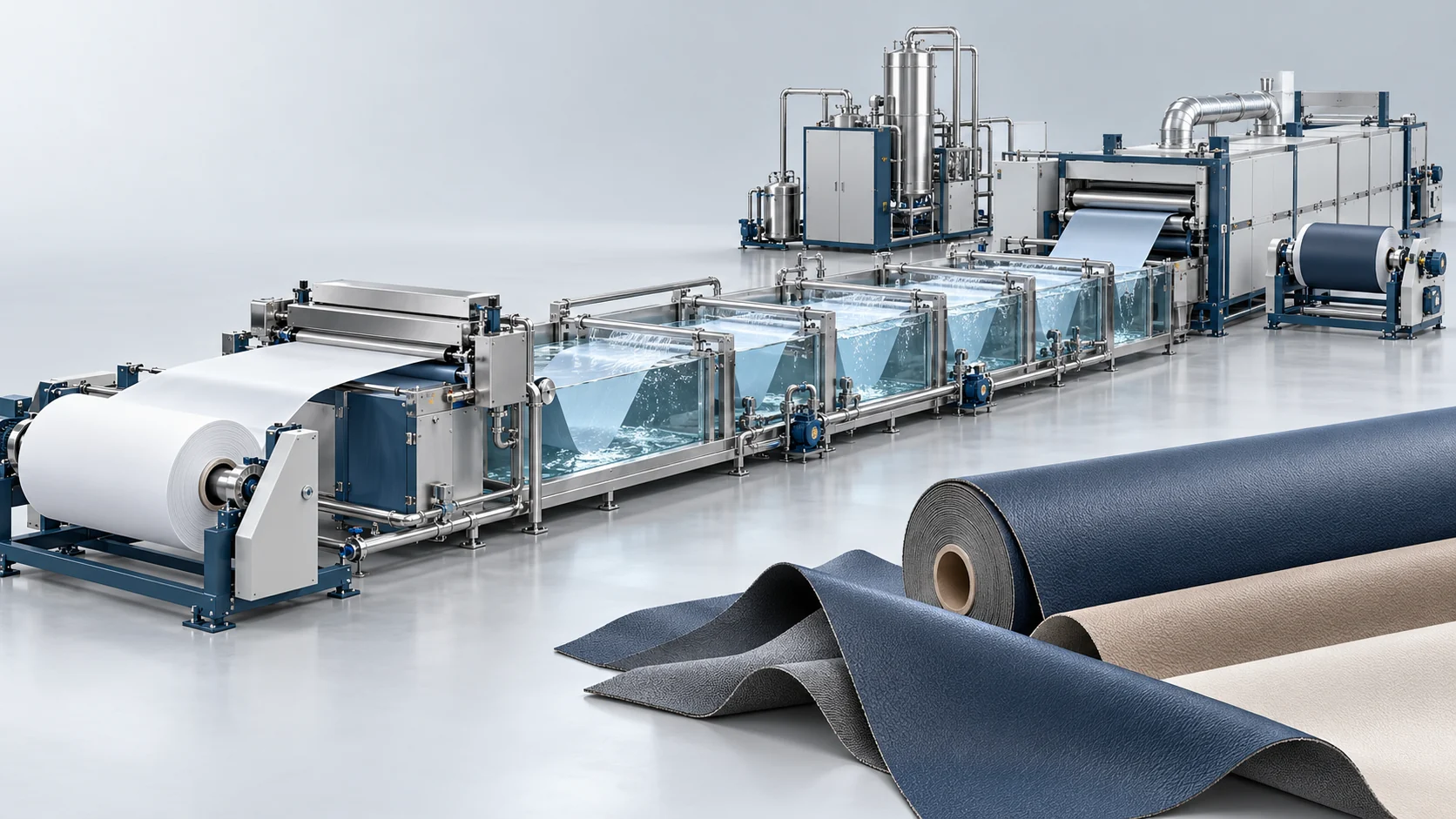
Wet-process leather manufacturing process
A fully automated wet-process leather production process, from raw material preparation to final product sampling and verification, ensures continuous and stable production.
Base fabric pretreatment process
Complete the substrate preparation, including substrate release, leveling, and stress stabilization, to create a suitable surface for applying the coating.
The paste application process
Prepare and meter the selected PU paste under agreed component-ratio, viscosity and temperature conditions. Coating thickness or coat weight is checked separately using the specified cross-web and machine-direction sampling plan.
Water bath solidification process
The coated substrate enters the aqueous coagulation bath. Solvent exchanges with water, causing phase separation and formation of the porous PU layer. Bath composition, temperature and residence time are defined for the selected paste.
Main technical specifications
Core technical parameters for the wet-process synthetic leather production line. The following values represent the design targets; actual performance may vary depending on the PU resin, backing material, and operating conditions.
| Parameter options | Parameter values |
|---|---|
| Coating Line Speed | 20–25 m/min — configuration reference; confirm for the selected paste, working width and coating construction |
| Component-Ratio Tolerance | ±0.8% reference for the selected paste-preparation system; measurement basis, ratio range and operating conditions agreed for acceptance |
| Coating Uniformity Acceptance | Define thickness or coat-weight tolerance, cross-web/machine-direction sampling, conditioning and the acceptance method for the selected coating |
| Third-tier DMF recovery rate | ≥95% |
| Emission Assessment | Concentration and limits defined for the specified sampling point, operating state and applicable assessment; measured separately from solvent-recovery rate |
| Time required for full specification change | ≤ 1 hour |
| Target finished product pass rate | ≥98% |
| Target defect rate | ≤2% |
| Finished product: 23°C bend resistance | ≥ 200,000 times |
| Associated unit | Key processes include: pre-processing, online intelligent quality control, and a three-stage DMF recovery system. |
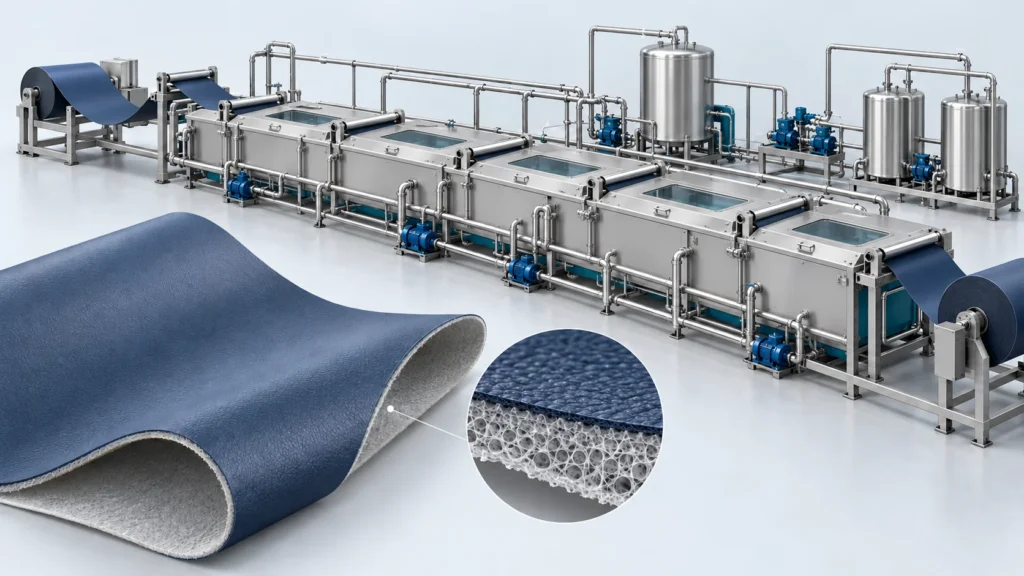
Equipment for Integrated solution for wet-process synthetic leather production
The coagulation/washing equipment is distinct from the distillation, wastewater and ventilation systems; identify which modules are supplied or retained.
Key features of the plan
The complete wet-cast leather production line offers a comprehensive advantage in terms of quality, environmental friendliness, flexibility, and technical service, enabling customers to consistently produce high-quality leather.
Achieve consistent film quality.
Precise viscosity and coating control minimize pinholes and cracks, resulting in uniform film formation and improved durability of the finished product.
Configured DMF Recovery Interfaces
Coordinate solvent collection, recovery and wastewater responsibilities within the ordered line. Recovery efficiency and emissions are validated separately; a recovery percentage does not establish workplace or site-wide compliance.
Efficient and flexible production
Quickly adapts to various types of leather, including car leather, luggage leather, and shoe leather. Also supports the modular modification of existing production lines, reducing project costs.
End-to-end implementation services
Customized solutions, formulation adaptation, DMF system integration, sample testing, and assistance with certification documentation, along with long-term maintenance and support.
Related Projects
The linked energy retrofit concerns its documented washing and recovery interfaces; compare only the same production and measurement boundary.
Questions About Integrated solution for wet-process synthetic leather production
Find answers about Integrated solution for wet-process synthetic leather production, including material selection, equipment configuration and the information needed to plan a production line.
Is solvent recovery part of the same equipment package?
What information is needed to size the production line?
What is included in the equipment package?
Are cycle time and finished-product performance fixed?
How is coating uniformity accepted?
Does the DMF recovery rate establish emission compliance?
What should be agreed at the interface to the DMF recovery plant?
Submit Your Production Goals
Share the following for this application: Fabric and resin data, coating mass, tank layout, wash flows, DMF measurements, recovery capacity, utilities and shutdown window. Our team will reply within one business day. Once requirements are clear, we provide a preliminary proposal within two business days.


