
Microfiber Wet Coagulation Energy Retrofit Project in China
Review draft: Microfiber Wet Coagulation Energy Retrofit. Configuration and reported outcomes require original project records.
Project Overview
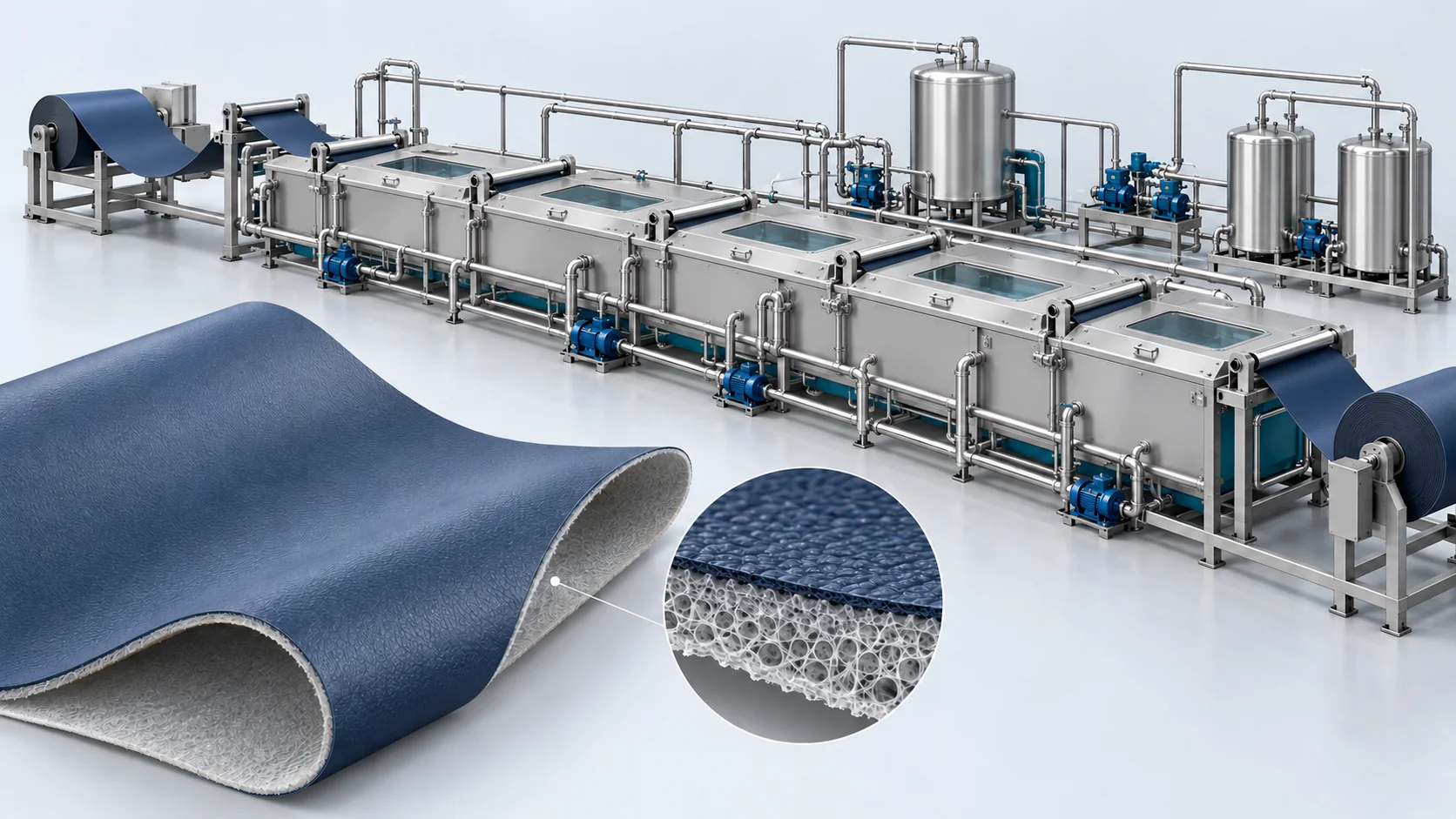
Illustration notice. Process illustrations are not verified photographs of this installation.
Project reference basis. Figures and configuration details are reported in the supplied project brief. They are reference values for the stated application, rather than verified acceptance results or a guarantee for another installation. Confirm the source records, material, tooling, operating schedule and test method when assessing a comparable project.
A leading island-type sea-island microfiber leather manufacturer in Shandong deployed Haifeng’s multi-stage countercurrent washing and DMF recovery retrofit system across its wet-process production workshop. The facility was upgraded to optimize the solvent coagulation and water-washing lines for 12 million square meters of annual suede microfiber base output.
Prior to the overhaul, the manufacturer utilized open overflowing wash tanks. Fresh water was flooded directly into each stage, creating enormous volumes of diluted wastewater containing only 8% to 11% DMF. The downstream distillation plant consumed an exorbitant 4 tons of industrial steam per ton of recovered DMF, driving monthly utility bills over 1.2 million RMB. Furthermore, fugitive DMF vapors across open tanks created strong odors exceeding occupational safety limits (25 mg/m³), threatening compliance shutdowns.
Haifeng engineered an integrated six-stage countercurrent closed washing retrofit centered on the HF-WET200-REC system. Featuring in-line optical refractometer closed-loop concentration controls and negative-pressure vapor collection canopies, the upgrade concentrated recovery effluent to a steady 20% DMF, cutting distillation steam energy by 32% while completely eliminating solvent odors on the plant floor.
Review point: Effluent concentration is not a liquid resin mix ratio, and refractometer Brix requires composition/temperature calibration before it represents DMF concentration. Recovery purity, water use and steam savings require process mass/energy balances. Enclosed washing does not by itself prove emissions or wastewater compliance.
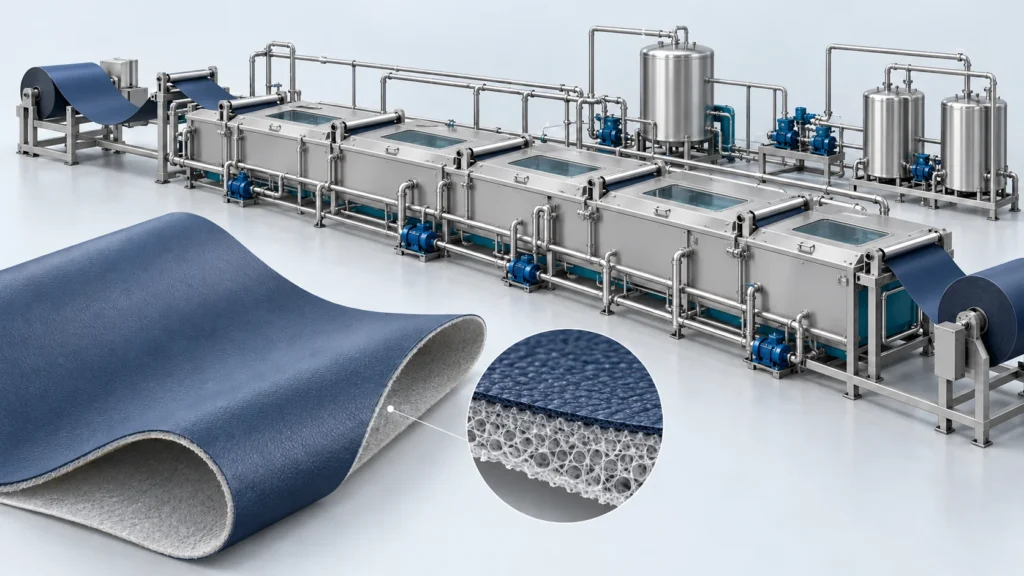
Concept illustration: Generated concept illustration for process discussion; not a photograph of the specified machine, a customer facility or a delivered project.
Solutions Delivery
Configuration reported in the supplied brief.
Haifeng engineered and executed a modular brownfield line conversion integrated during a scheduled plant maintenance window. The existing open wash tanks were replaced with six fully enclosed 316L stainless steel countercurrent cascade tanks equipped with pneumatic squeeze rollers.
Digital optical refractometers were installed across each tank’s circulation circuit, continuously measuring real-time DMF concentrations. The PLC master controller commands proportional solenoid valves to transfer water in a reverse cascade direction opposite to web travel. Fresh water enters only at the final clean-water tank (Stage 6), progressively cascading back to Stage 1.
The effluent discharged from Stage 1 to the distillation plant is stabilized between 19.0% and 21.0% DMF, halving water distillation mass. Sealed negative-pressure canopies fitted with pneumatic inspection windows cover all six tanks, collecting 99.95% of volatile solvent fumes into plant air scrubbers. Residual DMF on the microfiber base exiting the final squeeze roll dropped below 150 ppm, ensuring complete washing efficiency.
Effluent concentration is not a liquid resin mix ratio, and refractometer Brix requires composition/temperature calibration before it represents DMF concentration. Recovery purity, water use and steam savings require process mass/energy balances. Enclosed washing does not by itself prove emissions or wastewater compliance.
| Equipment | Model | Qty | Function |
|---|---|---|---|
| Countercurrent Washing Tank Skid | HF-WET200-REC | 1 line | 6-stage enclosed 316L stainless tanks with gradient cascade plumbing. |
| In-Line Optical Refractometer Array | HF-ORA-06 | 6 units | Real-time digital refractive concentration sensors controlling transfer valves. |
| Negative-Pressure Vapor Canopy System | HF-VCS-36 | 1 set | 36-meter sealed stainless covers capturing 99.95% of fugitive solvent fumes. |
| Heavy-Duty Pneumatic Squeegee Rollers | HF-PSR-06 | 6 sets | High-pressure dewatering nip rolls minimizing carry-over between wash stages. |
Reported Results — Original Records Required
Modernize Your Wet-Process Leather Energy Efficiency
Connect with Haifeng wet-process chemical engineers to deploy multi-stage countercurrent washing retrofits engineered to slash steam distillation costs.


