
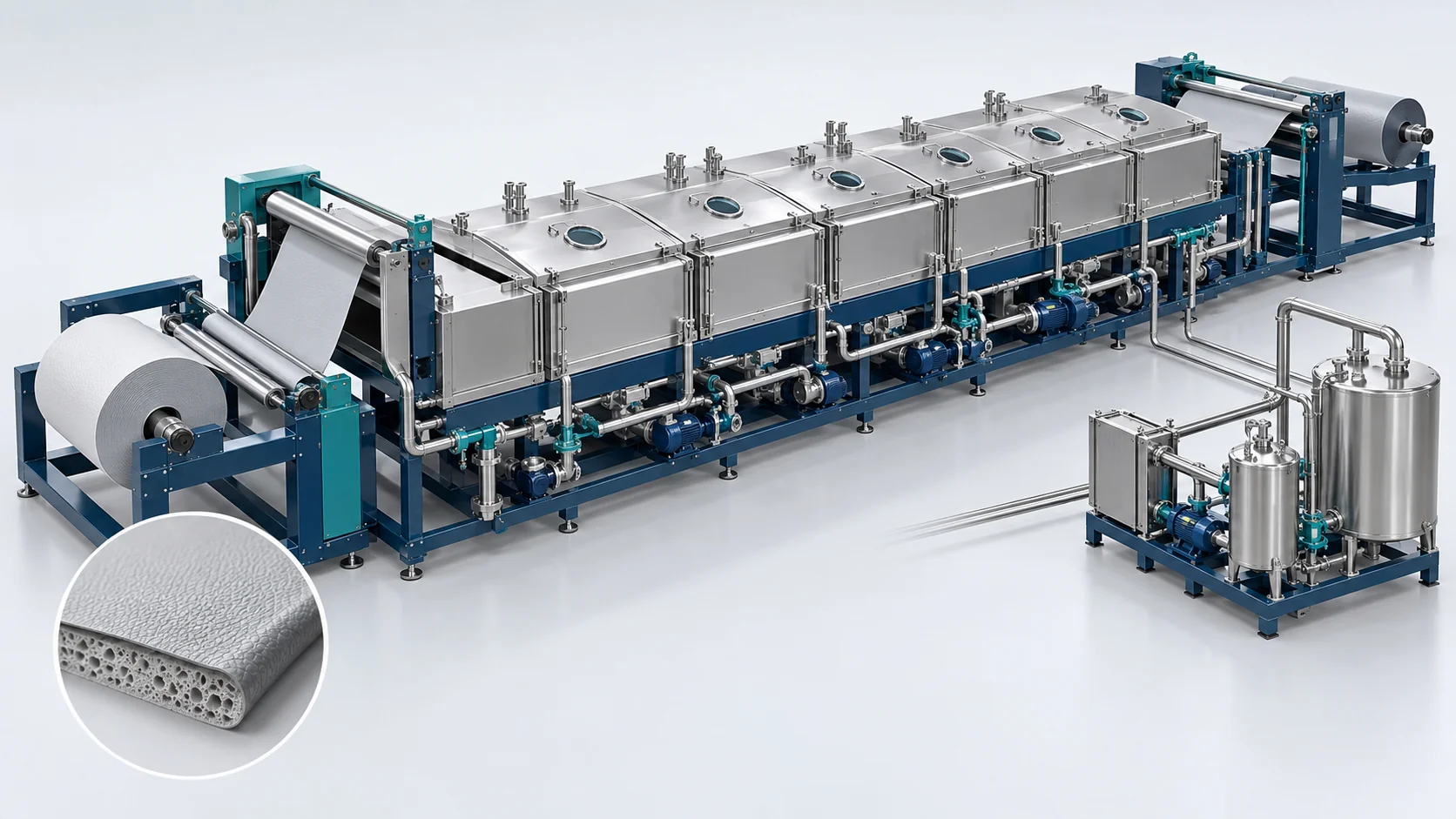
DMF Coagulation and Washing Line | Wet-Process Leather
A multistage DMF/water coagulation and countercurrent washing package with monitored circulation and recovery interfaces.
Multi-Stage Countercurrent Washing for Wet Synthetic Leather
A multistage DMF/water coagulation and countercurrent washing package with monitored circulation and recovery interfaces.
A multistage DMF/water coagulation and countercurrent washing package with monitored circulation and recovery interfaces.
Configured coagulation/washing tanks, circulation pumps, fluid monitoring and web-handling interfaces. Distillation, extraction, wastewater treatment and upstream coating scope are separately agreed.
Effluent concentration is not a liquid resin mix ratio, and refractometer Brix requires composition/temperature calibration before it represents DMF concentration. Recovery purity, water use and steam savings require process mass/energy balances. Enclosed washing does not by itself prove emissions or wastewater compliance.
Concept illustration: Generated concept illustration for process discussion; not a photograph of the specified machine, a customer facility or a delivered project.
Material Flow and Working Principle
Resin Impregnation & Uniform Metering
Microfiber nonwoven substrate passes through a pressurized immersion bath containing DMF-polyurethane resin, followed by precision squeegee rolls setting pick-up weight.
Multi-Stage Coagulation Displacement
The impregnated web enters an enclosed coagulation bath where DMF is exchanged with water under controlled temperature, coagulating polyurethane into fine porous sponges.
In-Line Refractometer Concentration Control
Optical digital refractometers measure DMF concentrations across each washing stage, automatically commanding proportional valves to transfer wastewater in a countercurrent direction.
Countercurrent Cascade Water Washing
Clean fresh water enters the final tank while progressing backward against web travel, stripping residual DMF from the base below 200 ppm before drying.
Concentrated Effluent Discharge & Vapor Scavenging
Concentrated wastewater (18%–22% DMF) discharges to the distillation plant with 32% lower steam demand, while negative-pressure exhaust covers capture 99.95% of solvent fumes.
Model and Technical Parameters
Supplied HF-WET200-REC configuration references, pending original calibration and acceptance documents. Material, finished-part and project outcomes are separate from equipment ratings. Effluent concentration is not a liquid resin mix ratio, and refractometer Brix requires composition/temperature calibration before it represents DMF concentration. Recovery purity, water use and steam savings require process mass/energy balances. Enclosed washing does not by itself prove emissions or wastewater compliance.
| Technical Parameter | HF-WET200-REC |
|---|---|
| Components | Multi-Stage Fluid System (Water + DMF Solvent Recycle) |
| Output Range (g/s) | Wash water circulation: 10.0 to 60.0 m³/hour |
| Power Supply | 380V, 3-Phase, 50Hz (Custom 440V/480V 60Hz optional) |
| Working Pressure | 0.2 to 0.4 MPa (Circulation and spray piping) |
| Tank Capacity (L) | Multi-tank array: 6 x 3,500 L (Stainless steel 304 sealed) |
| Weight | 14,200 kg (Complete 6-stage washing tanks and piping array) |
| Dimensions (L×W×H) | 36,000 mm x 2,800 mm x 2,200 mm |
| Steam Energy Consumption Cut | ≥ 32% (Distillation recovery plant); Measured steam mass flow meters; supplied reference pending original configuration or test records |
| Fresh Water Consumption Cut | ≥ 50% (vs traditional direct overflow washing); Water meter measurement; supplied reference pending original configuration or test records |
| Fugitive DMF Vapor Suppression | < 0.05% (Enclosed negative-pressure hood); Workshop ambient PID sensor; supplied reference pending original configuration or test records |
| Residual DMF on Base Fabric | < 200 ppm (After final washing tank stage); Gas chromatography extraction; supplied reference pending original configuration or test records |
| Target effluent DMF concentration | Effluent DMF Concentration 18% to 22% (Target steady state); supplied configuration reference, see review point |
| Refractometer reference; calibration required | ±0.5% Brix / Concentration (Digital optical refractometer); supplied configuration reference, see review point |
Key Equipment Features
Configured coagulation/washing tanks, circulation pumps, fluid monitoring and web-handling interfaces. Distillation, extraction, wastewater treatment and upstream coating scope are separately agreed.
32% Distillation Steam Savings
Supplied configuration reference: Concentrates effluent to 18%–22% DMF, drastically reducing the thermal energy required to evaporate water in recovery towers. Actual capability requires material and tooling validation.
50% Fresh Water Reduction
Supplied configuration reference: Multi-stage countercurrent washing recycles water backward against web travel, halving fresh water consumption. Actual capability requires material and tooling validation.
Real-Time Optical Concentration Tracking
Supplied configuration reference: Digital refractometers automatically adjust replenishment valves, maintaining precise tank concentration gradients. Actual capability requires material and tooling validation.
< 0.05% Odor Vapor Containment
Supplied configuration reference: Enclosed tank canopies with negative-pressure exhaust capture solvent fumes, ensuring compliance with air quality laws. Actual capability requires material and tooling validation.


