
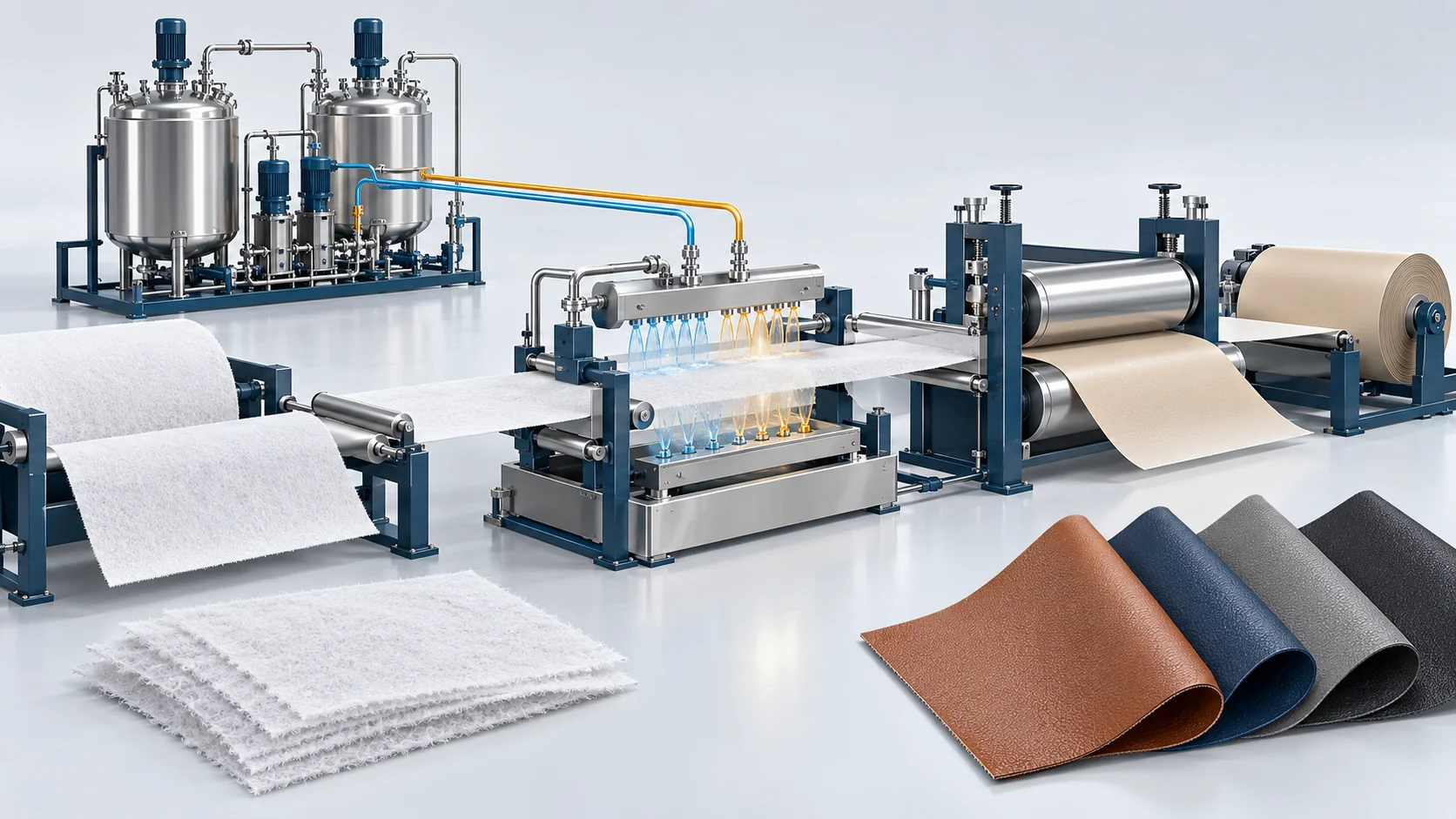
Solvent-Free Microfiber Suede Solution
Coordinate solvent-free reactive PU impregnation and calendering for the selected microfiber substrate.
Extreme Mechanical Toughness for Luxury Automotive Microfiber Suede
Reactive microfiber impregnation links substrate preparation, component conditioning, mixing, application and nip control. A calender force does not by itself prove complete penetration or prevent a dry core. Tear resistance and odor belong to the finished suede construction and its test conditions.
Defined supply scope
Define the metering/application package, calender, cure and finishing. Solvent-free formulation does not establish odorless material or automatic OEM acceptance.
Inputs for process selection
Microfiber data, moisture, resin, wet pickup, nip/cure conditions, final hand and tear/odor test requirements.
Equipment scope, retained factory interfaces and acceptance are agreed for the selected material and part. Define the metering/application package, calender, cure and finishing. Solvent-free formulation does not establish odorless material or automatic OEM acceptance.
Solvent-Free Microfiber Suede Workflow
Prepare the microfiber → Prepare and deliver the PU → Impregnate and calender → Cure and inspect. Define preparation, filling, cure and output timing separately for the selected configuration.
Prepare the microfiber
Confirm fineness, mass, moisture and structure.
Prepare and deliver the PU
Validate conditioning, ratio and usable reaction window.
Impregnate and calender
Establish application and nip conditions without damaging the substrate.
Reference Solution Engineering Envelope
Existing configuration and test references. Equipment settings, material results and finished-assembly results are separate; apply each value only to its documented configuration and conditions.
| Parameter | Value / Unit | Applicable Configuration / Conditions |
|---|---|---|
| Calendering Nip Clamping Force | Up to 150 kN (Hydraulic linear compression) | Precision ground hardened steel rolls with thermal oil heating |
| Supported Microfiber Fineness | Down to 0.05 Denier | Sea-island needle-punched nonwoven synthetic fleece |
| Finished Suede Tear Strength | Greater than or equal to 1.5x Natural Leather | ISO 3377-2 testing (≥ 120 N vs 80 N genuine leather) |
| Automotive Interior Odor Rating | VDA 270 Grade ≤ 2.5 (Tested at 65°C) | 100% solids solvent-free formulation with zero DMF |
| Continuous Line Working Speed | 3.0 to 15.0 m/min | Synchronized roll-to-roll servo drive system |
| Working Web Width Envelope | 1,400 to 1,600 mm | Dual-die slotted manifold on heavy-duty machine bed |
Core Equipment for This Solution
Equipment references are selected by their documented process. Main metering, auxiliary supply and alternative routes are not a single standard package.
Process controls and application checks
Evaluate these functions with the selected material, tooling and production brief. Finished-part results require their own acceptance evidence.
Substrate-matched impregnation
Develop resin delivery and nip conditions for the actual fiber network.
Defined uniformity checks
Inspect core and cross-web distribution rather than assuming full penetration.
Comparable material tests
Use stated specimens and conditioning for tear and odor comparisons.
Related Projects
These are related application references. Compare the actual material, process and delivered modules; reported project figures are not acceptance results for another line.
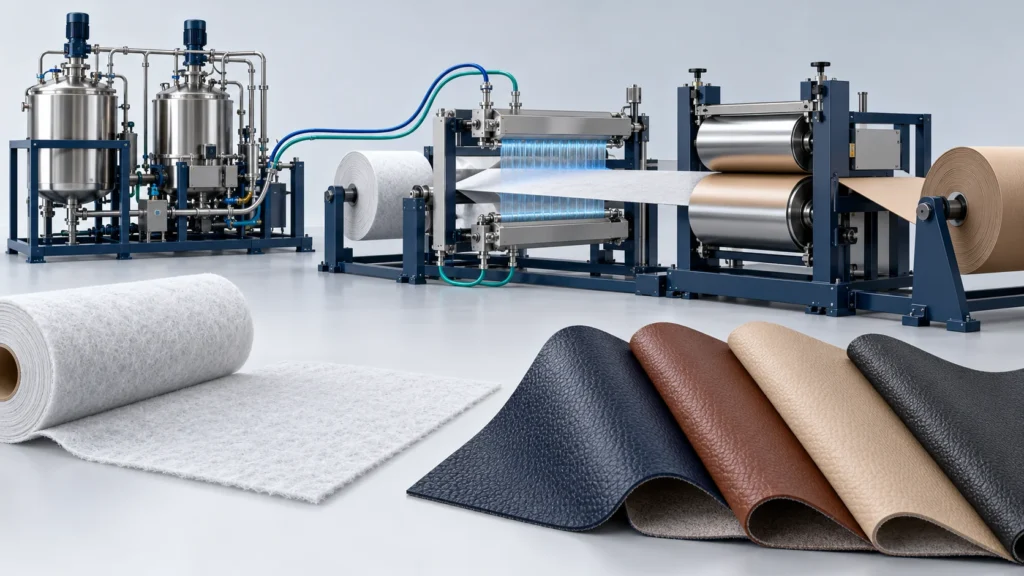
Production Planning FAQ
Selection, supply scope and validation for this production route.
Does nip force establish full impregnation?
Does solvent-free processing guarantee OEM odor approval?
What information is needed for a preliminary configuration?
Discuss Your Production Goals
Share the following with your production brief: Microfiber data, moisture, resin, wet pickup, nip/cure conditions, final hand and tear/odor test requirements. Our team will reply within one business day. Once requirements are clear, we provide a preliminary proposal within two business days.


