
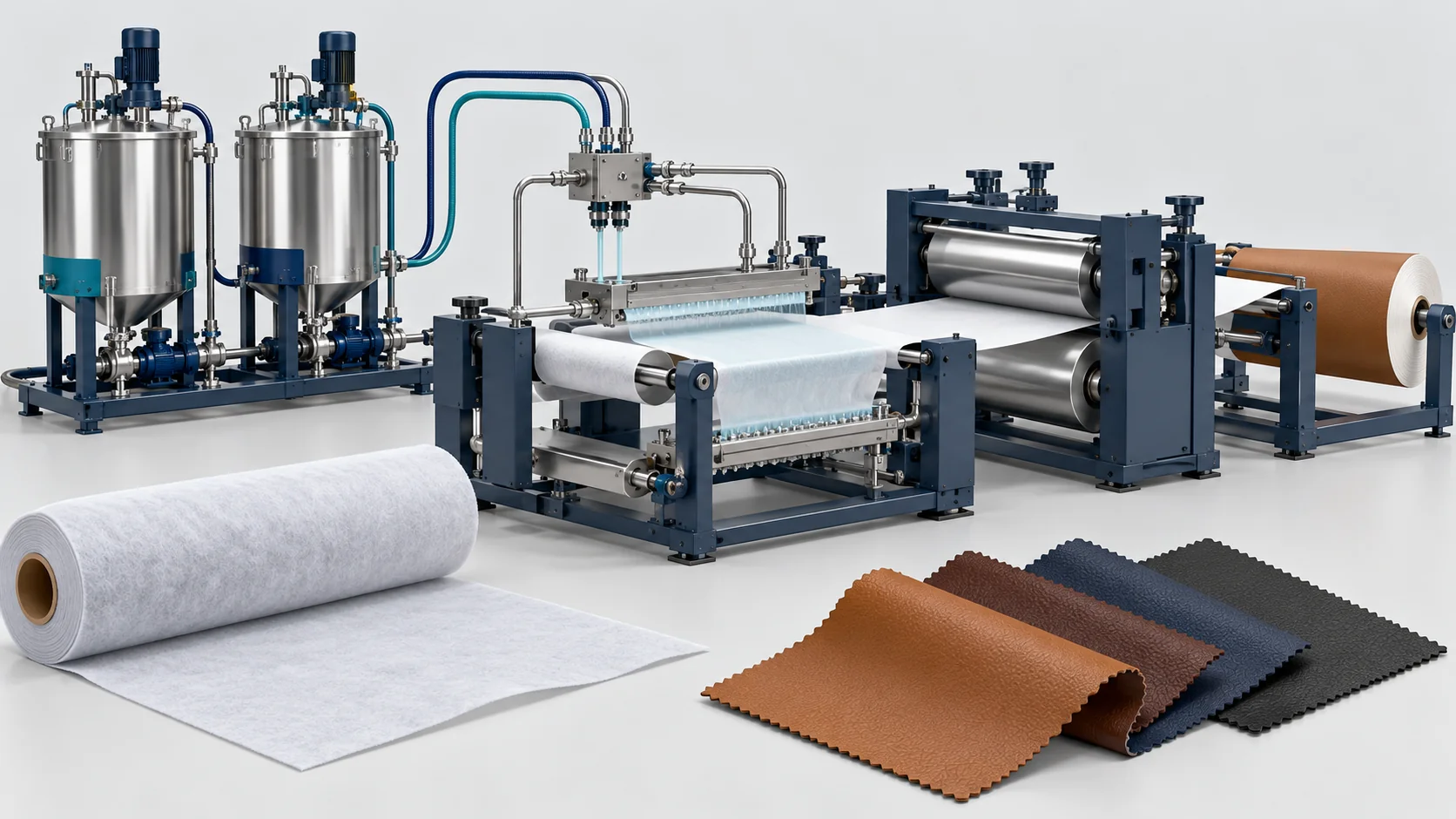
Solvent-Free PU Impregnation Line | Microfiber Leather
Two-component reactive impregnation and coordinated calendering for microfiber synthetic-leather substrates.
Deep Solvent-Free Impregnation for Luxury Suede-Feel Microfiber
Two-component reactive impregnation and coordinated calendering for microfiber synthetic-leather substrates.
Two-component reactive impregnation and coordinated calendering for microfiber synthetic-leather substrates.
Conditioned resin streams, metering/mixing, double-sided impregnation and calendering interfaces. Microfiber substrate, selected formulation, drying/curing and finishing scope are confirmed separately.
150 kN is a total roll/nip force, not pressure or force per unit width; assess roll geometry and loading separately. Penetration into fine fibers, tear comparison and odor results depend on the complete material system. Solvent-free formulation is not a universal zero-emission or exposure claim.
Concept illustration: Generated concept illustration for process discussion; not a photograph of the specified machine, a customer facility or a delivered project.
Material Flow and Working Principle
Nonwoven Surface Desiccation & Infeed Tensioning
Needle-punched sea-island microfiber nonwoven fleece (0.05D) unrolls through heated pre-drying cylinders to reduce moisture under 0.2% before impregnation.
Vacuum Degassed Chemical Conditioning
Two-component solvent-free polyols and isocyanates are degassed below 0.05 kPa in 200 L jacketed tanks and metered at 1:1 ratios via high-pressure servo gear pumps.
Double-Sided Enclosed Slotted Impregnation
The fleece passes between twin opposed slotted extrusion dies that inject low-viscosity 100% solids reactive polyurethane simultaneously onto both fabric faces.
High-Pressure Hydraulic Calendering Micro-Penetration
The wet composite passes through heated precision-ground steel rolls under 150 kN hydraulic linear force, driving liquid polyurethane deep into the 0.05D fiber bundles.
Thermal Drum Step-Curing & Suede Buffing Winding
The saturated composite crosslinks across large thermal oil drums (120°C) before cooling, inspection, and transfer to sea-island alkali extraction and buffing lines.
Model and Technical Parameters
Supplied HF-SFI160-DB configuration references, pending original calibration and acceptance documents. Material, finished-part and project outcomes are separate from equipment ratings. 150 kN is a total roll/nip force, not pressure or force per unit width; assess roll geometry and loading separately. Penetration into fine fibers, tear comparison and odor results depend on the complete material system. Solvent-free formulation is not a universal zero-emission or exposure claim.
| Technical Parameter | HF-SFI160-DB |
|---|---|
| Components | 2 Components (A: Solvent-Free Polyol, B: Polymeric Isocyanate) |
| Output Range (g/s) | 1.0 to 12.0 kg/min (Continuous double-sided delivery) |
| Mixing Ratio Range | 100:80 to 100:120 (By weight) |
| Ratio Accuracy | ±0.2% (Continuous Coriolis mass flow tracking) |
| Power Supply | 380V, 3-Phase, 50Hz (Custom 440V/480V 60Hz optional) |
| Working Pressure | 0.5 to 0.8 MPa (Chemical lines and injection slots) |
| Tank Capacity (L) | Day tanks: 2 x 200 L (Stainless steel with vacuum/heat jacket) |
| Weight | 11,500 kg (Impregnation coater and hydraulic calendering unit) |
| Dimensions (L×W×H) | 24,000 mm x 3,200 mm x 2,800 mm |
| Calendering Nip Clamping Force | Up to 150 kN (Hydraulic linear compression); Heavy-duty precision ground rolls; supplied reference pending original configuration or test records |
| Microfiber Fineness Capability | Down to 0.05 Denier (Sea-island fiber); Complete bundle core penetration; supplied reference pending original configuration or test records |
| Cured Matrix Tear Strength | ≥ 1.5x Genuine Leather (ISO 3377-2 test); Microfiber suede finished composite; supplied reference pending original configuration or test records |
| Continuous Line Working Speed | 3.0 to 15.0 m/min (Line-speed synchronized); Heavy nonwoven saturation; supplied reference pending original configuration or test records |
Key Equipment Features
Conditioned resin streams, metering/mixing, double-sided impregnation and calendering interfaces. Microfiber substrate, selected formulation, drying/curing and finishing scope are confirmed separately.
150 kN Hydraulic Deep Penetration
Supplied configuration reference: High-pressure calendering rolls drive 100% solids resin deep into dense 0.05D fiber bundles. Actual capability requires material and tooling validation.
Double-Sided Symmetrical Saturation
Supplied configuration reference: Twin opposed injection slots eliminate unbonded dry cores, ensuring uniform matrix density throughout. Actual capability requires material and tooling validation.
1.5x Tear Strength vs Natural Leather
Supplied configuration reference: Continuous interlocking with microfibers yields tensile and tear strengths 1.5 times higher than leather. Actual capability requires material and tooling validation.
100% Zero-Solvent Cleanliness
Supplied configuration reference: Replaces legacy DMF immersion tanks, achieving material-dependent emission control and VDA 270 Grade ≤ 2.5 interior ratings. Actual capability requires material and tooling validation.


