
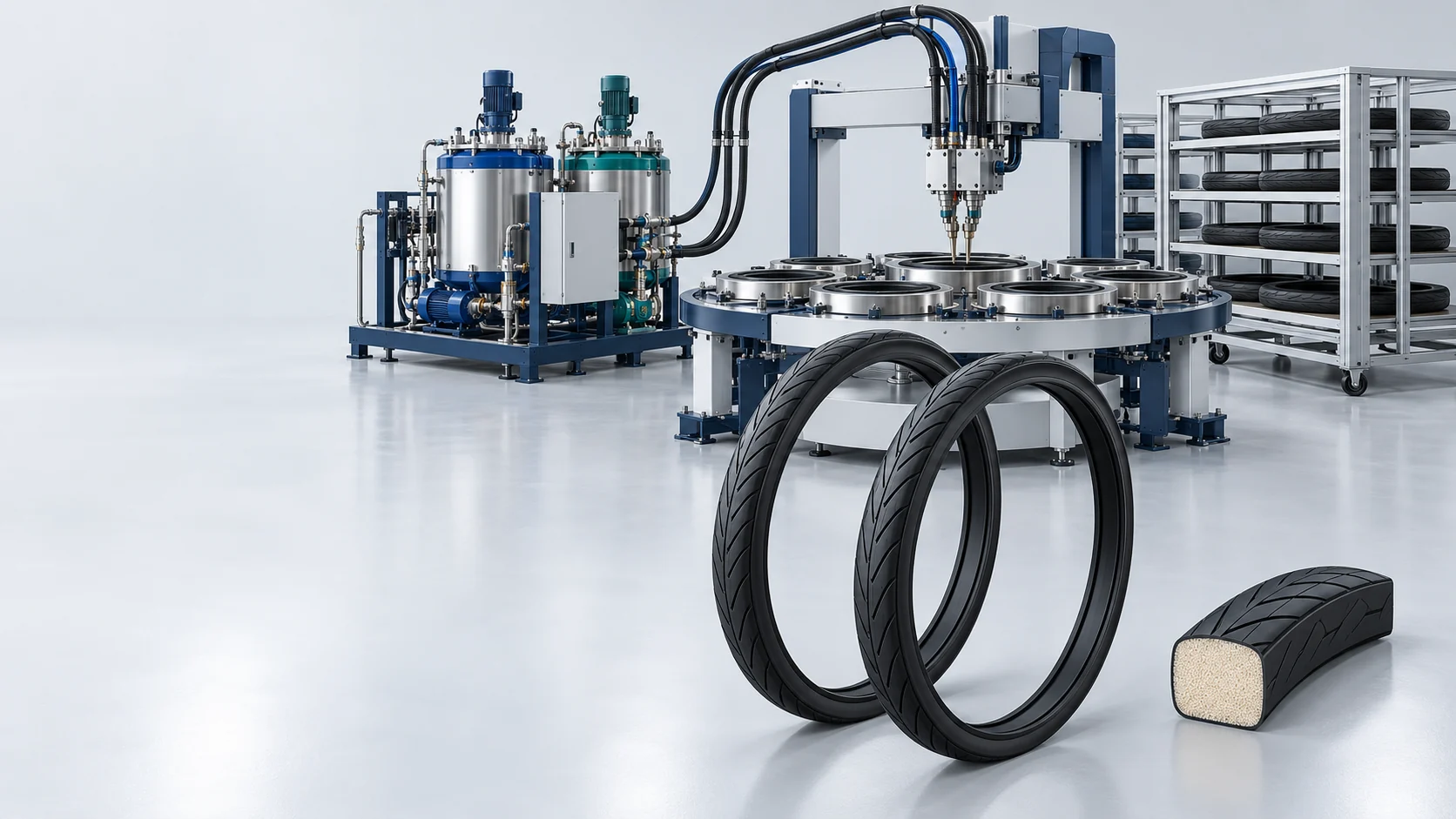
Solid PU Bicycle Tire Production Solution
Plan solid polyurethane bicycle tire production with material preparation, metering, mixing, mold filling and post-curing for your tire designs and output goals.
Automated Solid PU Bicycle Tire Molding
This route molds new solid polyurethane bicycle tires using material preparation, two-component metering and mixing, mold filling, curing and finishing. Select molds and formulations for the tire geometry, wheel interface and duty requirements. The reactive PU system and any blowing-agent route are confirmed from material-supplier data before equipment configuration.
Material Compatibility and Finished-Tire Testing
Confirm the selected reactive PU formulation, component ratio and processing window with the material supplier. Density, hardness, abrasion, rebound and puncture behavior are validated on representative finished tires; substance requirements are reviewed separately.
Flexible production, reducing costs and increasing efficiency.
The fastest cycle time is one minute per part, with a total changeover time of ≤1.5 hours. This compares to a semi-manual production line, which reduces overall energy consumption by 20% and material waste by 5-7%.
The existing 6000 hours operating reference requires its original equipment, test and failure-definition records; it is not a universal reliability commitment. Size the molded bicycle-tire operation from the actual tire mix, shot and mold population. Agree material trials and production validation as delivery activities, with commissioning and after-sales responsibilities defined in the project agreement.
Project implementation and validation workflow
These stages describe agreed development and delivery activities, not a completed customer installation or a machine operating cycle.
Performance testing of samples
Agree formulation-development and sample-trial work against the specified tire requirements. Review elasticity, hardness and abrasion tests before the quotation and configuration are finalized.
Factory site condition assessment and evaluation
Professional engineers conduct on-site assessments, gather data on tire sizes, annual production capacity, quality standards, and target export markets, and then develop customized handover layouts.
Laboratory formula validation process
Review the selected formulation and casting procedure through the agreed laboratory or sample trials before the design is finalized.
Technical specifications and performance analysis
The following represents a benchmark for the proposed solution: more than 6000 hours of operation under standard load conditions; final configuration will be determined based on tire specifications, materials, and production capacity, subject to a signed technical agreement between the parties.
| Parameter specifications | PU bicycle, solid tires, automated molding line |
|---|---|
| Applicable products | Urban commuting, mountain biking, folding bikes, children's balance bikes, shared bicycles. For solid PU tire construction. |
| Evenness of mixing | ≥98% |
| Production rate | Single-cavity mold: 1.5-2 minutes per piece; Multi-cavity linkage: as fast as 1 minute per piece |
| Annual production capacity | 80,000 - 120,000 per year |
| Reference acceptance rate | ≥98% (based on standardized molding + reference values from formulation control) |
| Waste rate of raw materials | 5-7% (as a reference for normal operating conditions) |
| Total mold replacement time | ≤1.5 hours; Similar specifications within the same series ≤1 hour |
| Temperature control accuracy | Foaming, post-curing temperature tolerance: ±1°C |
| Comparison of energy consumption | Compared to traditional hand-crafted foam production, this process reduces overall energy consumption by 20%. |
| Formulation system | Selected reactive polyurethane system; component ratio, processing window and any blowing-agent route confirmed from material-supplier data |
| Configuration settings | Integrated performance testing: foam density, hardness, resilience, and puncture resistance testing. |
| Equipment reliability | Under standard operating conditions, stable and reliable operation for more than 6000 hours. |
| Adaptability | Support the existing semi-manual workshop with modular upgrades and renovations. |
| Compliance assistance | Assist with compliance to EN ISO 4210, ETRTO, and REACH SVHC regulations. |
| Contents of delivery | Key process scheme, two-component dispensing foam machine, one-piece casting mold, post-curing and testing unit, on-site installation and commissioning, formulation process, personnel training, and long-term spare parts supply. |
| Warranty Information | Executed in accordance with the terms of the formal contract and the technical agreement. |
Equipment for Haifeng Automation Turnkey Production Solution for Polyurethane Solid Bicycle Tires
The bicycle-tire metering unit and automatic tire-line reference describe different supply levels. Identify the selected main unit, mold handling and any retained equipment.
Low-Pressure PU Foaming Machine | Bicycle Solid Tires
Low-Pressure PU Foaming Machine for Bicycle Solid Tires. Review configuration, material requirements and process interfaces with Haifeng.
Automatic PU Tire Production Line | Bicycle Solid Tires
A 24-station PU tire production configuration with metering, indexed tooling, curing and demolding. Timing follows the validated tire and mold setup.
Key advantages of the plan
Material preparation, metering, molding and finished-tire validation configured for the selected solid polyurethane tire.
Material-Specific Process Configuration
Match material preparation, metering, mixing and curing to the selected reactive PU system. Finished-tire properties and applicable substance requirements use their own agreed test and supplier records.
Precise temperature control, ensuring consistent product quality.
Achieving a uniformity of ≥98%. PLC centralized dynamic temperature control, with a temperature tolerance of ±1°C, reducing variations in foam density and batch consistency, resulting in a final product pass rate of ≥98%.
Efficient, flexible, and rapid re-manufacturing
Fastest multi-module change: single module change in 1 minute; full set of module changes within 1.5 hours; same series specifications within 1 hour; supports mixed-batch orders with various specifications.
Modular upgrades to enable export compliance
An existing, traditional workshop can be modularly adapted to preserve existing assets. This adaptation can also facilitate compliance with EN ISO 4210, ETRTO, and REACH SVHC regulations, opening up access to international markets.
Related Projects
Use the bicycle-tire case as the main application reference; adjacent wheel projects illustrate processing experience rather than the same tire duty.
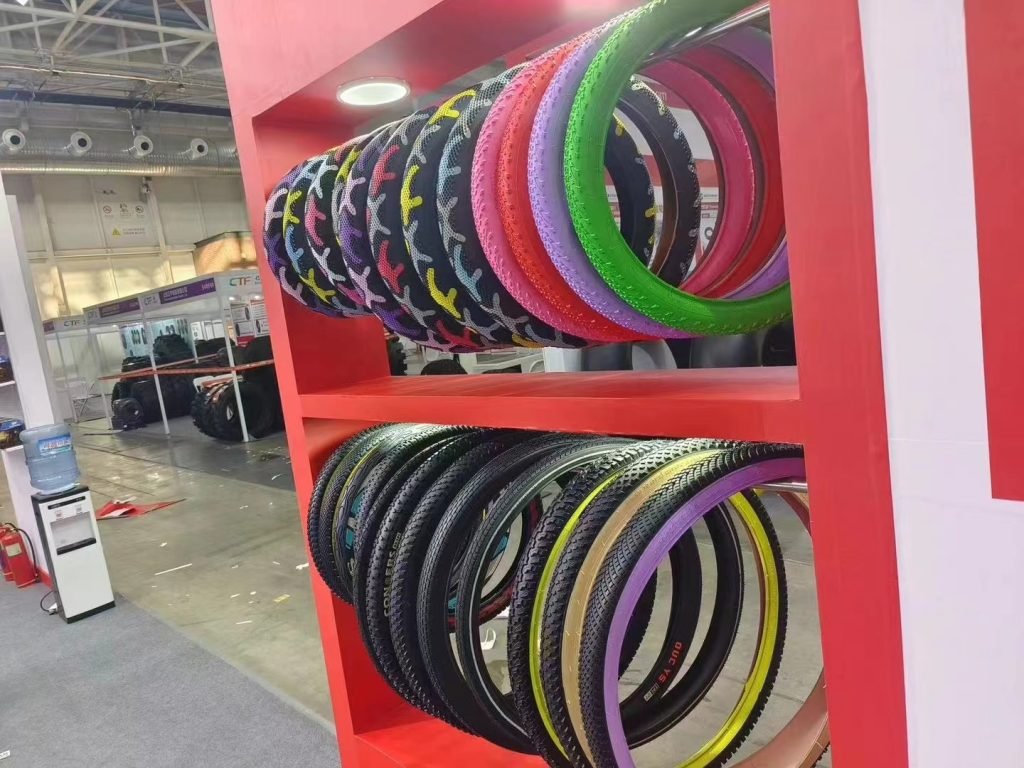
E-Bike and Bicycle Solid PU Tire Production Line Upgrade Project in China
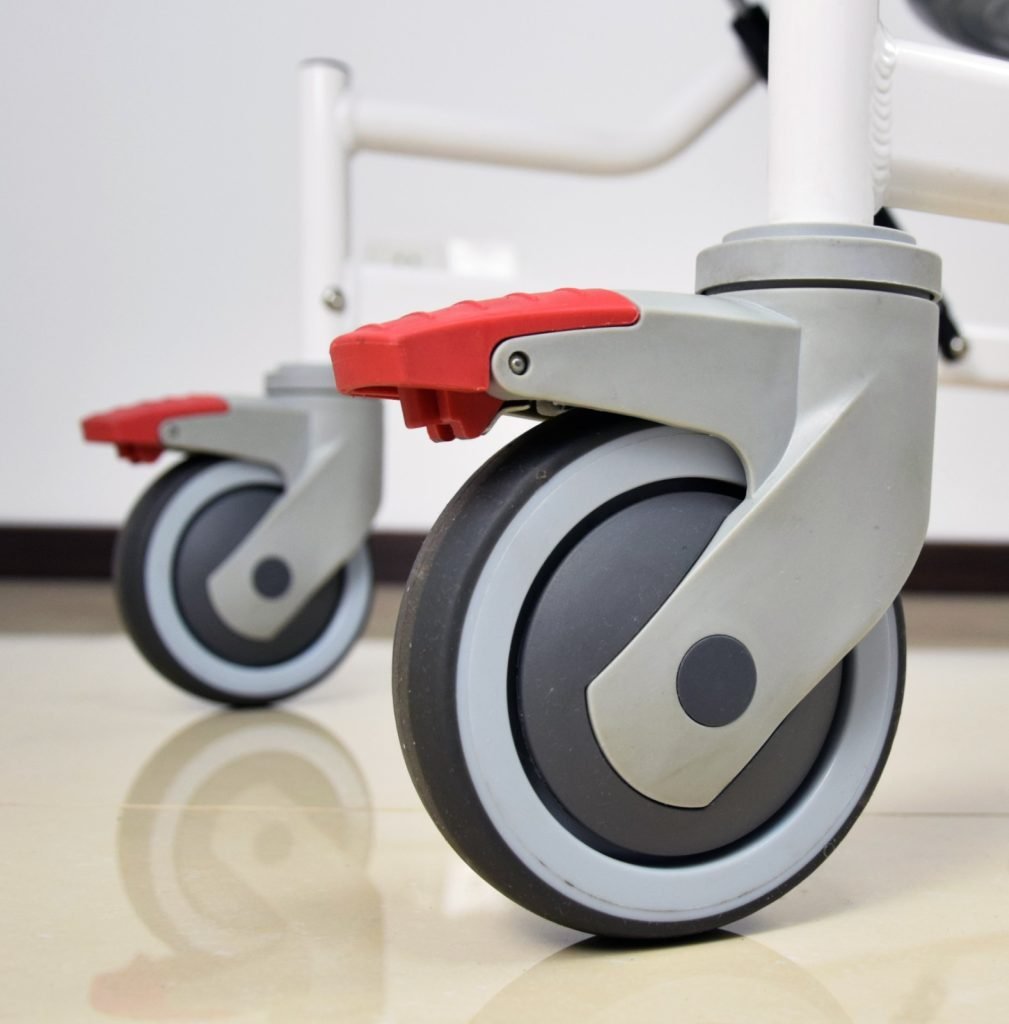
Medical Caster and AGV PU Wheel Production Line Upgrade Project in China
Production Planning FAQ
Selection, supply scope and validation for this production route.
Is this tire molding or filling an existing casing?
What information is needed to select the formulation?
How is production capacity calculated?
Does the equipment establish bicycle or tire qualification?
Does this page specify water-based or water-blown PU?
How do multiple molds and product changes affect shift output?
Discuss Your Solid PU Bicycle Tire Line
Share the following for this application: Tire and rim drawings, shot mass, formulation, molds and cavities, color changes, working hours and output targets. Our team will reply within one business day. Once requirements are clear, we provide a preliminary proposal within two business days.


