
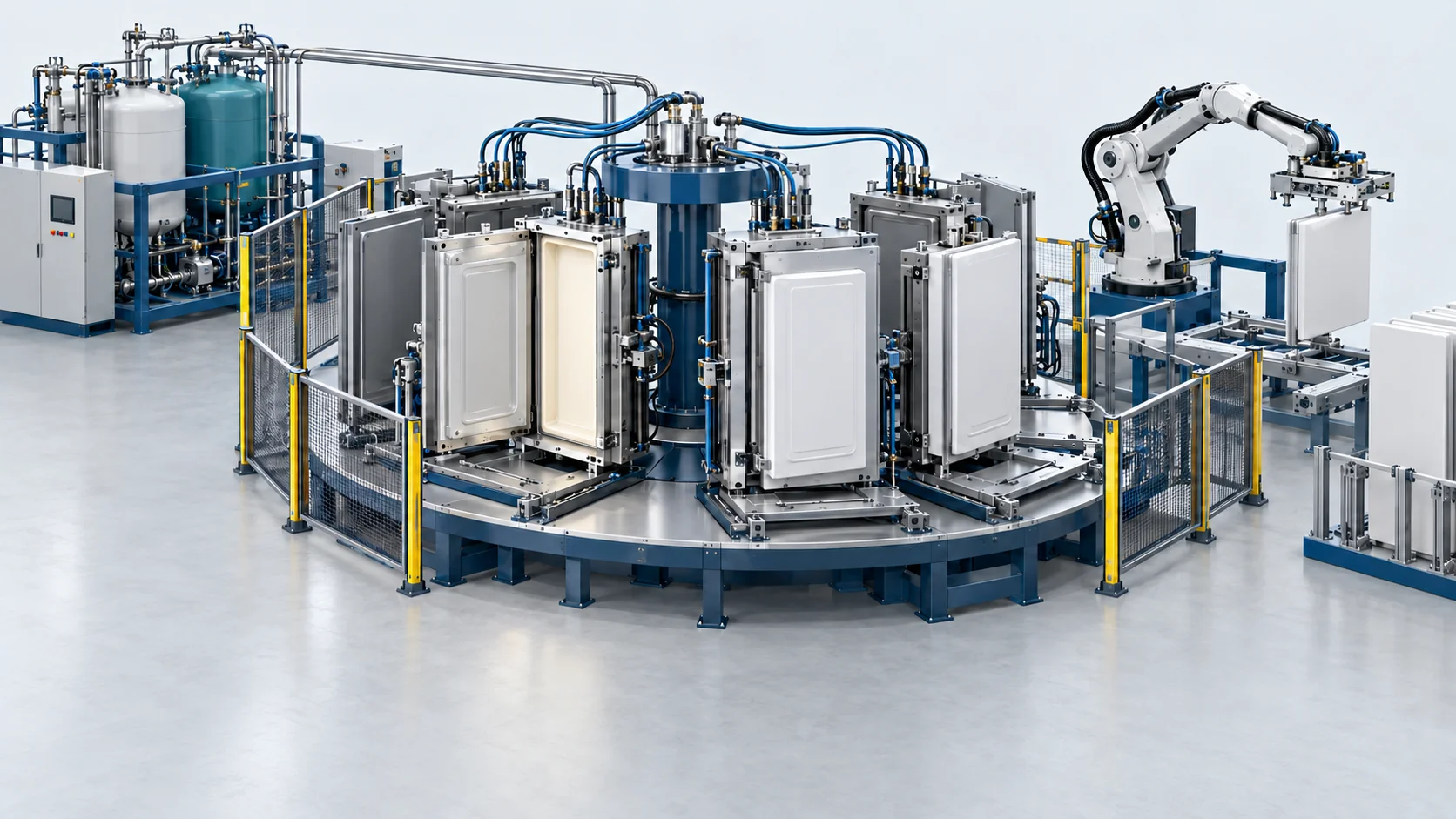
Rotary Refrigerator Door Foaming Solution
Configure refrigerator door injection, indexed fixture handling, thermal control and robotic interfaces around door geometry and the required production rate.
Extreme Throughput & Footprint Efficiency for Refrigerator Doors
Configure refrigerator door injection, indexed fixture handling, thermal control and robotic interfaces around door geometry and the required production rate. The described package combines high-pressure feed and mixing with an eight-position rotary fixture, temperature circuits and loading/unloading interfaces. Tooling, panel materials, cyclopentane safety controls and utility connections are defined for the project.
Product, material and tooling
The described package combines high-pressure feed and mixing with an eight-position rotary fixture, temperature circuits and loading/unloading interfaces. Tooling, panel materials, cyclopentane safety controls and utility connections are defined for the project.
Capacity and acceptance
Review all preparation, dispensing, curing, handling and inspection stages. Material and component results require separate original test records.
Configuration references are reviewed for the selected material, product geometry and acceptance conditions. A 1.4 kg shot in 2.4 s implies 35 kg/min, below the supplied 60–180 kg/min range. Five curing index positions at 18 s give 90 s, not the claimed 140 s; confirm station count and residence. The 18×12 m footprint is 216 m², whereas the summary rounds to 220 m².
Turnkey Vertical Rotary Door Foaming Process
The supplied process sequence is a configuration reference. Temperature, pressure, output and cure settings are confirmed for the selected material and tooling. A 1.4 kg shot in 2.4 s implies 35 kg/min, below the supplied 60–180 kg/min range. Five curing index positions at 18 s give 90 s, not the claimed 140 s; confirm station count and residence. The 18×12 m footprint is 216 m², whereas the summary rounds to 220 m².
Robotic Infeed & Vacuum Shell Positioning
Configured reference: Articulated robots place metal door skins and plastic liners into the open platen at Station 1, using vacuum suction to eliminate shifting.
High-Speed Gantry Impingement Injection
Configured reference: A high-pressure impingement head traverses over open door cavities, injecting cyclopentane-polyurethane at 16.5 MPa in 2.5 seconds.
Hydraulic Fast Lock & Vertical Indexing
Configured reference: Mold platens clamp shut under 300 kN force within 3.0 seconds, and the 8-station drum indexes by 45 degrees into the vertical curing arc.
Reference Solution Engineering Envelope
Values transcribed from the supplied configuration brief. Material properties and finished-product benchmarks are separate validation targets, not general equipment guarantees.
| Parameter | Value / Unit | Applicable Configuration / Conditions |
|---|---|---|
| Single-Door Production Tact Time | Less than or equal to 18 seconds | Finished door output per indexing cycle; supplied reference requiring configuration or test verification |
| Plant Floor Space Footprint | Approximately 220 m² | 60% reduction vs 550 m² horizontal floor carousel; supplied reference requiring configuration or test verification |
| Chemical Injection Flow Rate | 60.0 to 180.0 kg/min | High-pressure servo axial piston proportioning skid; supplied reference requiring configuration or test verification |
| Foam Density Variance | Within ±0.8 kg/m³ | 12-point multi-position density testing across door; supplied reference requiring configuration or test verification |
| Hydraulic Mold Clamp Tonnage | 300 kN per station | High-strength toggle mechanism resisting foam pressure; supplied reference requiring configuration or test verification |
| Maximum Door Dimensions | 2,000 mm x 900 mm | Multi-model adjustable aluminum tooling platens; supplied reference requiring configuration or test verification |
Core Equipment for This Solution
The linked pages describe shared preparation or feed-system families, not proof of delivery of the dedicated models listed in the case. The described package combines high-pressure feed and mixing with an eight-position rotary fixture, temperature circuits and loading/unloading interfaces. Tooling, panel materials, cyclopentane safety controls and utility connections are defined for the project.
Cyclopentane PU Foaming Machine | Refrigerators and Freezers
The HF-CP200-HP is an explosion-proof high-pressure polyurethane foaming machine engineered for precision cyclopentane premixing and uniform insulation filling in domestic and commercial refrigeration lines.
Cyclopentane Safety and Premixing System | PU Foaming
Cyclopentane storage/feed, premixing or inline blending and monitoring interfaces configured for a PU/PIR panel line. The project schedule defines supply boundaries and equipment documentation.
Core Advantages of Haifeng Rotary Door Systems
Engineering functions and interfaces developed for the specified product and material system.
Indexed Fixture Handling
Configure and validate indexed fixture handling for the selected product, formulation, tooling and production conditions.
Door Injection Control
Configure and validate door injection control for the selected product, formulation, tooling and production conditions.
Rotary Temperature Circuits
Configure and validate rotary temperature circuits for the selected product, formulation, tooling and production conditions.
Line Balance Engineering
Configure and validate line balance engineering for the selected product, formulation, tooling and production conditions.
Related Project Draft
Review the project configuration described in the supplied brief. Project records and reported results require verification before public use.
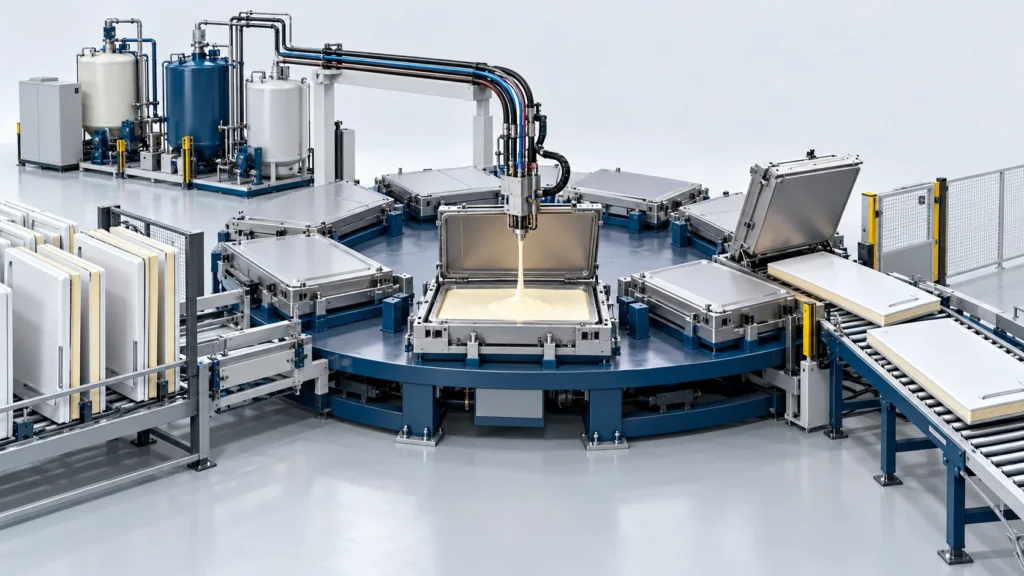
Frequently Asked Questions
Technical questions to establish the equipment scope, material window and validation plan.
How is the rotating fixture balanced?
What is required for glass-faced door tooling?
How is temperature control supplied to rotating molds?
How are injection and curing stages balanced?
Request a Rotary Door Foaming Line Proposal
Share your finished product or drawing, material system, target capacity, automation requirements and factory conditions to discuss the line configuration.


