
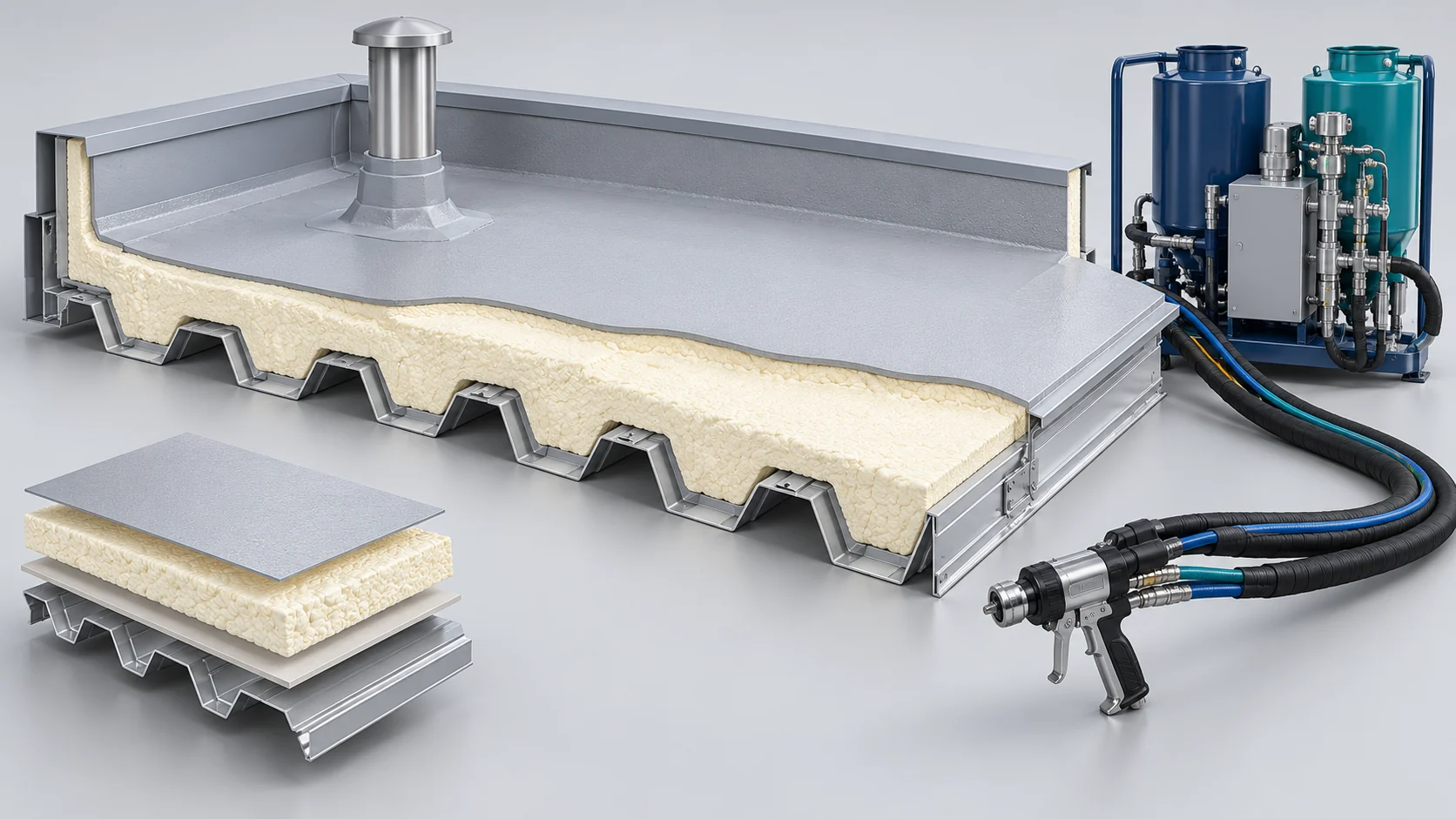
Roof Spray PU Foam Insulation Solution
Plan SPF roof-insulation equipment with material conditioning, spraying and protective-coating interfaces configured for the roof assembly, substrate and application conditions.
Monolithic High-Pressure Spray Polyurethane Foam Solutions for Industrial Roofs
Configure SPF spraying and the specified protective-coating interfaces for the roof assembly. Substrate condition, drainage, penetrations, flashings, wind resistance and maintenance are reviewed as part of the complete roofing system.
Roof Preparation and Detailing
Review moisture, deck condition, drainage, penetrations, flashings and fixing repairs before application. Insulation foam is combined with the specified protective finish.
Material and Equipment Matching
Select the formulation, pass thickness, conditioning and equipment pressure-flow duty together. Coating compatibility and recoat conditions follow the specified roofing system. Specify the blended-polyol grade, isocyanate grade, processing viscosity and reaction window before selecting the proportioner, heating duty and spray gun. A free-rise foam datasheet does not establish installed roof density or the performance of the finished roofing assembly.
Compare Related Production Routes
Define the complete roof build-up before choosing spray equipment. Survey substrate condition, drainage, penetrations, flashing and access, then select foam thickness and its protective finish. Material cream time, recoat and roof release are different stages.
Production Workflow for Roof Spray Polyurethane Foam Insulation Line
The sequence is configured for the selected application and material. Temperatures, pressures, reaction timing and pass thickness are reference conditions reviewed through project trials.
Roof Deck Cleaning & Moisture Verification
The metal or concrete substrate is swept, oil-degreased, and checked with moisture meters; loose rust is treated to secure high chemical bonding strength.
Proportional Fluid Heating & Recirculation
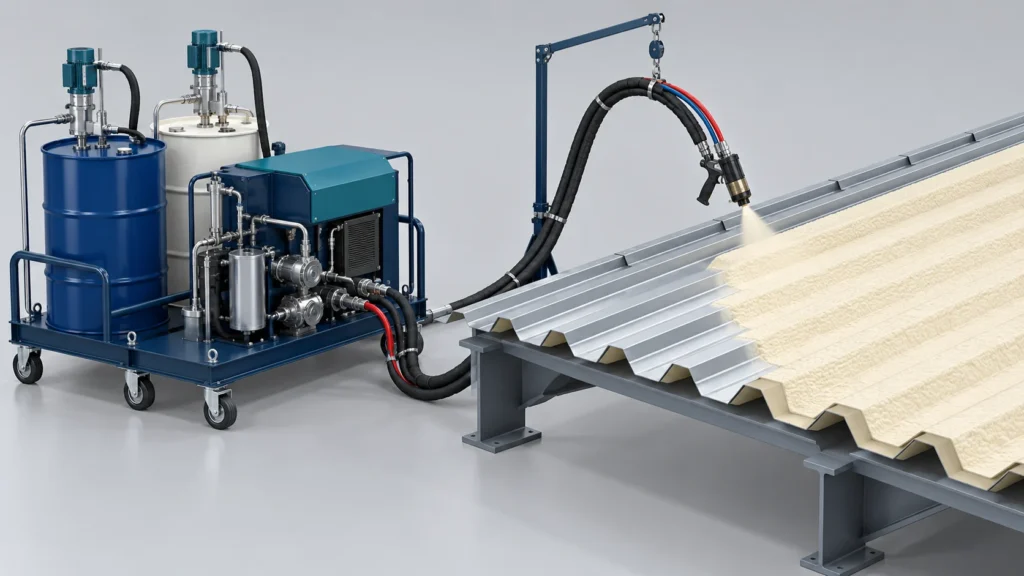
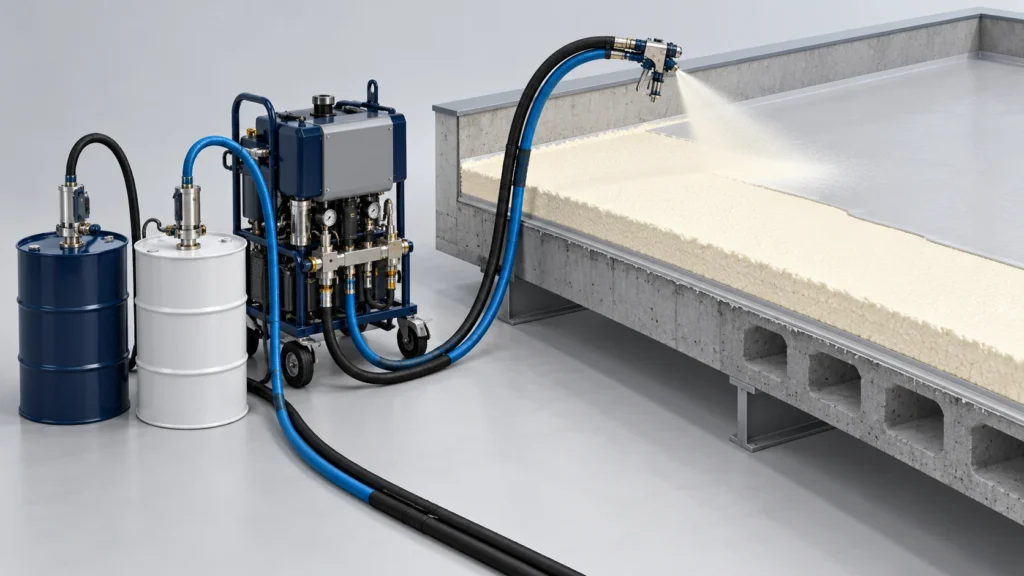
Prepare polyol A and isocyanate B in separate circuits. Check their operating viscosity and temperatures, verify component delivery, then condition the selected hoses and gun for a representative spray trial. Material setpoints and hose reach follow the selected formulation and equipment limits.
High-Pressure Impingement Atomization
Apply the selected formulation through a compatible impingement spray gun. Pressure, flow and pass conditions are checked for the equipment; cream time is separate from full cure.
Technical Specifications
Supplied application and equipment references for configuration review. Material properties, operating conditions and acceptance tests are agreed for the selected project.
| Technical Parameter | Supplied Reference / Configuration | Engineering Context & Verification |
|---|---|---|
| Target Application | Industrial Roofs, Logistics Warehouses, Vaulted Ceilings | Commercial roof thermal envelope & waterproofing |
| Material Matrix | Rigid Closed-Cell Polyurethane Foam (SPF) | High-index MDI and polyol formulation |
| Core Foam Density | 40 – 50 kg/m³ (Roof grade) | Supplied material reference; traffic and roof loads assessed for the complete assembly |
| Thermal Conductivity (λ) | 0.020–0.022 (supplied reference) W/(m·K) | Thermal test method, mean temperature, conditioning and aging to be agreed |
| Closed-Cell Content | ≥95% | Supplied cell-content reference; water absorption and roofing-system performance assessed separately |
| Proportioner Fluid Output | 8 – 18 kg/min | Variable hydraulic pumping displacement |
| Max Fluid Pressure | Up to 200 bar (2900 psi) | Configuration-dependent maximum; confirm selected model and flow at operating pressure |
Reference Haifeng Insulation Equipment
HF-SP03 and HF-SP02 are reference spray products with different pressure-flow and hose ratings. Review the required foam or coating material and application duty before selecting a product configuration. The insulation and waterproofing spray references need the actual material, gun, heated hose and coating duty defined separately.
PU Spray Machine | Cold Storage Insulation
PU conditioning and spraying for cold-storage insulation, with formulation, substrate, hose delivery and site conditions reviewed.
PU Spray Machine | Building Waterproofing
PU spraying equipment designed for waterproofing engineering, delivering high adhesion and seamless membrane formation. Ideal for roof, tunnel, and basement waterproofing in building and infrastructure projects.
Key Engineering Advantages
Application-specific process controls, tooling and equipment integration.
Roof-System Detailing
Coordinate foam, protective coating, drainage, penetrations and flashings.
Thermal-Performance Planning
Review insulation thickness and thermal duty; energy savings depend on the building and operating baseline.
Wind-Resistance Review
Assess attachment, substrate and roof assembly against the project requirements.
Dead-Load Assessment
At 40–50 kg/m³ and 50 mm thickness, foam alone is approximately 2.0–2.5 kg/m²; include coatings and other layers in the roof load review.
Related Projects
Roof projects illustrate their particular substrate and build-up. Verify which surface preparation and protective layers were included before comparing performance.
Frequently Asked Questions
Compare production routes, material requirements, equipment configurations and project inputs.
Can SPF be applied over an existing roof?
Does foam alone provide a finished waterproof roof?
Can people walk on the finished roof?
How are the spray unit and hose selected?
What sets pass thickness and coating timing?
Can a blend-polyol datasheet define the installed roof-foam density?
What site utilities should be checked before selecting the spray unit?
What inputs are needed for this configuration?
What information is needed beyond roof area?
Discuss Your Insulation Equipment and Application
Share the following for this application: Roof survey, substrate/moisture, drainage and details, insulation/protective system, thickness, access and work-area plan. Our team will reply within one business day. Once requirements are clear, we provide a preliminary proposal within two business days.


