
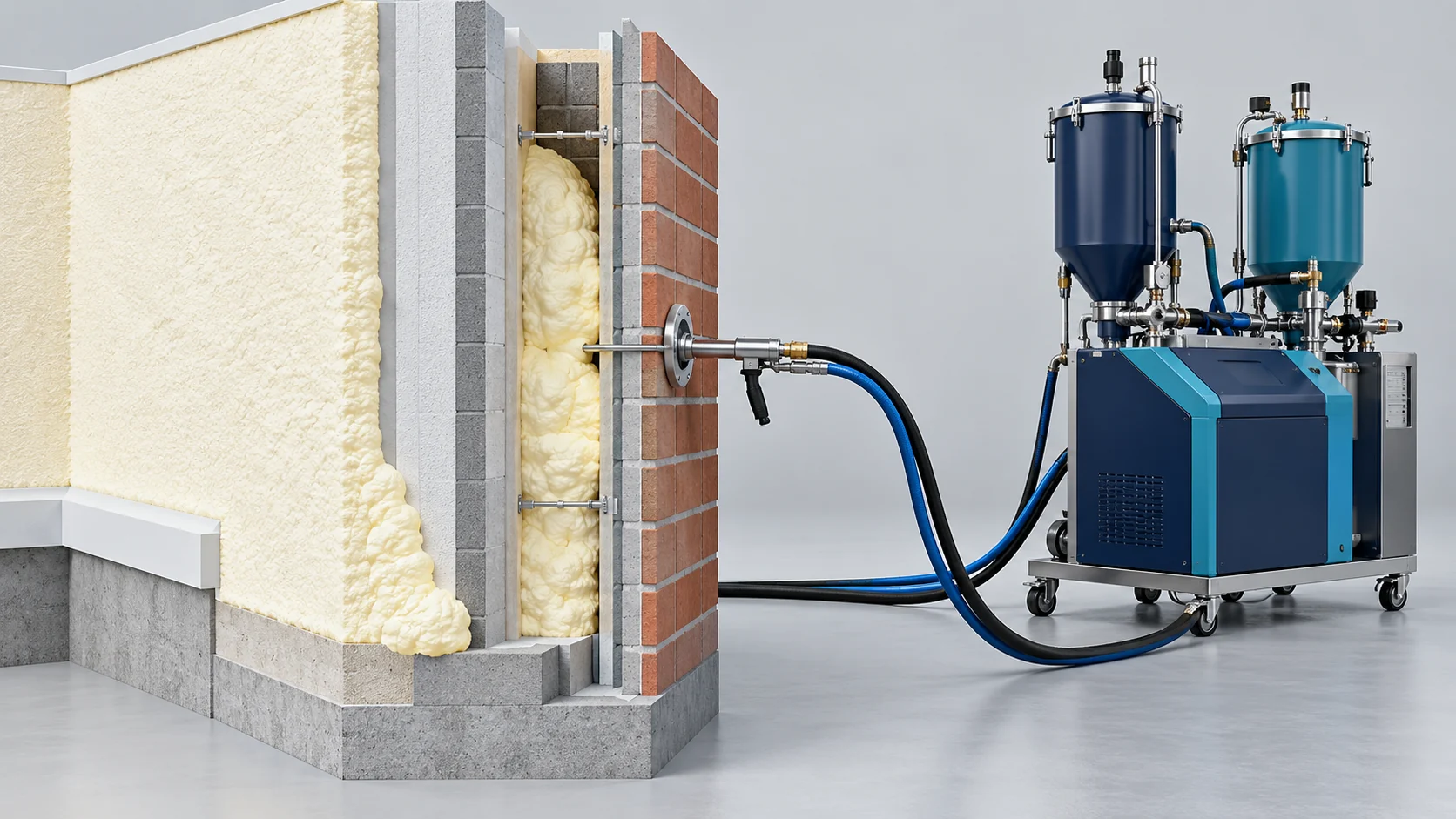
Building Cavity PU Foam Insulation Solution
Versatile high-pressure polyurethane spray and cavity injection systems for exterior walls and steel buildings, delivering continuous, airtight thermal insulation.
Precision PU Spray & Cavity Injection Solutions for Building Envelopes
Exterior walls and prefabricated building envelopes require thermal resistance combined with structural wind-load durability. Mechanical board fastening methods leave unbonded air gaps that create wind draft channels, and eventually fail under negative wind-suction loads. Haifeng’s building envelope polyurethane solution provides dual functionality: high-pressure exterior wall airless spraying for continuous thermal wraps, and closed-cavity pressure injection for double-skin pre-engineered steel buildings and masonry walls. Injected or sprayed foam expands in-situ, filling every micro-crevice to deliver an airtight envelope.
40% Thinner Wall Profile Engineering
Extremely low thermal conductivity (λ ≤ 0.022 W/(m·K)) achieves required building code thermal ratings at nearly half the thickness of mineral wool, maximizing indoor floor space.
Full Structural Composite Action
High-strength chemical adhesion (>0.3 MPa) bonds interior and exterior steel panels into a unified composite diaphragm, increasing facade stiffness against cyclonic winds.
Haifeng delivers complete mobile application systems—from dual-mode proportioners and multi-zone heated hoses to precision cavity injection probes—empowering commercial contractors to execute high-specification building envelope insulation. Haifeng provides equipment and process integration, on-site commissioning and operator training, a 1-year machine warranty and long-term spare parts support. Site construction and material supply follow the project delivery scope.
Production Workflow for Building Envelope PU Insulation Machine System
The workflow for Building Envelope PU Insulation Machine System covers Substrate Setup, Thermal Conditioning, In-Situ Application, Inspection & Seal. Confirm the sequence and equipment interfaces against the selected material system and product design.
Substrate Preparation & Injection Port Setup
For cavity injection, injection ports are drilled in predetermined grid patterns; for exterior spraying, the wall surface is cleared of dust and moisture-tested.
High-Pressure Precursor Thermal Conditioning
Dual proportioner heaters and heated hoses maintain polyol and isocyanate streams at 45°C–55°C, ensuring balanced viscosity and rapid cream-gel kinetics inside cavities.
Dual-Mode High-Pressure Spray or Cavity Injection
High-pressure impingement heads atomize chemicals for surface coats or inject timed liquid shots into wall cavities, allowing foam to expand and fill internal geometries.
Technical Specifications
Configuration and application values from the supplied engineering brief. Material properties and project results apply to their stated conditions.
| Technical Parameter | Standard Specification / Value | Engineering Context & Verification |
|---|---|---|
| Target Application | Exterior Building Walls, Steel Structure Wall Cladding | Vertical envelope thermal and acoustic protection |
| Material Matrix | Rigid Polyurethane (PUR) / Polyisocyanurate (PIR) | Formulation selected for the project |
| Core Foam Density | 35 – 45 kg/m³ | Optimized for thermal efficiency and lightweight |
| Thermal Conductivity (λ) | ≤0.021 – 0.023 W/(m·K) | ASTM C518 heat flow meter verification |
| Tensile Adhesion Strength | >0.3 MPa (To steel / concrete) | Tensile pull-off adhesion testing |
| Proportioner Fluid Output | 6 – 14 kg/min | Variable displacement for controlled cavity fills |
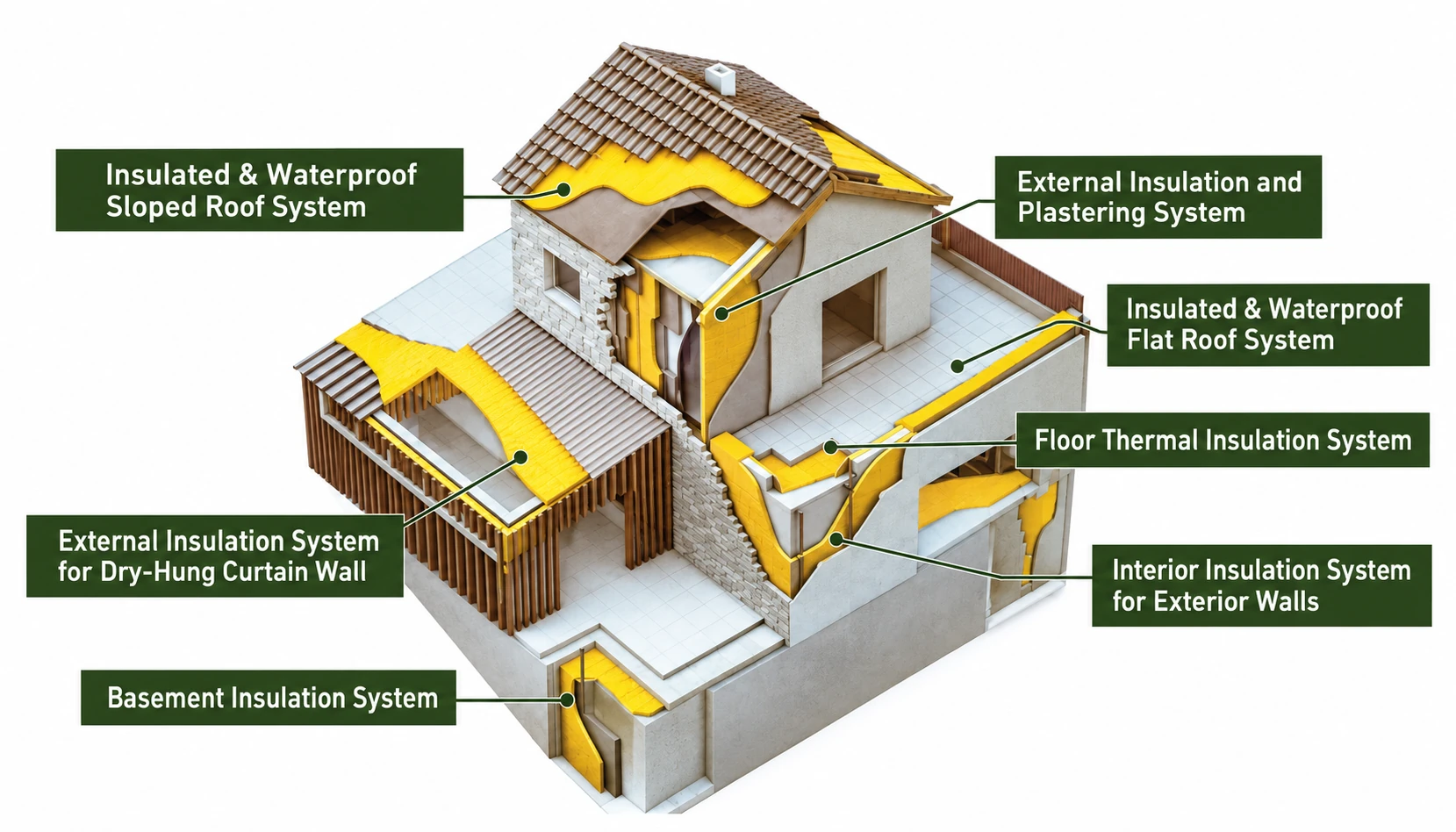
This cutaway locates thermal-insulation zones across a building envelope. It is an application-planning schematic, not verification of a particular material, spray method or completed customer installation.
Building Envelope Insulation Zones
Reference Haifeng Insulation Equipment
Listed equipment shows its current application configuration. The metering unit, hose, gun or injection head and optional modules are selected for this project.
Key Engineering Advantages
Application-specific process controls, tooling and equipment integration.
Zero Draft Cavity Fill
Liquid injection expands into every internal stud channel, completely halting convective draft heat loss.
40% Space-Saving Thin Profile
Delivers equivalent thermal insulation at almost half the thickness of traditional mineral fiber blankets.
Dual-Mode Application Versatility
Switches rapidly between open-wall airless spraying and closed-cavity port injection with simple nozzle changeouts.
Related Equipment Delivery and Application Cases
Review two supplied cases, their equipment delivery, implementation and application results.
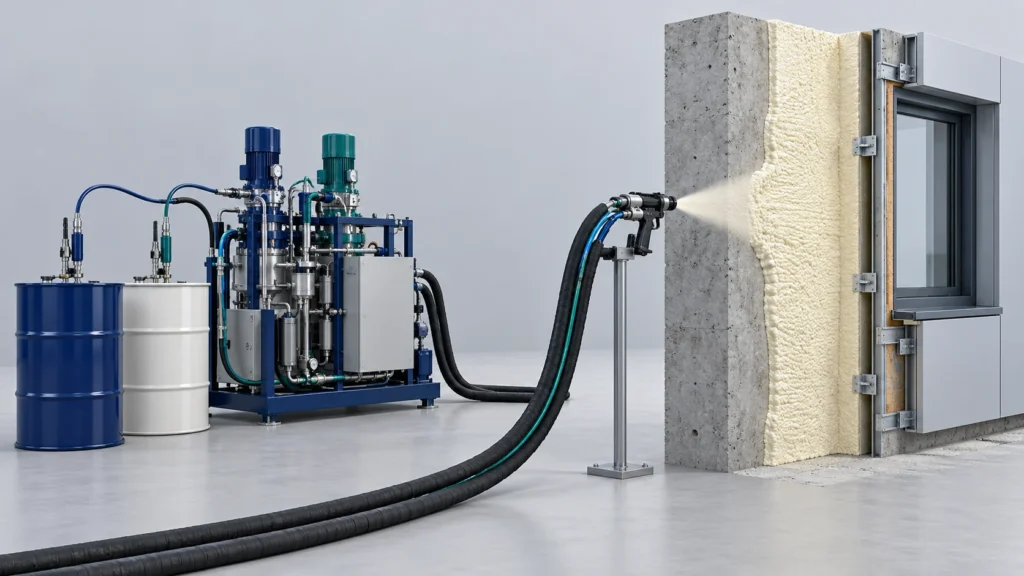
Commercial Exterior Wall PU Insulation Project in Brazil
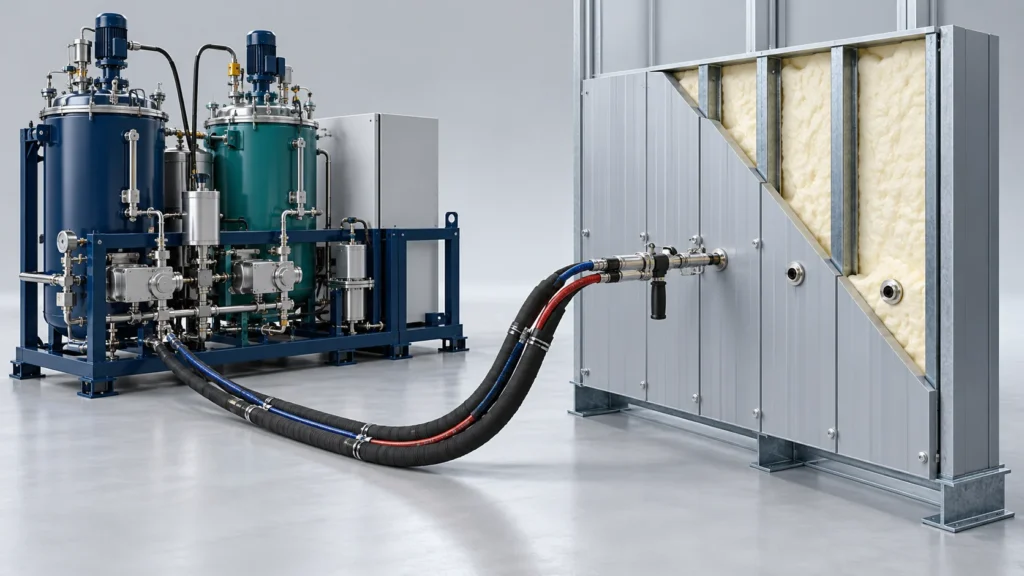
Steel Building Cavity PU Injection Line Project in China
Frequently Asked Questions
Process selection, site conditions and equipment integration.
How does cavity injection prevent wall panel blowouts from expansion pressure?
What is the advantage of spray PU over external wall insulation boards?
What is the typical installation and commissioning timeline on-site?
Discuss Your Insulation Equipment and Application
For Building Envelope PU Insulation Machine System, send finished-product drawings or samples, material data, target output, automation needs and factory conditions. Haifeng can use these inputs to discuss the line configuration and technical interfaces.


