
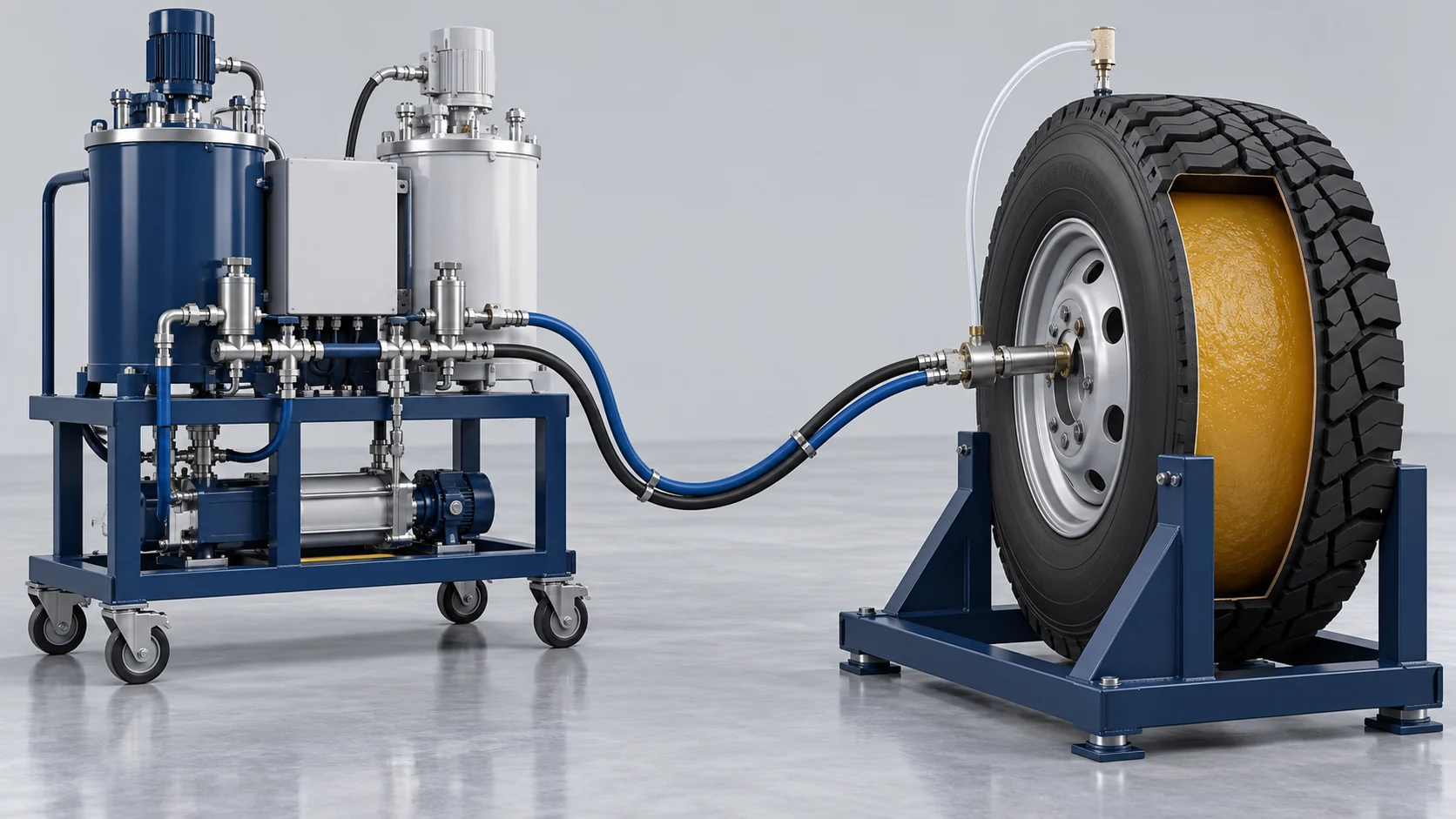
Pure PU Engineering Tire Filling Solution
Haifeng configures pure PU tire filling with two-component metering, controlled cavity filling and curing for puncture-resistant off-road tire assemblies.
Pure PU Engineering Tire Filling Solution
Replace the air space in an existing rubber tire casing with a two-component polyurethane filling system that cures inside the casing. This route preserves the tire tread and casing and is distinct from molding an entire polyurethane tire around a wheel center. Select the filling formulation and process around tire size, duty, load and service requirements.
Dedicated Cavity-Filling Route
Use the existing casing as the filling envelope. Do not apply high-pressure closed-mold tire-casting settings to this route.
Define the Assembly and Formulation
State tire and rim identity, load and speed conditions, formulation, ratio basis, material quantity and cure criteria in the technical specification.
Haifeng coordinates material delivery, the filling connection, controls and curing-workflow integration for the specified order. Delivery includes on-site commissioning, operator training, a 1-year machine warranty and long-term spare parts support.
From Material Preparation to the Cured Tire Assembly
Four coordinated stages for the selected tire, formulation and equipment configuration.
Casing and Wheel Preparation
Inspect the existing tire casing and rim and define the tire-specific pressure, material quantity and cure schedule. The workpiece is a tire/rim assembly, rather than a tire-shaping mold.
Two-Component Material Delivery
Condition and meter the two PU components to the selected formulation. The Haifeng reference unit lists an A:B ratio of 100:100; establish the ratio basis with the selected material system.
Tire-Cavity Filling
Mix and introduce the liquid filling into the existing tire cavity with a suitable filling connection and air-release arrangement. Control tire pressure to the casing and rim specification.
Equipment Reference and Application Inputs
Existing Haifeng equipment data are stated separately from tire-specific process settings.
| Parameter | Reference Value | Scope |
|---|---|---|
| Route | Two-component PU, without intentionally added rubber granules | Existing pneumatic tire casing |
| Reference Haifeng Model | HF-LPM-1A1B-OTR | Dedicated filling-equipment reference |
| Discharge Flow Rate | 300–1000 L/h | Equipment configuration; operating point is application dependent |
| Raw Material Mix Ratio | A:B = 100:100 | Equipment configuration; operating point is application dependent |
| Tank Volume | 30 L | Equipment configuration; operating point is application dependent |
| Total Motor Power | 2.2 kW | Equipment configuration; operating point is application dependent |
| Metering Accuracy | ±0.3% | Equipment configuration; operating point is application dependent |
| Working Pressure | 0–2 MPa | Equipment configuration; operating point is application dependent |
| Tire Filling Pressure | Set from tire/rim and application requirements | Distinct from mixing or equipment working pressure |
| Load Capacity | Specify per wheel and duty conditions | Do not derive a 12-ton rating from the filling machine |
| Cure Schedule | Selected PU material system data and release check | Time and temperature are formulation specific |
| Warranty | 1 year | Haifeng machine warranty |
Reference Haifeng Tire-Filling Equipment
Review the current equipment configuration, then define the application-specific filling integration.
Configuration Priorities
Define each control function around the tire and formulation.
Metering and Recipe Control
Specify the liquid components and ratio basis independently of any granule feed.
Separate Pressure Settings
Define the tire-cavity setpoint and the equipment operating limits separately.
Coordinated Filling Integration
Match the mixing, material path and filling connection to the liquid or particulate mixture.
Batch and Release Records
Record material batches, filled quantity, pressure and cure-release checks for each order.
Tire-Filling Questions
Key differences between tire filling and complete tire molding.
Is this the same process as molding a solid PU tire?
Can the pump working-pressure range be used as the tire filling pressure?
Is there one cure time for all PU filling formulations?
Does the filling machine give the tire a 12-ton load rating?
Plan Your Engineering Tire-Filling System
For Pure PU Engineering Tire Filling Solution, send finished-product drawings or samples, material data, target output, automation needs and factory conditions. Haifeng can use these inputs to discuss the line configuration and technical interfaces.


