
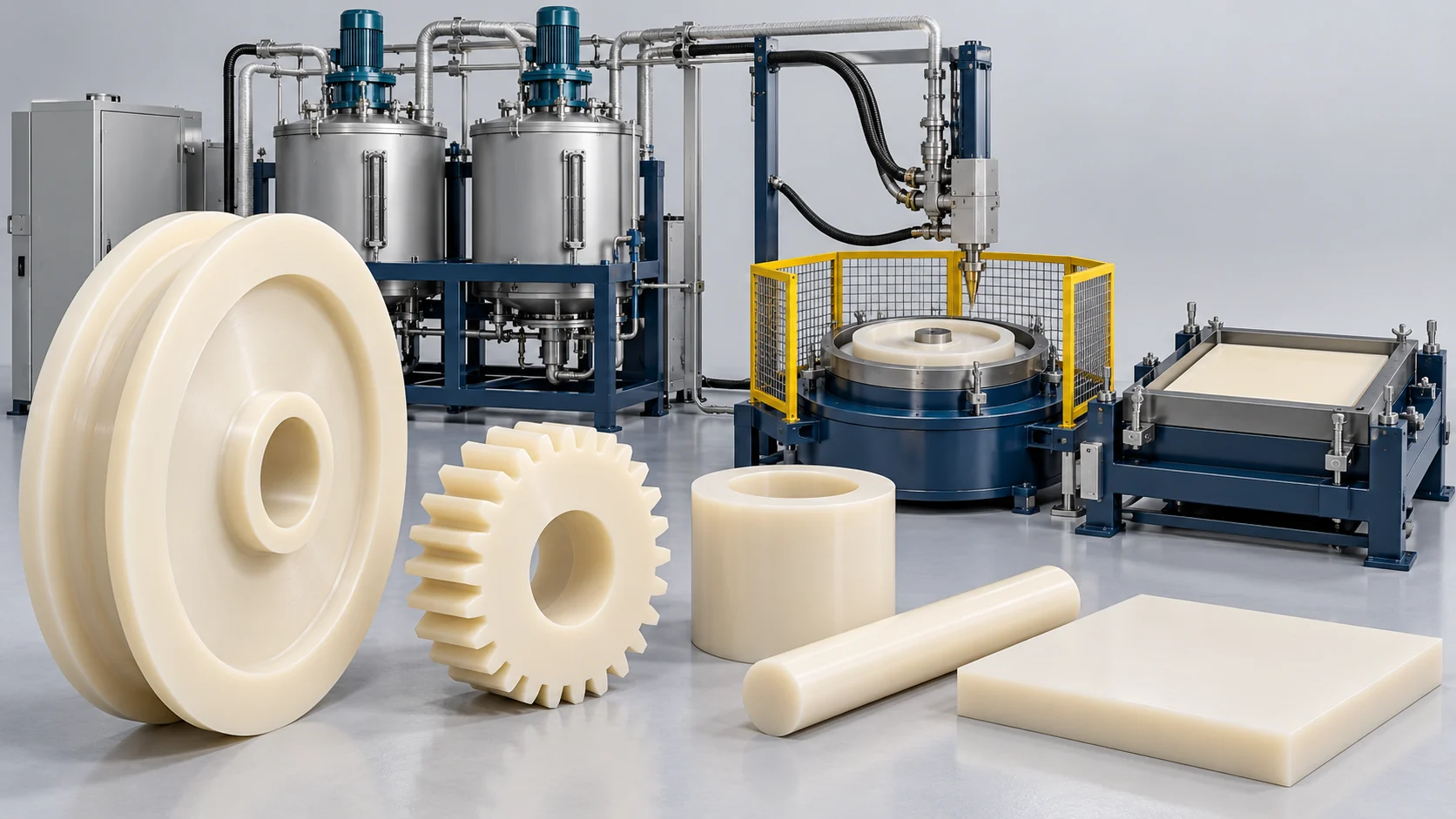
Monomer Cast Nylon Engineering Solution
Equipment planning for cast PA6 sheaves, gears, bushes and stock shapes, covering monomer preparation, heated feed control, shape-specific casting, polymerization and annealing.
High-Molecular-Weight Polymerization for Extreme Mechanical Wear
Heavy industrial infrastructure—including lattice boom cranes, port shiploaders, and underground mining conveyors—requires structural wear components capable of handling high cyclic contact stress, severe sliding abrasion, and extreme weight reduction. Conventional steel components introduce excessive parasitic mass that limits boom reach, while standard injection molded plastics are constrained by low molecular weights and small part thicknesses. Haifeng’s Monomer Cast Nylon (MC Nylon) Solution overcomes these limitations by combining high-purity caprolactam vacuum dehydration with controlled in-situ anionic polymerization inside dynamic centrifugal molds.
Monomer Preparation
Enclosed melting and vacuum conditioning precede the calibrated catalyst and activator feed streams. Residual water is checked using the agreed sampling method.
Shape-Specific Casting
Suitable rotational parts use configured centrifugal tooling. Plates, rods and tubes require separate mold designs and filling/heating arrangements; they are not nylon pellet extrusion.
Tooling, heating, material preparation, filling and post-casting treatment are matched to the component dimensions, material recipe and production target. Part quality and material properties require project-specific testing.
End-to-End Monomer Cast Nylon Workflow
A configured sequence of monomer preparation, catalyst and activator conditioning, heated metering, shape-specific casting, in-mold polymerization and annealing.
Monomer Melting & Deep Vacuum Falling-Film Dehydration
Caprolactam is melted and passed through the specified vacuum-conditioning stage. The supplied vacuum and water-content targets require confirmation of operating conditions and original test records.
Catalytic Dosing & Dry Nitrogen Blanketing
Monomer is split into Stream A (with alkaline catalyst) and Stream B (with activator and optional MoS₂ lubricants), sealed under positive dry nitrogen gas (0.05 MPa).
Closed-Loop Precision Thermal Metering
Servo-driven high-temperature gear pumps meter Streams A and B into heated supply lines, with mass flow loops holding stoichiometric ratio tolerances within ±0.3%.
Reference Solution Engineering Envelope
Typical capability matrix for Haifeng turnkey monomer cast nylon (MC Nylon) machinery packages.
| Parameter | Value / Unit | Applicable Configuration / Conditions |
|---|---|---|
| Liquid Pouring Capacity | 5.0 to 45.0 kg/min | Continuous variable servo-driven high-temperature pump skid |
| Degassing Vacuum Performance | Absolute pressure ≤ 0.01 kPa | Dual-stage rotary vane vacuum system with cold trap protection |
| Thermal Conditioning Limit | Ambient up to 150°C | Multi-zone thermal oil circulating jackets (tolerance ±0.5°C) |
| Supported Sheave Diameters | Ø 200 mm to Ø 1,500 mm | Variable dynamic-balanced centrifugal rotary casting stations |
| Centrifugal Turntable Velocity | 400 to 1,200 RPM | Supplied drive range; approved operating speed depends on tooling, load and balancing |
| Cured Part Rockwell Hardness | R115 to R120 | Reported material range; original specimen and test records require verification |
Core Equipment for This Solution
The package covers enclosed caprolactam melting and vacuum preparation, heated metering, dynamic mixing, the specified centrifugal casting stations and controls. Annealing oil baths and horizontal plate fixtures are optional. Caprolactam and chemical additives are supplied separately; the central thermal-oil source and dry nitrogen supply are customer interfaces. Direct casting of plates, rods and tubes uses shape-specific tooling and process configuration.
Core Advantages of Haifeng MC Nylon Systems
Engineering features designed to solve moisture deactivation, internal shrinkage voids, and thermal crystallization cracking.
Component-Specific Weight Planning
Compare the actual cast-nylon design with the selected metal baseline; the sheave-case weight result is not a universal reduction.
Defined Part Inspection
Confirm the part inspection method, detection threshold and sampling plan instead of assuming every casting is void-free.
Modified Nylon Formulations
Lubricant dispersion options are selected with the chemical supplier; rope wear and service life require their own tests.
Thermal Conditioning Interfaces
Feed-line and mold temperature controls are configured separately against the casting geometry and material recipe.
Related Project Draft
Review the project configuration described in the supplied brief. Project records and reported results require verification before public use.
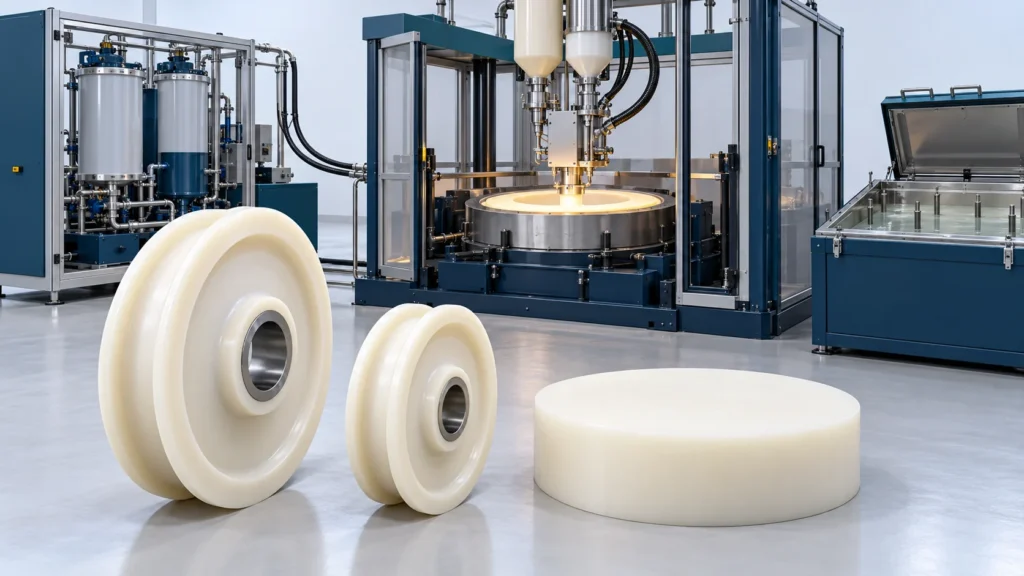
Frequently Asked Questions
Find answers about Monomer Cast Nylon Engineering Solution, including material selection, equipment configuration and the information needed to plan a production line.
How does MC Nylon achieve higher molecular weight than standard injection nylon?
Why is thermal oil heating preferred over electric band heaters for caprolactam?
Can metal hubs or splined steel inserts be cast directly into the nylon part?
What is the purpose of post-cure oil bath annealing for MC Nylon parts?
Request an MC Nylon Machinery Proposal
Share the finished component and drawing, material/modification requirements, target capacity, automation needs, and available mold-heating, nitrogen and factory utilities.


