
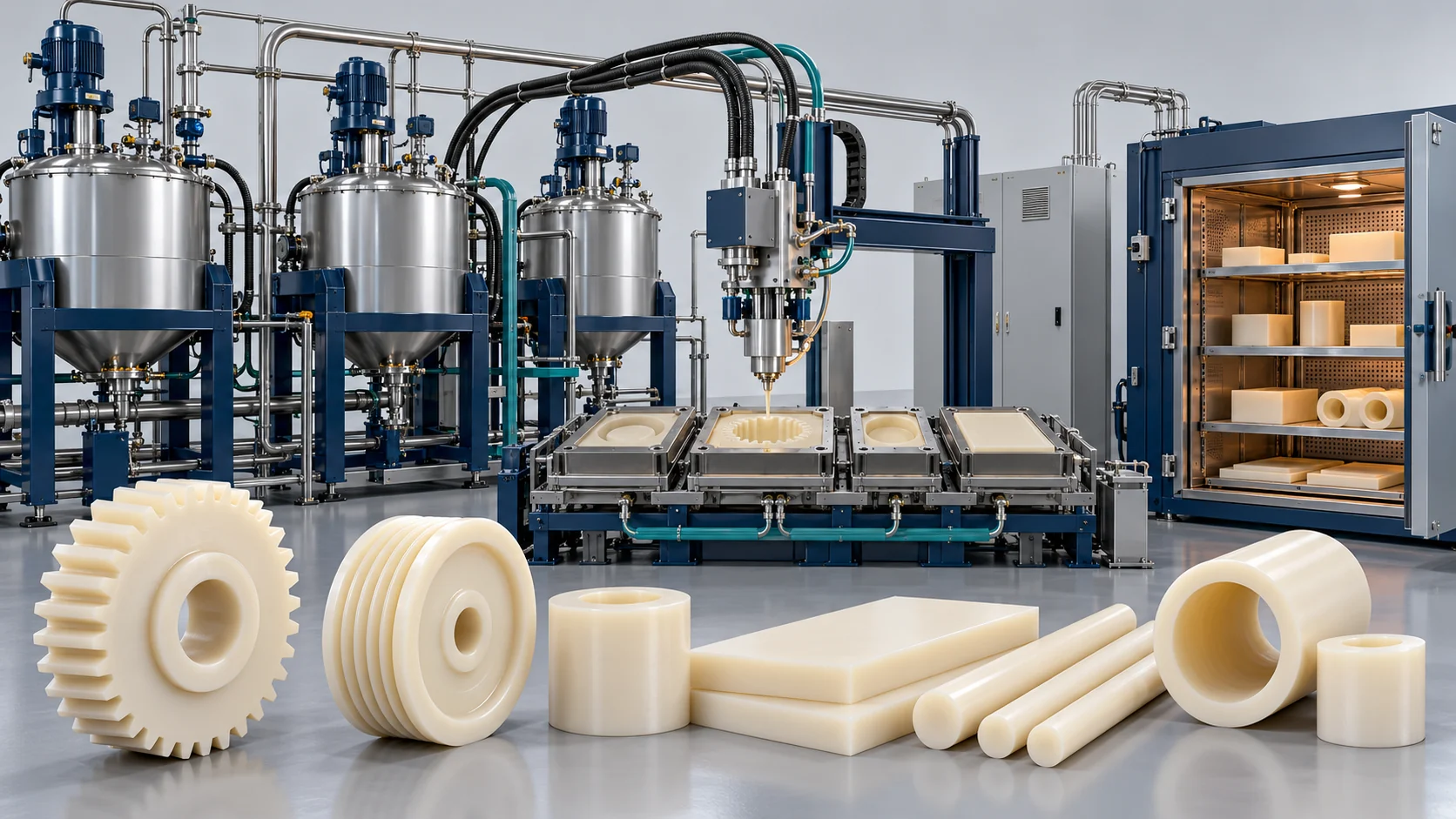
MC Nylon Component and Stock-Shape Casting Solution
Coordinate activated caprolactam preparation, hot metering/mixing and in-mold polymerization for MC Nylon parts and stock shapes.
Build the Process Around Your Product
Coordinate activated caprolactam preparation, hot metering/mixing and in-mold polymerization for MC Nylon parts and stock shapes.
Product and material first
Start with the finished-product drawing, material system and acceptance requirements. The process route and equipment configuration are assessed together.
Capacity across the whole process
Define output with preparation, forming/reaction, curing, handling and inspection included. The slowest stage and product changes determine practical line capacity.
Choose discrete MC Nylon parts, plates or rod/tube stock before defining mold and thermal handling. Activated monomer preparation, reactive casting, polymerization and subsequent conditioning are distinct from nylon extrusion or upstream caprolactam manufacture.
From Preparation to Qualified Product
A planning sequence for the specified route. Final settings and acceptance conditions are established through material and part review.
Define parts and stock shapes
Review gears, pulleys, bushes, plates, rods or tubes with dimensions and finishing allowance.
Prepare the monomer system
Specify approved caprolactam/catalyst/activator handling, conditioning and moisture control.
Prepare heated tooling
Choose the casting arrangement and control mold condition for the intended geometry.
Information Needed to Configure the Line
Provide these inputs so the equipment range, interfaces and validation plan can be defined.
| Design input | Information required |
|---|---|
| Product drawing | Shape, dimensions, inserts and machining allowance |
| Reaction system | Caprolactam, catalyst/activator, ratio and handling instructions |
| Casting arrangement | Mold type, heat control, shot range and handling |
| Output/quality | Parts per shift, conditioning and dimensional/material tests |
Core Equipment and Integrated Interfaces
The MC Nylon casting reference concerns conditioned reactive feed and delivery. Selected molds, continuous forming or finishing need their own scope.
Coordinate the Equipment With the Process
Evaluate repeatability, handling and acceptance across the full workflow.
Monomer preparation
Select dehydration and thermal handling for the actual reaction system.
Product-form tooling
Define discrete-part, plate or stock-form receiving equipment separately.
Condition and finish
Plan post-treatment, machining allowance and dimensional/material inspection.
Industry cast-nylon reference
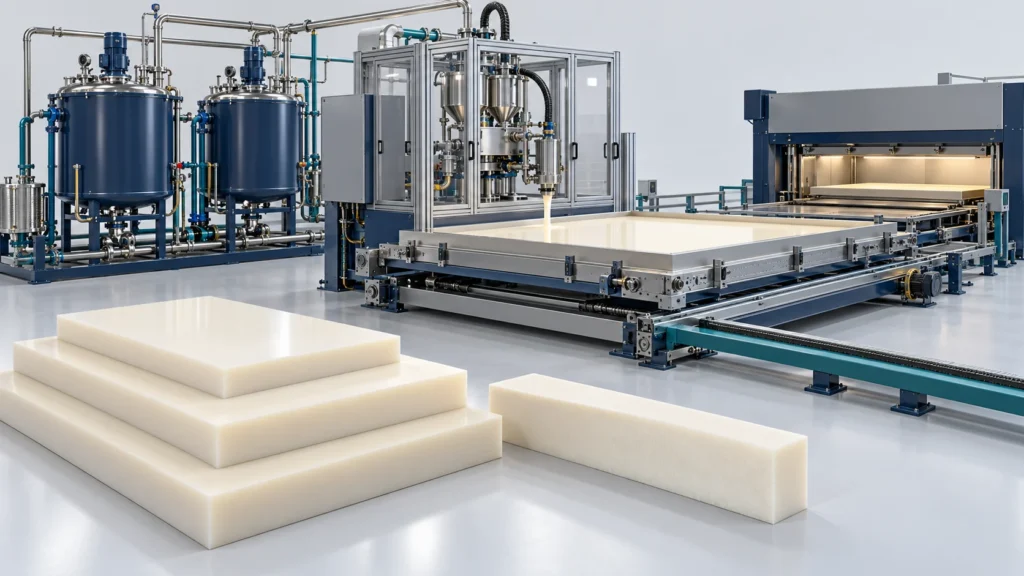
The plate item is an industry reference, not proof that every part or stock-shape configuration has the same equipment and performance.
Frequently Asked Questions
Clarify the production route before selecting a machine.
Does this scope include nylon extrusion or caprolactam manufacture?
What information is needed to size the production line?
What is included in the equipment package?
Are cycle time and finished-product performance fixed?
How does product form change an MC Nylon casting proposal?
Submit Your Production Goals
Share the following for this application: Product/stock drawing, monomer/catalyst data, inserts, shot, mold heat, finishing allowance and material/dimensional tests. Our team will reply within one business day. Once requirements are clear, we provide a preliminary proposal within two business days.


