
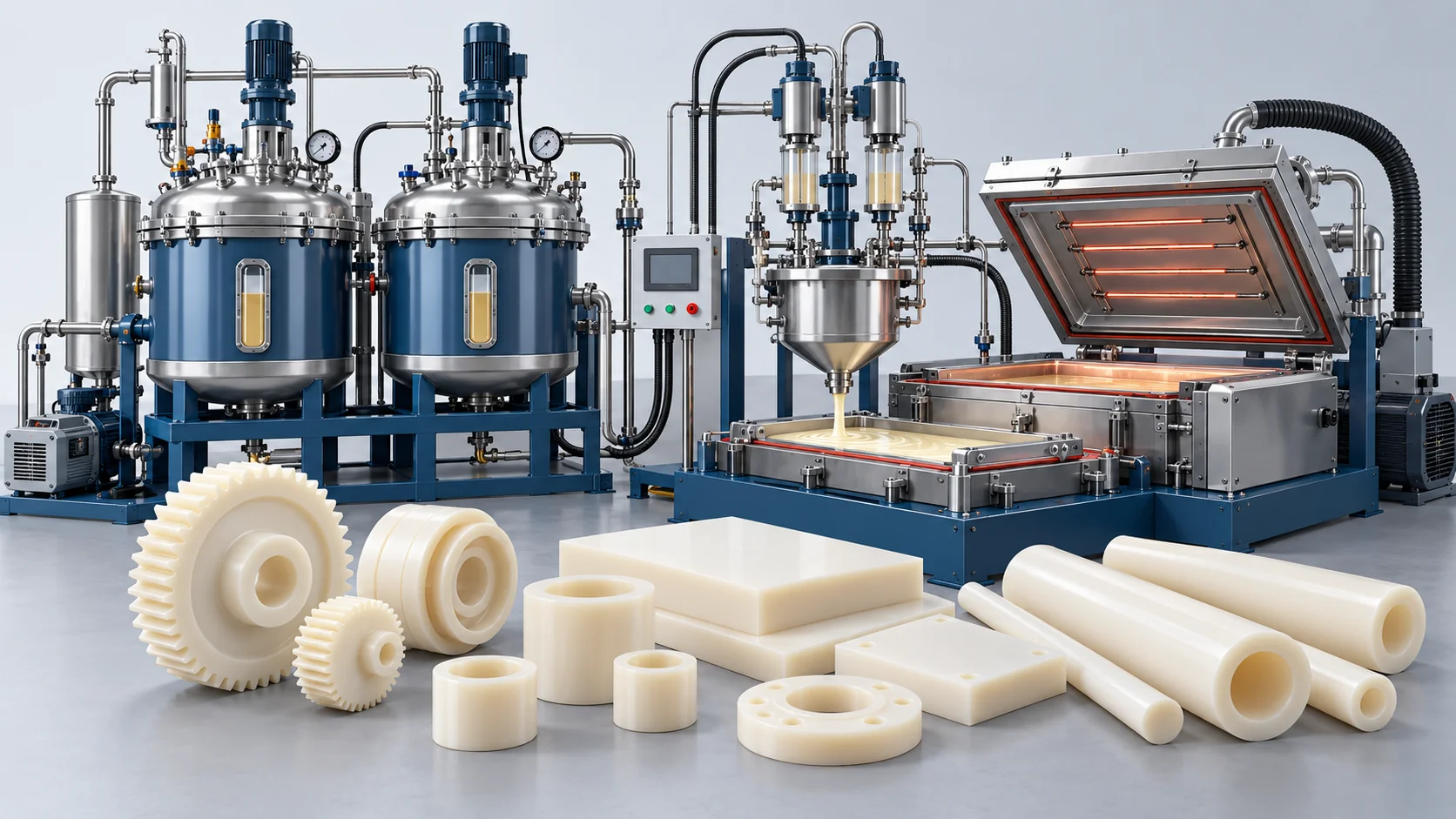
Vacuum MC Nylon Casting Machine | Engineering Parts
The HF-MCN150-VT package combines enclosed caprolactam preparation, vacuum dehydration, heated metering and mixing, and configured centrifugal or direct casting for MC Nylon components.
Deep Vacuum Anionic Polymerization for Heavy-Duty MC Nylon
The HF-MCN150-VT is an industrial monomer cast nylon (MC Nylon) vacuum casting machine designed for high-purity caprolactam degassing, closed stoichiometric metering, and centrifugal molding of heavy-duty pulleys and wear liners.
The HF-MCN150-VT is described in the supplied brief as a monomer cast nylon preparation and casting system for in-mold anionic polymerization of caprolactam into cast PA6 components. Dual heated preparation vessels, metering pumps and a dynamic mixing head supply the selected mold.
Centrifugal stations are configured for suitable rotational parts such as sheaves and bushes. Plates, solid rods and other shapes require their own direct-casting tooling and heating arrangement. Molecular weight, residual monomer, void content and mechanical performance depend on the material, geometry and validated process conditions.
Material Flow and Working Principle
Solid Charging & Deep Vacuum Dehydration
Solid caprolactam is melted and vacuum-conditioned in the specified jacketed vessels. Vacuum setpoints and the reported sub-20 ppm moisture target are verified against the chosen formulation, sampling method and original test records.
Additive Dosing & Stoichiometric Conditioning
The liquid monomer is divided into Tank A (monomer + catalyst, e.g., sodium hydroxide) and Tank B (monomer + activator/color/lubricants), maintained under positive nitrogen pressure (0.05 MPa) to prevent oxidation.
High-Speed Laminar Mixing & Discharge
Heated pumps meter the prepared A and B streams into the dynamic mixing head. The supplied brief specifies a nominal 1:1 volumetric split; the mass ratio and catalyst/activator recipe are calibrated separately.
Centrifugal Filling & In-Mold Anionic Polymerization
The mixed monomer is delivered into preheated tooling for in-mold polymerization and crystallization. Centrifugal molds use an approved speed for their geometry and load; direct-casting molds use their own filling sequence. Cure time is confirmed for the formulation and section thickness.
Controlled Annealing & Demolding
Solidified components are demolded and transferred to continuous step-down oil baths or thermal ovens for crystalline stress-relieving annealing to ensure dimensional stability and prevent warpage.
Model and Technical Parameters
Supplied HF-MCN150-VT configuration data. Vacuum performance, post-degassing water content and centrifugal speed require original test records. Maximum component diameter and maximum rotational speed are separate limits, not a simultaneous operating guarantee. The permitted speed is established for the mold, mass, balancing, fixtures and load.
| Technical Parameter | HF-MCN150-VT |
|---|---|
| Components | 2 Streams (Tank A: Monomer + Catalyst, Tank B: Monomer + Activator) |
| Output Range (g/s) | 5.0 to 45.0 kg/min (Continuous adjustable) |
| Mixing Ratio Range | Nominal 1:1 A/B volumetric feed split in the supplied brief; mass basis and formulation calibration require confirmation |
| Ratio Accuracy | ±0.3% (Measured with steady thermal oil circulation) |
| Power Supply | 380V, 3-Phase, 50Hz (Custom 440V/480V 60Hz optional) |
| Working Pressure | 0.3 to 0.6 MPa (Metering lines and dynamic mixing head) |
| Tank Capacity (L) | Day tanks: 2 x 150 L (Stainless steel with vacuum/oil jacket) |
| Weight | 3,800 kg (Main melting skid and centrifugal station) |
| Dimensions (L×W×H) | 3400 mm x 2400 mm x 2650 mm |
| Degassing Vacuum Degree | ≤ 0.01 kPa (Absolute pressure); Thin-film falling chamber |
| Maximum Heating Temp | 150°C (Circulating thermal oil jacket); Melting vessels and feed lines |
| Centrifugal Table Speed | Supplied drive range 400–1,200 RPM; permitted operating speed confirmed for the specific mold, load and balancing records |
| Monomer Moisture Content | Reported target <20 ppm after degassing; Karl Fischer method and original sampling records require verification |
Key Equipment Features
The package covers enclosed caprolactam melting and vacuum preparation, heated metering, dynamic mixing, the specified centrifugal casting stations and controls. Annealing oil baths and horizontal plate fixtures are optional. Caprolactam and chemical additives are supplied separately; the central thermal-oil source and dry nitrogen supply are customer interfaces. Direct casting of plates, rods and tubes uses shape-specific tooling and process configuration.
Vacuum Monomer Preparation
The specified falling-film vacuum stage conditions the monomer before metering; final water content requires a defined measurement.
Configured Centrifugal Casting
Rotational tooling is selected for the part geometry, permitted load and approved speed envelope.
Heated Material Path
Thermal-oil jackets condition tanks, pumps and feed lines; mold heating has its own temperature settings.
Dry Nitrogen Interfaces
The specified enclosed vessels and transfer interfaces use the agreed dry nitrogen supply and process controls.


