
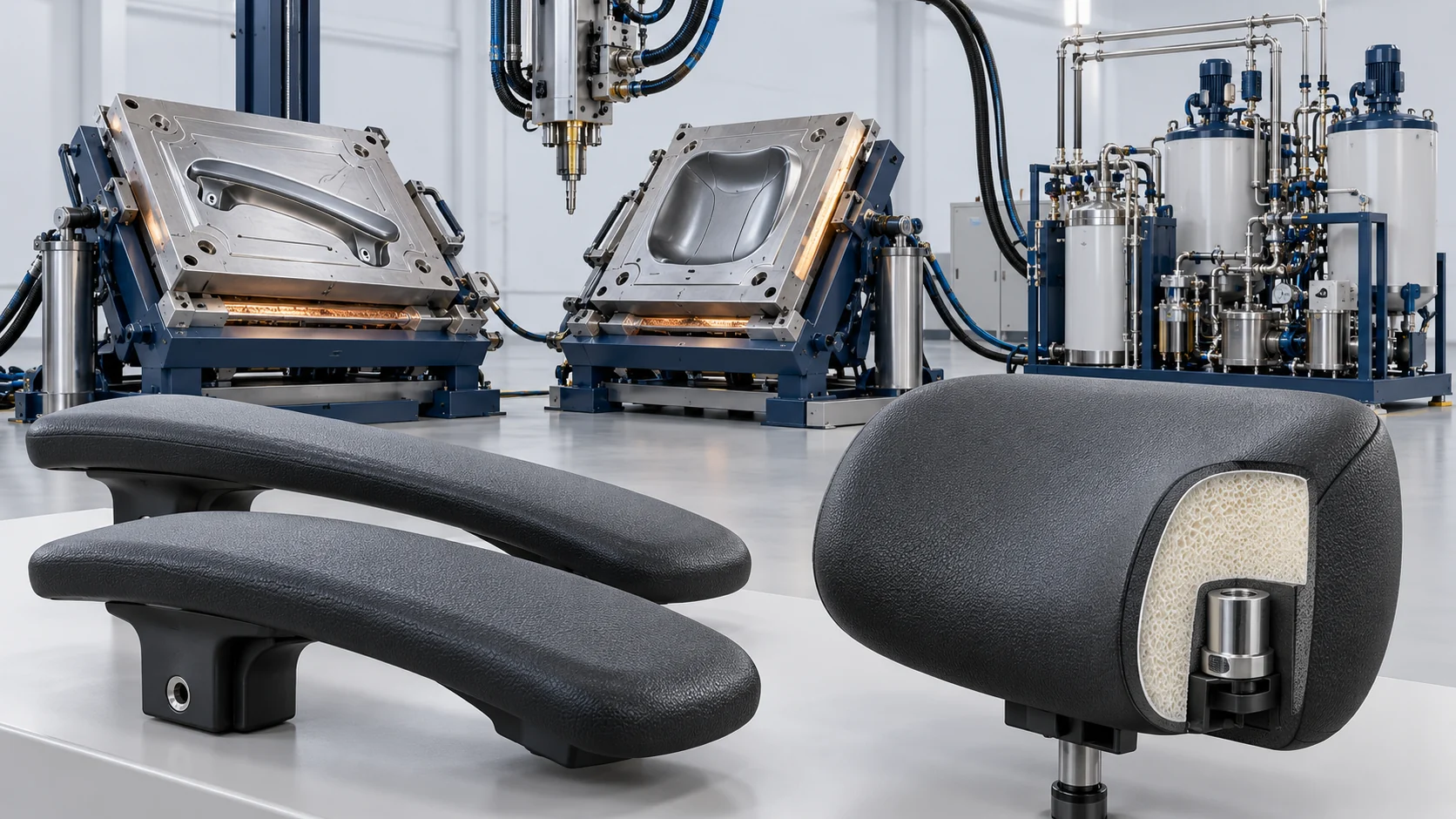
Integral Skin PU Foam Molding Solution
Configure integral-skin PU armrests and furniture components with defined surface and cleaning tests.
Precision Polyurethane Integral Skin Solutions for Ergonomic & Medical Furniture
Integral-skin furniture parts combine a molded outer skin and cellular core around the selected geometry and inserts. Skin formation, touch and surface integrity depend on the formulation, tool and cure. Use in healthcare furniture does not by itself establish resistance to every disinfectant or a medical qualification.
Defined supply scope
Define the metering, fixtures, mold handling and any coating stage. Verify water-blown compatibility, skin quality and insert bonding with the selected material system.
Inputs for process selection
Part and insert drawings, desired touch, surface finish, cleaning regime, abrasion method, shot mass and output.
Equipment scope, retained factory interfaces and acceptance are agreed for the selected material and part. Define the metering, fixtures, mold handling and any coating stage. Verify water-blown compatibility, skin quality and insert bonding with the selected material system.
Integral Skin PU Foam Molding Workflow
Prepare inserts and tooling → Condition and dispense → Mold and cure → Inspect and clean-test. Define preparation, filling, cure and output timing separately for the selected configuration.
Prepare inserts and tooling
Confirm insert location, mold finish and the required surface system.
Condition and dispense
Establish material conditions and the filling sequence for the part.
Mold and cure
Validate skin/core formation, venting and the thermal sequence.
Technical Specifications
Existing configuration and test references. Equipment settings, material results and finished-assembly results are separate; apply each value only to its documented configuration and conditions.
| Technical Parameter | Standard Specification / Value | Engineering Context & Verification |
|---|---|---|
| Target Application | Medical Furniture Armrests, Office Chair 3D/4D Pads | Tactile high-wear furniture interfaces |
| Material Matrix | Polyurethane Integral Skin Elastomer (Water-Blown) | Eco-friendly zero-ODP formulation |
| Surface Hardness Range | Shore A 45 to Shore A 80 (Customizable) | Tailored from plush softness to rigid grips |
| Core Density Range | 250 – 450 kg/m³ | High shock-absorbing microcellular core |
| Metering Output Capacity | 10 – 35 kg/min (Customizable) | Micro-shot precision servo axial pumps |
| Demolding Cycle Time | 90 – 140 seconds (Standard 120 s) | High-cadence multi-carrier production |
| Taber Abrasion Test | Acceptance target agreed for the selected specimen | State the method, abrasive wheel, load, conditioning, cycle count and endpoint in the report |
| Wyzenbeek Abrasion Test | Separate result where the method is applicable | State the method, abradant, tension/load, conditioning, double-rub count and failure criterion; do not convert it to a Taber rating |
Equipment for This Solution
Equipment references are selected by their documented process. Main metering, auxiliary supply and alternative routes are not a single standard package.
Process controls and application checks
Evaluate these functions with the selected material, tooling and production brief. Finished-part results require their own acceptance evidence.
Defined skin inspection
Agree the permitted pores, pinholes and texture variation instead of assuming a flawless surface.
Cleaning-specific validation
Test the actual disinfectant, concentration, exposure and repeated cleaning cycles.
Component-specific feel
Establish hardness and support response on the selected material and molded geometry.
Related Projects
These are related application references. Compare the actual material, process and delivered modules; reported project figures are not acceptance results for another line.
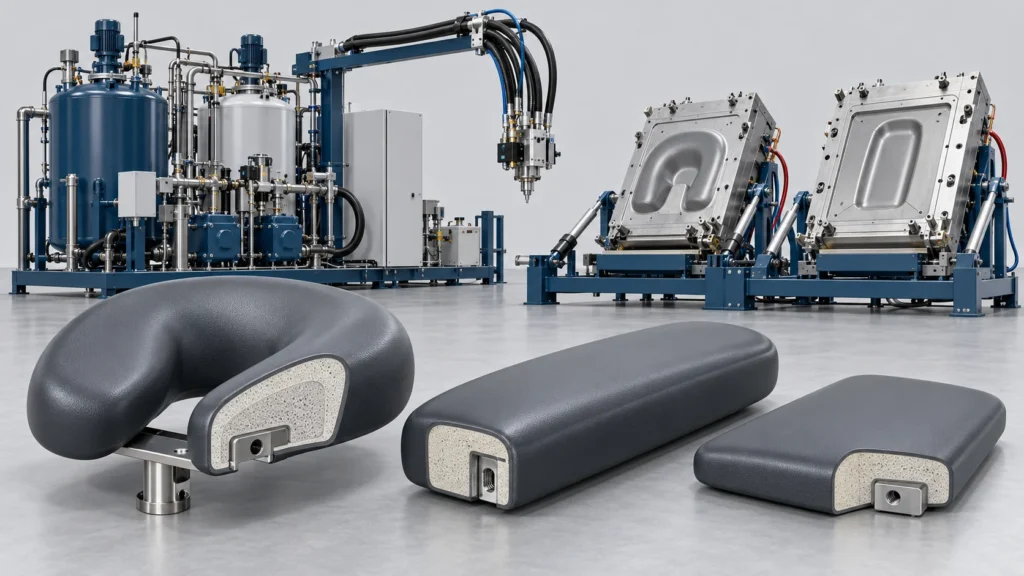
Medical Furniture Integral Skin PU Line Project in Russia
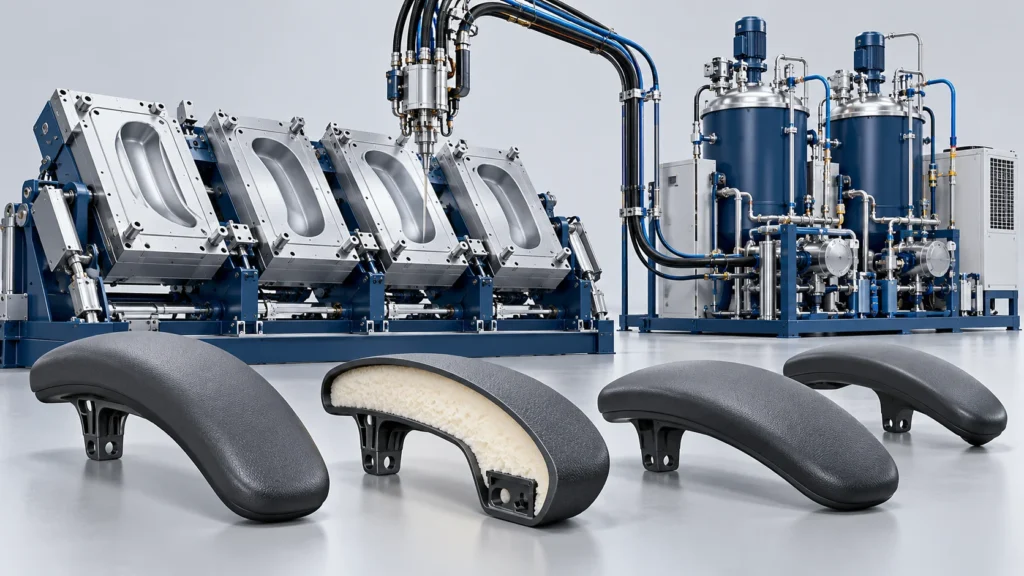
Office Chair Armrest Integral Skin PU Line Project in China
Frequently Asked Questions
Answers on process selection, equipment integration and delivery support.
Does an integral skin repel every hospital disinfectant?
Does mold tilting eliminate pinholes?
What information is needed for a preliminary configuration?
Discuss Your Furniture Production Project
Share the following with your production brief: Part and insert drawings, desired touch, surface finish, cleaning regime, abrasion method, shot mass and output. Our team will reply within one business day. Once requirements are clear, we provide a preliminary proposal within two business days.


