
ETPU Precursor Pelletizing Solution
Reactive extrusion and uniform micro-pellet production for downstream expanded-TPU bead and footwear development.
Engineered Precursor Chemistry for High-Energy-Return Popcorn Midsoles
Reactive extrusion and uniform micro-pellet production for downstream expanded-TPU bead and footwear development.
Equipment and process scope
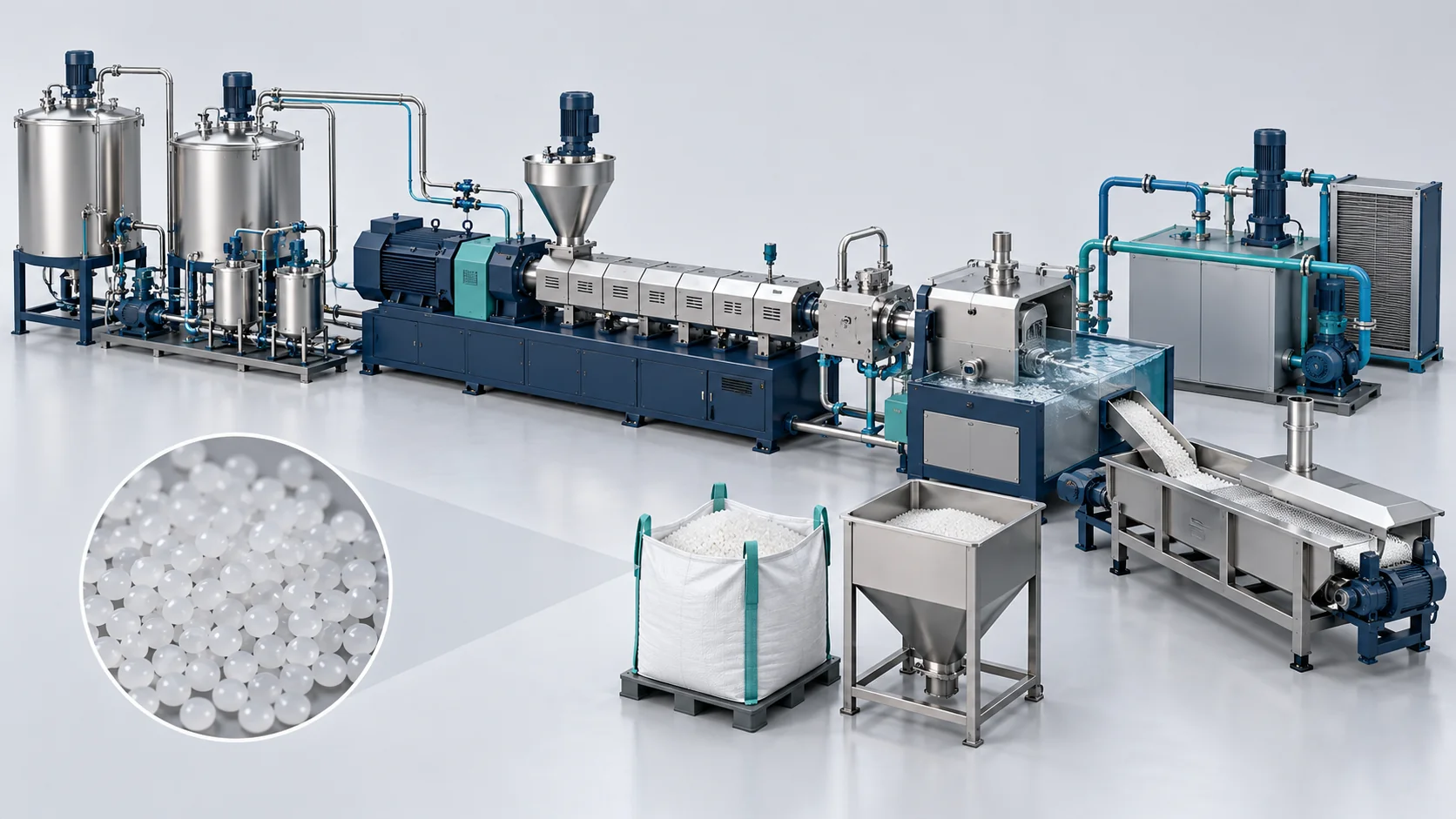
Liquid feed preparation, reactive extrusion, melt pumping and micro-pelletizer with drying interfaces. Supercritical-gas expansion and bead molding equipment are separately defined.
Validation and production planning
This line produces unexpanded TPU precursor pellets. Supercritical expansion and steam-chest molding are downstream stages, not proven functions of the pelletizer. Rebound, expansion ratio and foam density refer to specified downstream samples. Extrusion pressure and supercritical vessel pressure are distinct. ASTM D2632 covers solid rubber and excludes cellular rubber; confirm an appropriate validated method for the cellular ETPU sample before using the reported rebound comparison.
Liquid feed preparation, reactive extrusion, melt pumping and micro-pelletizer with drying interfaces. Supercritical-gas expansion and bead molding equipment are separately defined. This line produces unexpanded TPU precursor pellets. Supercritical expansion and steam-chest molding are downstream stages, not proven functions of the pelletizer. Rebound, expansion ratio and foam density refer to specified downstream samples. Extrusion pressure and supercritical vessel pressure are distinct. ASTM D2632 covers solid rubber and excludes cellular rubber; confirm an appropriate validated method for the cellular ETPU sample before using the reported rebound comparison.Generated concept illustration for process discussion; not a photograph of the specified machine, a customer facility or a delivered project.
Turnkey ETPU Precursor Granulation Process
Configuration sequence from the supplied brief. Material, tool, pressure/temperature basis and complete line balance require verification. This line produces unexpanded TPU precursor pellets. Supercritical expansion and steam-chest molding are downstream stages, not proven functions of the pelletizer. Rebound, expansion ratio and foam density refer to specified downstream samples. Extrusion pressure and supercritical vessel pressure are distinct. ASTM D2632 covers solid rubber and excludes cellular rubber; confirm an appropriate validated method for the cellular ETPU sample before using the reported rebound comparison.
Four-Stream Closed-Loop Mass-Flow Feeding
Supplied process reference: Low-crystallinity PCL polyols, PTMEG, molten pure MDI, and extenders are metered at 85°C into the extruder throat under nitrogen.
Controlled-Crystallinity Twin-Screw Polymerization
Supplied process reference: Reactants advance through an L/D = 54 barrel, where low-shear blocks guide molecular weight growth to tailor hard-segment domains.
Gear Pump Pressure Stabilization & Fine Filtration
Supplied process reference: An oil-jacketed melt pump stabilizes delivery pressure at 15.0 MPa, passing melt through a 250-mesh hydraulic screen changer.
Reference Solution Engineering Envelope
Supplied configuration and validation references; material/component results are separate from equipment ratings.
| Parameter | Value / Unit | Applicable Configuration / Conditions |
|---|---|---|
| Continuous Production Output | 200.0 to 600.0 kg/hour | High-torque co-rotating twin-screw extruder with gear pump; supplied configuration or material target, pending the applicable original records |
| Precursor Bead Diameter Profile | 1.2 mm ± 0.05 mm | Micro-orifice carbide die plate (0.8–1.2 mm holes); supplied configuration or material target, pending the applicable original records |
| Supercritical Autoclave Expansion | 4.0 to 6.0 Times (sc-CO₂) | Physical autoclaving at 12 MPa and 125°C; supplied configuration or material target, pending the applicable original records |
| Molded Sole Ball Rebound | Reported cellular-sample rebound; method pending review | ASTM D2632 excludes cellular rubber; establish an appropriate validated method and original ETPU sample record |
| Expanded Bead Specific Gravity | 0.15 to 0.22 g/cm³ | Water displacement density measurement; supplied configuration or material target, pending the applicable original records |
| Precursor Residual Moisture | Less than 0.02% (200 ppm) | High-speed centrifugal spin dryer with fluidized bed; supplied configuration or material target, pending the applicable original records |
Core Equipment for This Solution
Liquid feed preparation, reactive extrusion, melt pumping and micro-pelletizer with drying interfaces. Supercritical-gas expansion and bead molding equipment are separately defined.
Core Advantages of Haifeng ETPU Systems
Configured equipment functions and interfaces for the selected material and tooling.
Extreme > 68% Energy Return
Supplied configuration function: Tailored soft-segment chemistry minimizes hysteretic mechanical energy loss under cyclic running strikes. Project-dependent performance requires validation.
1.2 mm Mini-Pellet Uniformity
Supplied configuration function: Micro-orifice underwater cutting yields identical bead masses, preventing irregular expansion in autoclaves. Project-dependent performance requires validation.
4–6x Supercritical Expansion
Supplied configuration function: Precursor formulation maximizes sc-CO₂ gas uptake, yielding ultra-lightweight densities (0.15– 0.22 g/cm^3). Project-dependent performance requires validation.
High-Pressure Non-Freezing Die
Supplied configuration function: Advanced ceramic internal thermal barriers prevent micro-orifices from freezing in water, ensuring steady runs. Project-dependent performance requires validation.
Related Project Draft
An anonymous project brief from the supplied document. Original attribution, dates, acceptance and outcome records require verification before public use.
Frequently Asked Questions
Why can't standard 3.0 mm TPU pellets be used for high-end ETPU midsoles?
How does the machine prevent die-hole freeze-offs with small 0.8 mm holes?
What is the ideal gas medium for expanding these precursor beads?
Can these precursor beads be colored during the reactive extrusion process?
Discuss Your Production Goals
Share your product or drawing, material system, target output, automation needs and factory utilities so the equipment and interfaces can be configured.


