
High-Rebound ETPU Popcorn Bead Line Project in China
Review draft: High-Rebound ETPU Popcorn Bead Line. Configuration and reported outcomes require original project records.
Project Overview
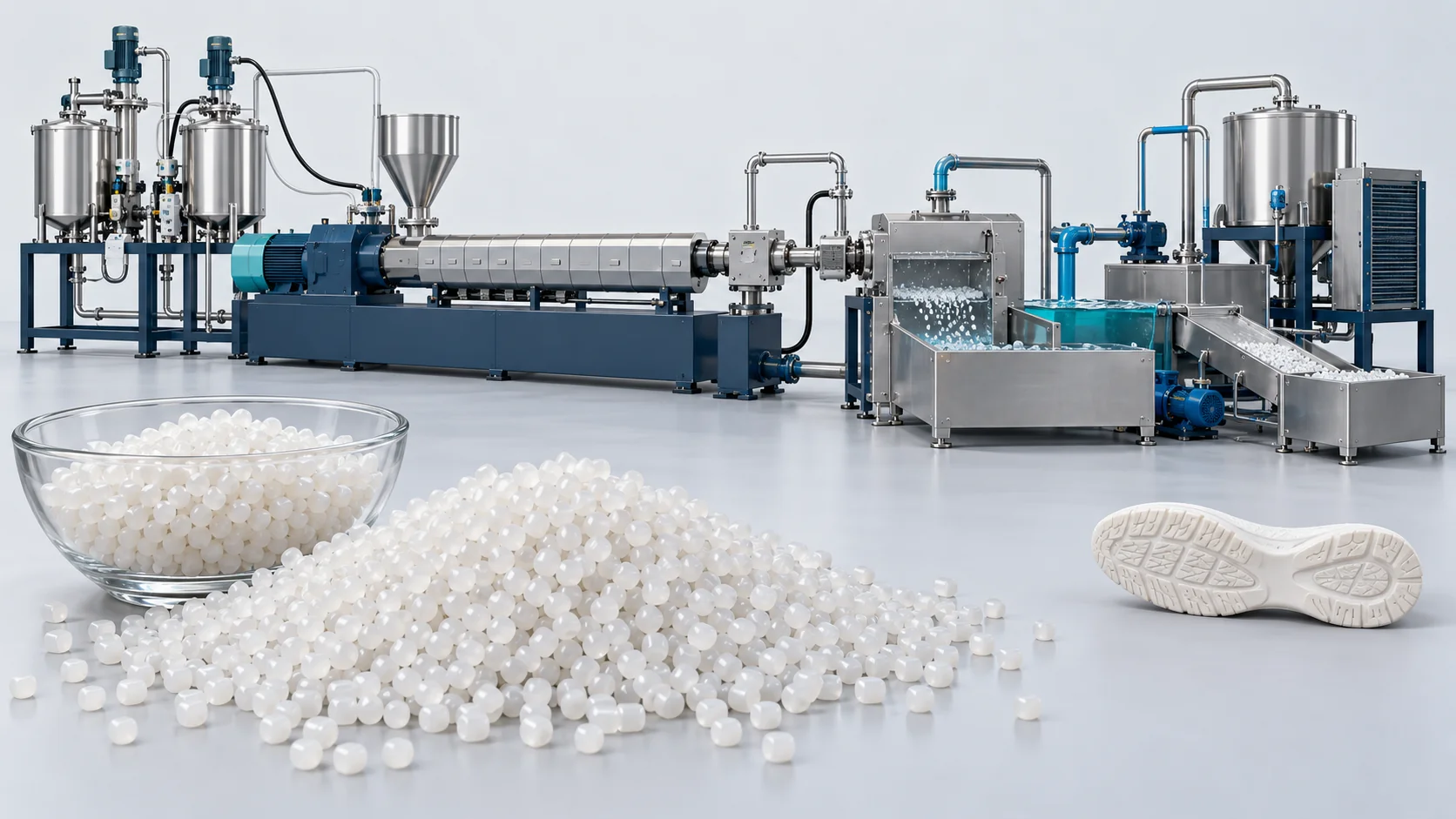
Illustration notice. Process illustrations are not verified photographs of this installation.
Project reference basis. Figures and configuration details are reported in the supplied project brief. They are reference values for the stated application, rather than verified acceptance results or a guarantee for another installation. Confirm the source records, material, tooling, operating schedule and test method when assessing a comparable project.
A leading global athletic footwear OEM supplier in Zhejiang deployed Haifeng’s specialized reactive extrusion and micro-pelletizing line to establish an in-house manufacturing cell for expanded thermoplastic polyurethane (ETPU / “popcorn” bead) precursors. The project was commissioned to supply ultra-lightweight, high-energy-return midsoles for professional marathon running shoes.
Previously, the manufacturer purchased generic commodity TPU pellets for supercritical physical foaming. Due to unoptimized hard-segment molecular distributions and broad pellet sizes, autoclaving with supercritical carbon dioxide (sc-CO₂) suffered from widespread cell rupture and bead agglomeration. Expansion was capped at 3.0 times with heavy specific gravities (> 0.28 g/cm³), and molded midsoles exhibited poor ball rebound elasticity (52% to 55%), failing international performance benchmarks.
Haifeng engineered a complete micro-pelletizing production cell centered on the HF-TPU70-ETPU platform. By synchronizing low-hysteresis continuous twin-screw polymerization with micro-orifice (1.0 mm) underwater cutting, the plant produced uniform 1.2 mm precursor beads that expanded by 5.2 times in autoclaves, delivering steam-molded shoe midsoles with energy ball rebounds exceeding 68.5% at an ultra-lightweight density of 0.18 g/cm³.
Review point: This line produces unexpanded TPU precursor pellets. Supercritical expansion and steam-chest molding are downstream stages, not proven functions of the pelletizer. Rebound, expansion ratio and foam density refer to specified downstream samples. Extrusion pressure and supercritical vessel pressure are distinct. ASTM D2632 covers solid rubber and excludes cellular rubber; confirm an appropriate validated method for the cellular ETPU sample before using the reported rebound comparison.
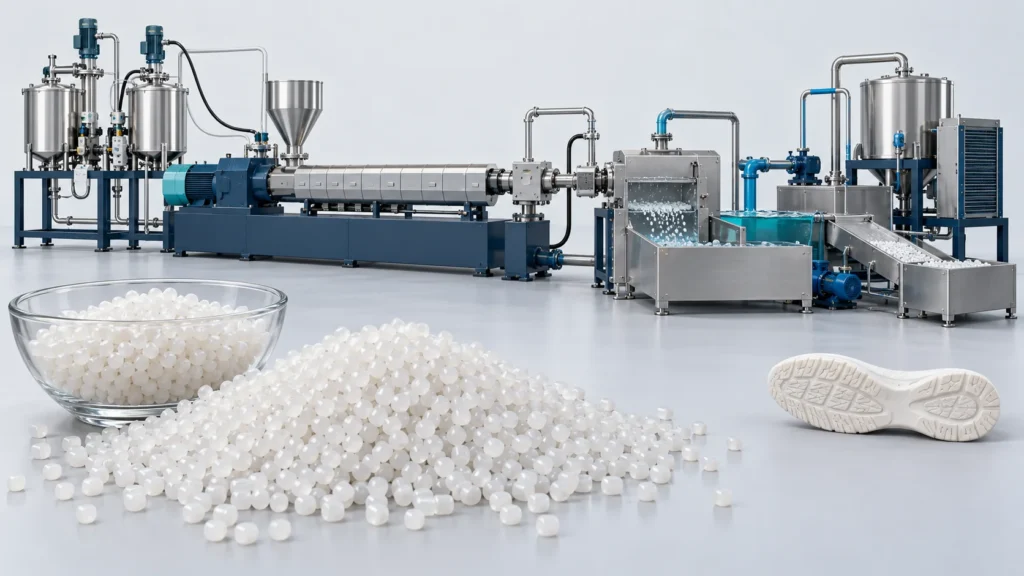
Concept illustration: Generated concept illustration for process discussion; not a photograph of the specified machine, a customer facility or a delivered project.
Solutions Delivery
Configuration reported in the supplied brief.
Haifeng engineered an automated reactive compounding and underwater micro-pelletizing plant. Liquid raw materials—specialized low-crystallinity PCL polyols, PTMEG polyethers, pure molten MDI, and chain extenders—are metered at 85°C into Zone 1 of an L/D = 54 co-rotating twin-screw extruder via Coriolis-guided servo pumps.
Across 12 temperature-controlled barrel zones, low-shear mixing elements guide molecular chain growth to create an optimal soft-to-hard phase separation matrix tailored specifically for high gas dissolution. The homogeneous melt passes through an electrically heated melt gear pump at 15.0 MPa into a fine 250-mesh hydraulic screen changer.
The melt discharges through a specialized micro-orifice carbide die plate (0.8 mm holes). Operating inside a tempered water chamber at 50°C, a high-speed multi-knife cutter running at 4,200 RPM slices the strands into mini-spherical beads with diameters of 1.2 mm ± 0.05 mm. The slurry is spin-dried centrifugally to drop moisture below 0.02% and sifted across dual-deck classifiers. Downstream supercritical CO₂ autoclaving yields uniform popcorn beads that fuse into finished running soles under 0.25 MPa steam.
This line produces unexpanded TPU precursor pellets. Supercritical expansion and steam-chest molding are downstream stages, not proven functions of the pelletizer. Rebound, expansion ratio and foam density refer to specified downstream samples. Extrusion pressure and supercritical vessel pressure are distinct. ASTM D2632 covers solid rubber and excludes cellular rubber; confirm an appropriate validated method for the cellular ETPU sample before using the reported rebound comparison.
| Equipment | Model | Qty | Function |
|---|---|---|---|
| ETPU Reactive Extrusion Skid | HF-TPU70-ETPU (L/D = 54) | 1 set | Core continuous polymerization, melt gear pumping, and 15 MPa filtration. |
| Micro-Orifice Underwater Pelletizer | HF-MUW-600 | 1 set | 0.8 mm carbide die plate and 4,500 RPM cutter yielding 1.2 mm mini-spherical beads. |
| High-Speed Centrifugal Spin Dryer | HF-CSD-02 | 1 unit | De-waters micro-bead slurry within seconds, reducing moisture under 0.02%. |
| Vibratory Bead Sizing Classifier | HF-VBC-03 | 1 unit | Multi-deck screen classifier separating off-spec fines to ensure ±0.05 mm size. |
Reported Results — Original Records Required
Master High-Rebound ETPU Popcorn Bead Manufacturing
Connect with Haifeng footwear polymer specialists to deploy continuous reactive micro-pelletizing lines engineered for supercritical ETPU foams.


