
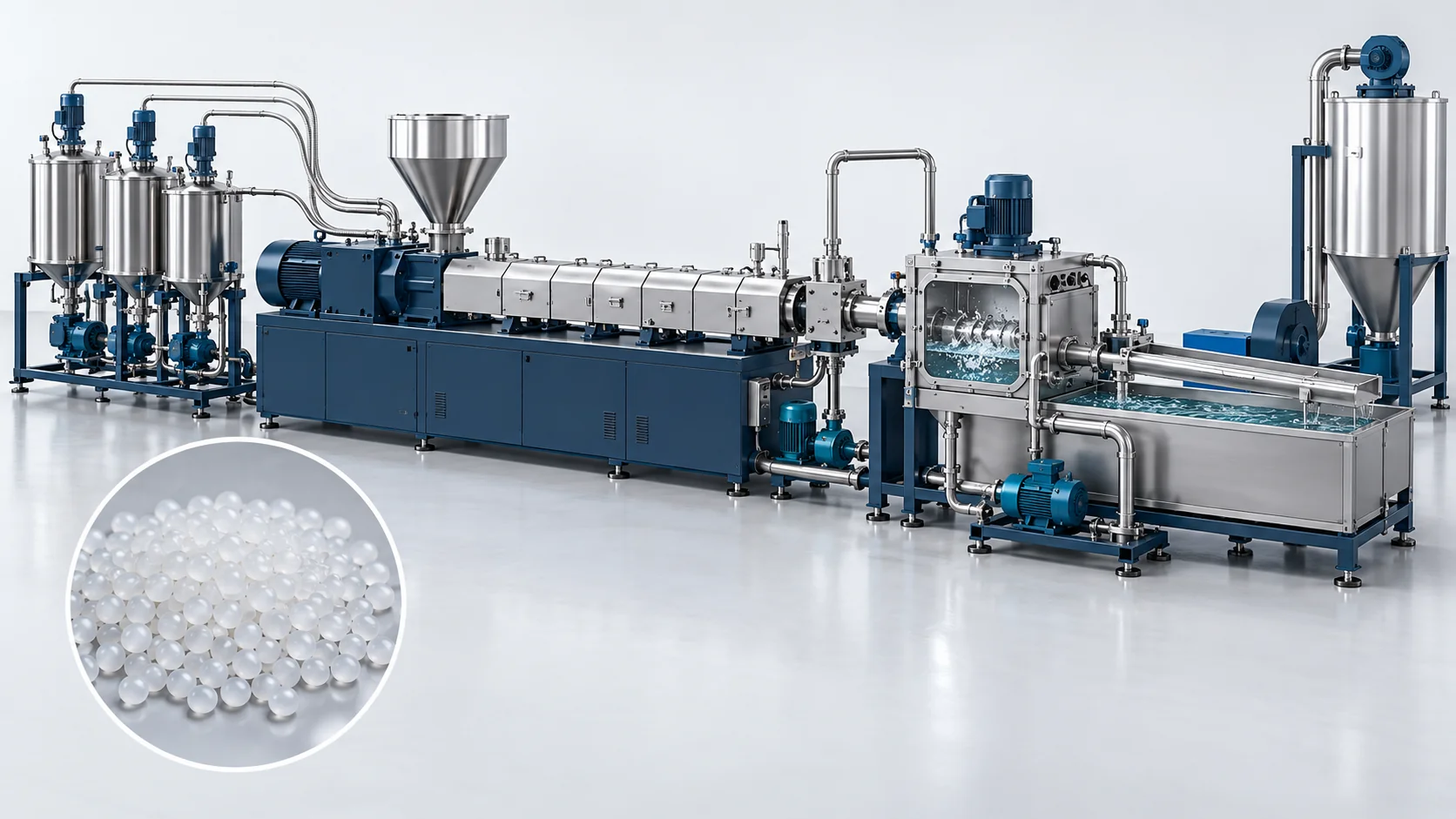
TPU Micro-Pellet Extrusion Line | ETPU Precursors
Reactive extrusion and uniform micro-pellet production for downstream expanded-TPU bead and footwear development.
Precision Micro-Pelletizing for Supercritical Physical Foaming TPU (ETPU)
Reactive extrusion and uniform micro-pellet production for downstream expanded-TPU bead and footwear development.
Reactive extrusion and uniform micro-pellet production for downstream expanded-TPU bead and footwear development.
Liquid feed preparation, reactive extrusion, melt pumping and micro-pelletizer with drying interfaces. Supercritical-gas expansion and bead molding equipment are separately defined.
This line produces unexpanded TPU precursor pellets. Supercritical expansion and steam-chest molding are downstream stages, not proven functions of the pelletizer. Rebound, expansion ratio and foam density refer to specified downstream samples. Extrusion pressure and supercritical vessel pressure are distinct. ASTM D2632 covers solid rubber and excludes cellular rubber; confirm an appropriate validated method for the cellular ETPU sample before using the reported rebound comparison.
Concept illustration: Generated concept illustration for process discussion; not a photograph of the specified machine, a customer facility or a delivered project.
Material Flow and Working Principle
Continuous Multi-Stream Chemical Dosing
Anti-crystallization polyols, molten pure MDI, and specialty chain extenders are conditioned under nitrogen at 85°C and displaced via Coriolis-metered servo pumps into the extruder throat.
Controlled Micro-Domain Reactive Polymerization
The liquid streams advance across 12 temperature-regulated zones in the twin-screw extruder (L/D = 54), tailoring the distribution of hard and soft segments to optimize subsequent gas absorption.
High-Pressure Melt Gear Pump Homogenization
A heated melt gear pump pulls polymer from screw tips, maintaining continuous extrusion pressures at 15 MPa through a continuous fine-mesh hydraulic screen changer.
Micro-Orifice Die-Face Underwater Pelletizing
The melt is pushed through micro-drilled die orifices (0.8–1.2 mm) into a high-flow water cutting chamber; high-speed multi-blade cutters spin at 4,500 RPM to slice 1.2 mm micro-beads.
Centrifugal Spin Drying & Fluidized Classification
The pellet slurry transfers to a high-speed centrifugal spin dryer that drops moisture below 0.02%, followed by multi-deck vibratory screens sorting beads to ±0.05 mm tolerances.
Model and Technical Parameters
Supplied HF-TPU70-ETPU configuration references, pending original calibration and acceptance documents. Material, finished-part and project outcomes are separate from equipment ratings. This line produces unexpanded TPU precursor pellets. Supercritical expansion and steam-chest molding are downstream stages, not proven functions of the pelletizer. Rebound, expansion ratio and foam density refer to specified downstream samples. Extrusion pressure and supercritical vessel pressure are distinct. ASTM D2632 covers solid rubber and excludes cellular rubber; confirm an appropriate validated method for the cellular ETPU sample before using the reported rebound comparison.
| Technical Parameter | HF-TPU70-ETPU |
|---|---|
| Components | 4 Liquid Streams (PCL/PTMEG, Pure MDI, Extender, Additive) |
| Output Range (g/s) | 200.0 to 600.0 kg/h (Continuous micro-pellet throughput) |
| Mixing Ratio Range | 100:28:7 to 100:55:18 (By weight) |
| Ratio Accuracy | ±0.15% (Coriolis mass flow continuous tracking) |
| Power Supply | 380V, 3-Phase, 50Hz (Custom 440V/480V 60Hz optional) |
| Working Pressure | 12.0 to 18.0 MPa (Micro-die extrusion and pelletizer head) |
| Tank Capacity (L) | Day tanks: 2 x 800 L (Stainless 304 with thermal oil jackets) |
| Weight | 15,200 kg (Extruder, gear pump, and micro-pelletizer skid) |
| Dimensions (L×W×H) | 23,000 mm x 3,400 mm x 3,000 mm |
| Micro-Pellet Diameter | 1.2 mm ± 0.05 mm (Mini-spherical bead geometry); Micro-orifice die plate cutting; supplied reference pending original configuration or test records |
| Supercritical Expansion Ratio | 4.0 to 6.0x (In sc-CO2 autoclave at 12 MPa); Downstream physical foaming; supplied reference pending original configuration or test records |
| Molded Bead Ball Rebound | Reported cellular-sample target; ASTM D2632 excludes cellular rubber. Appropriate validated method and original sample report required. |
| Expanded Bead Specific Gravity | 0.15 to 0.22 g/cm³ (Expanded foam density); Water displacement measurement; supplied reference pending original configuration or test records |
Key Equipment Features
Liquid feed preparation, reactive extrusion, melt pumping and micro-pelletizer with drying interfaces. Supercritical-gas expansion and bead molding equipment are separately defined.
> 68% High Ball Rebound
Supplied configuration reference: Controlled soft/hard segment morphology delivers over 68% energy return in supercritical molded soles. Actual capability requires material and tooling validation.
1.2 mm ± 0.05 mm Micro-Pelletizing
Supplied configuration reference: Micro-orifice underwater cutting yields uniform mini-spherical beads, preventing irregular popcorn shapes. Actual capability requires material and tooling validation.
4–6x Supercritical Expansion
Supplied configuration reference: Precursor formulation maximizes sc-CO₂ gas absorption, dropping expanded densities to 0.15– 0.22 g/cm^3. Actual capability requires material and tooling validation.
Low Hysteresis Heat Loss
Supplied configuration reference: Advanced polymer architecture minimizes mechanical hysteresis energy loss under high-frequency running impact. Actual capability requires material and tooling validation.


