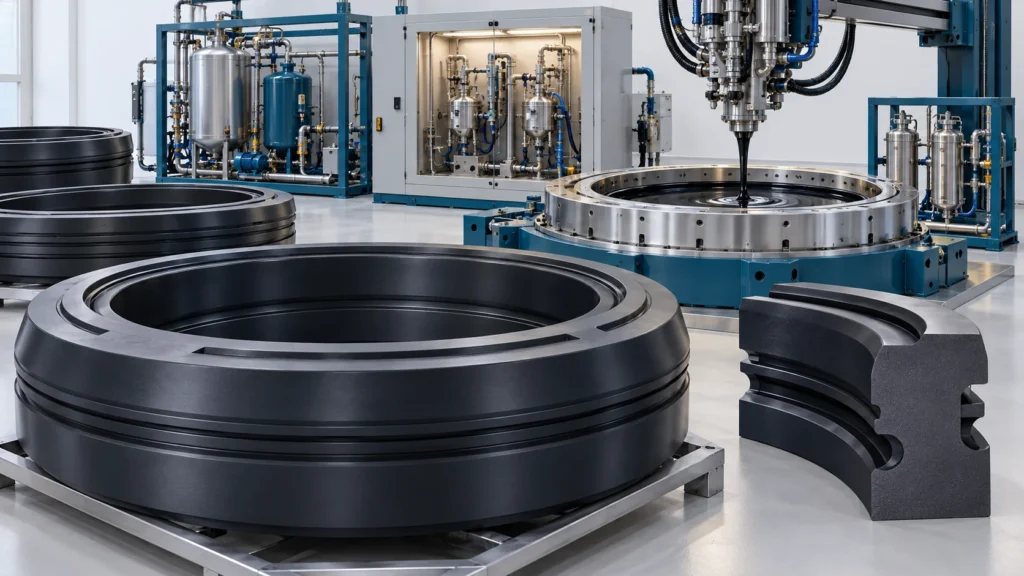
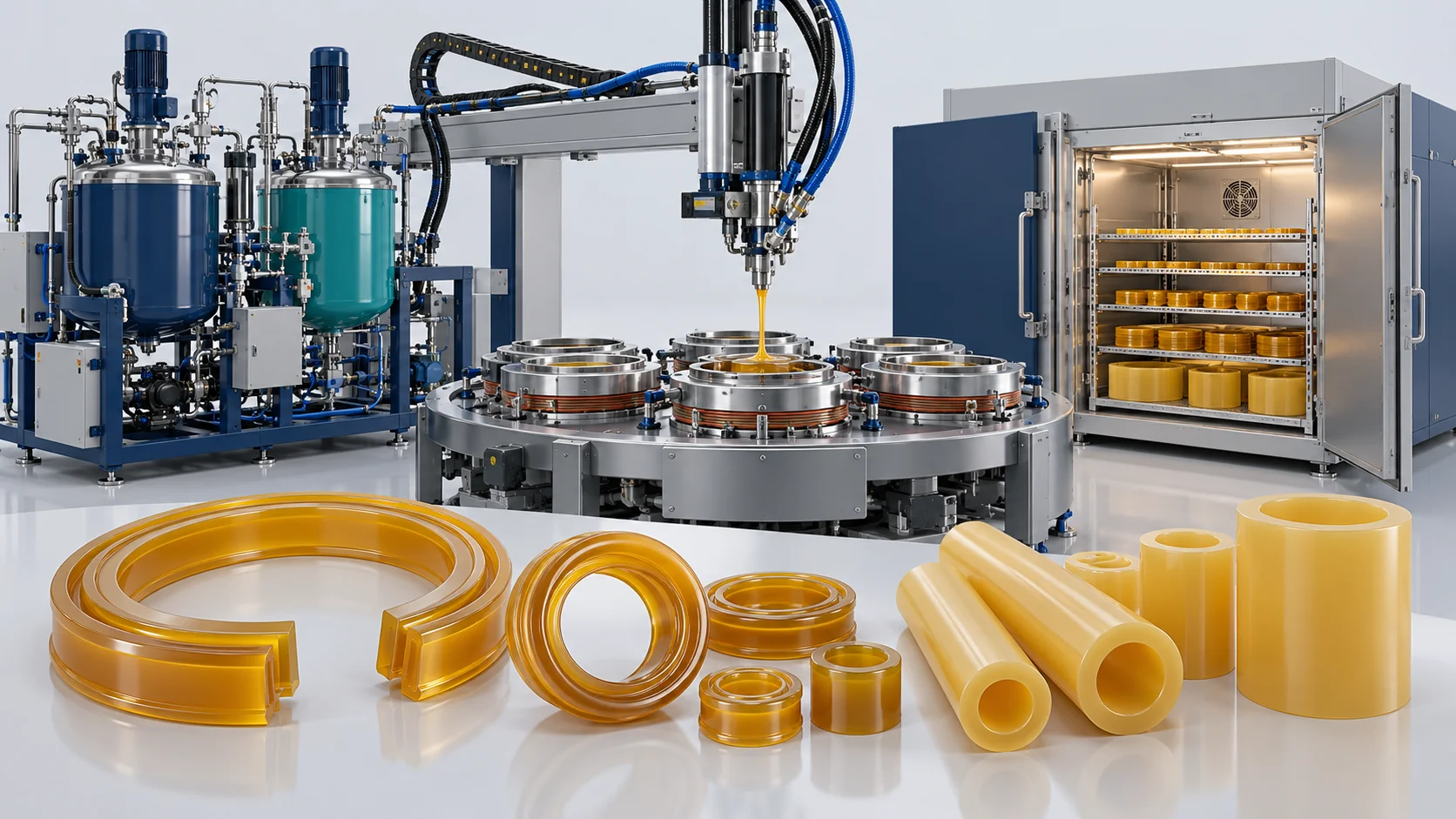
Cast Polyurethane Seal Manufacturing Solution
Plan cast polyurethane seal blanks or near-net parts for a specified hydraulic or industrial sealing duty.
Build the Process Around Your Product
Plan cast polyurethane seal blanks or near-net parts for a specified hydraulic or industrial sealing duty.
Product and material first
Start with the finished-product drawing, material system and acceptance requirements. The process route and equipment configuration are assessed together.
Capacity across the whole process
Define output with preparation, forming/reaction, curing, handling and inspection included. The slowest stage and product changes determine practical line capacity.
The proposal distinguishes Haifeng casting equipment from molds, precision machining and customer or third-party seal qualification.
From Preparation to Qualified Product
A planning sequence for the specified route. Final settings and acceptance conditions are established through material and part review.
Define sealing duty
Review pressure, media, temperature, motion and the finished seal drawing.
Select material and molds
Confirm elastomer chemistry, hardness, shrinkage allowance and whether the seal is cast directly or machined from a blank.
Prepare materials
Condition components and verify the ratio and handling requirements for the selected formulation.
Information Needed to Configure the Line
Provide these inputs so the equipment range, interfaces and validation plan can be defined.
| Design input | Information required |
|---|---|
| Seal geometry | Cross-section, diameter, inserts, cavities per mold and dimensional tolerance |
| Operating duty | Pressure, fluid, temperature and sliding/rotating conditions |
| Material recipe | Component count, viscosity, ratio and cure window |
| Output plan | Parts per shift, product changes and finishing workload |
Core Equipment and Integrated Interfaces
The proposal distinguishes Haifeng casting equipment from molds, precision machining and customer or third-party seal qualification.
PU Elastomer Casting Machine | Hydraulic Seals
PU casting machine designed for hydraulic seal production, featuring high-precision metering for dimensional stability. Oil-resistant and wear-resistant, ideal for high-pressure hydraulic systems and fluid power applications.
PU Elastomer Casting Machine | Seals
PU casting unit designed for polyurethane seals production, ensuring dimensional consistency and sealing performance with high-precision metering. Ideal for hydraulic, pneumatic, and automotive applications.
Coordinate the Equipment With the Process
Evaluate repeatability, handling and acceptance across the full workflow.
Material-specific configuration
Component circuits, thermal control, mixing and receiving equipment are matched to the approved chemistry and processing window.
Defined interfaces
The proposal distinguishes Haifeng casting equipment from molds, precision machining and customer or third-party seal qualification.
Documented acceptance
The proposal defines trials, process records, inspection responsibilities and product-specific acceptance conditions.
Frequently Asked Questions
Clarify the production route before selecting a machine.
Does a casting line alone qualify a hydraulic seal?
What information is needed to size the production line?
What is included in the equipment package?
Are cycle time and finished-product performance fixed?
Submit Your Production Goals
Share the finished product, material, target capacity, automation requirements and factory conditions to discuss a project-specific line configuration.
Related Application References
Review the material, product geometry, equipment scope and reference conditions within each record when assessing a comparable application.