
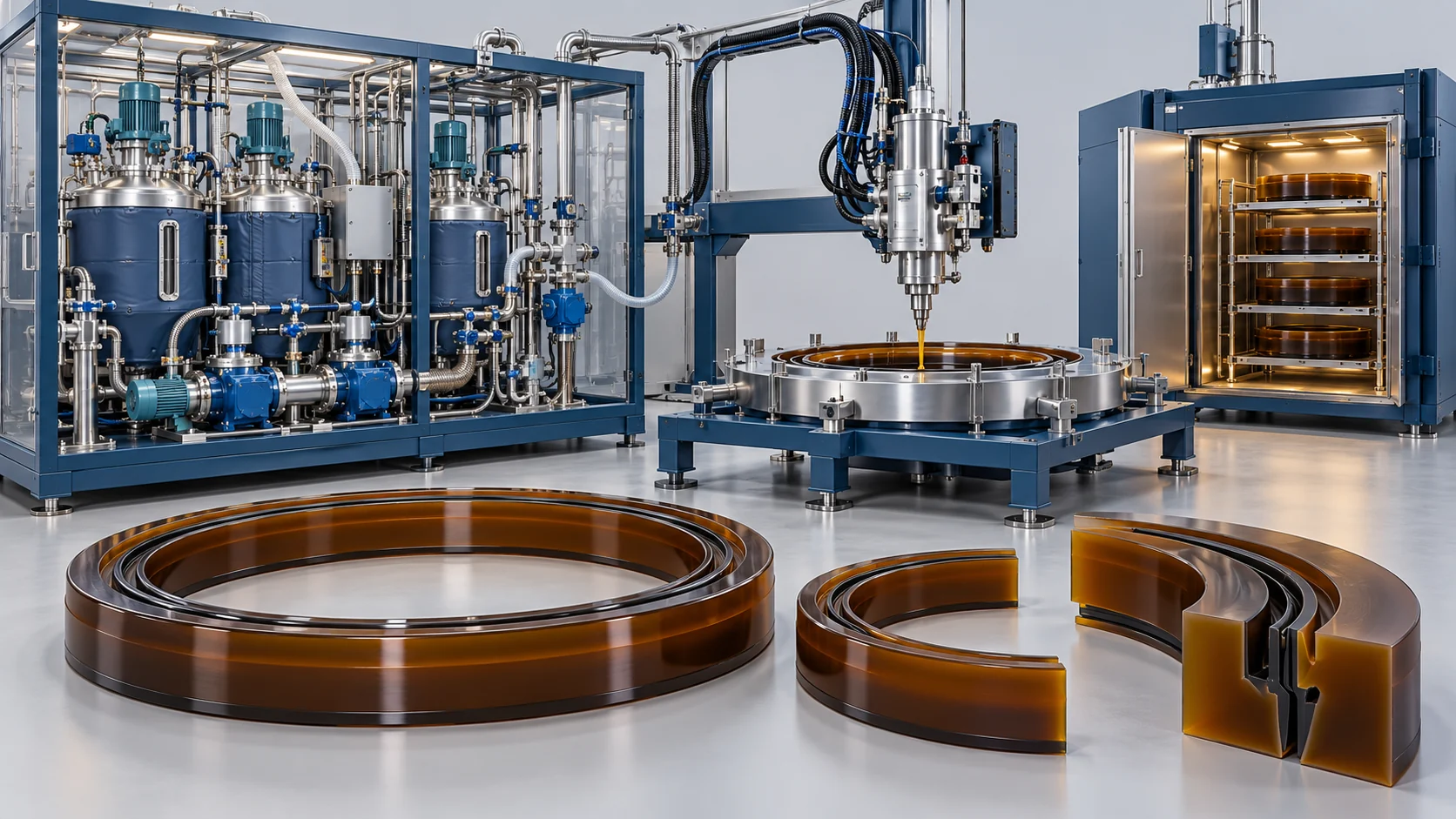
Subsea Polyurethane Seal Casting Solution
Enclosed material preparation, magnetic-coupled metering and balanced dispensing for cast polyurethane seal components. Finished-seal qualification is a separate material and component test requirement.
Molecular-Level Integrity for Deep-Water High-Pressure Barriers
Enclosed material preparation, magnetic-coupled metering and balanced dispensing for cast polyurethane seal components. Finished-seal qualification is a separate material and component test requirement. The package covers falling-film material preparation, magnetic-coupled metering, balanced dynamic mixing, dry nitrogen interfaces and controls. Vacuum tooling and step-treatment baths are optional. Prepolymer and curatives are supplied by the selected chemical supplier; nitrogen and site power are customer interfaces. Equipment delivery does not by itself establish RGD or subsea component qualification.
Vacuum Material Preparation
The specified preparation stage conditions the prepolymer; residual water and gas content require original measurements.
Magnetic-Coupled Metering
The specified pump containment arrangement removes the conventional rotating shaft-seal interface; integrity is verified for the configuration.
The equipment package is selected against finished-part geometry, material, output target and factory interfaces. Material properties, life comparisons and inspection results require project-specific test records.
Turnkey High-Integrity Seal Casting Workflow
An ultra-clean, high-temperature industrial sequence engineered for void-free polyurethane synthesis.
Three-Stage Falling-Film Hyper-Vacuum Degassing
TODI/PCL prepolymers are heated to 120°C and processed through spiral plates in 0.5 mm films under 0.01 kPa absolute pressure to reduce moisture below 10 ppm.
Magnetic-Drive Air-Isolated Metering
Hermetically sealed gear pumps driven by magnetic couplings meter components through thermal oil jacketed lines without dynamic shaft seal leakage.
Zero-Pressure-Differential Dynamic Homogenization
Streams enter a titanium-rotor dynamic head where automatic bypass valves match recirculation pressure to injection pressure, eliminating start surge spikes.
Reference Solution Engineering Envelope
Supplied configuration references. Values depend on the stated formulation, tool and operating conditions; component qualification and reported project outcomes require separate records.
| Parameter | Value / Unit | Applicable Configuration / Conditions |
|---|---|---|
| Degassing Vacuum Performance | Absolute pressure ≤ 0.01 kPa | Multi-stage falling-film continuous tower |
| Prepolymer Moisture Level | Less than 10 ppm | Karl Fischer titration after vacuum processing; supplied target pending original sampling records |
| Chemical Metering Capacity | 1.0 to 12.0 kg/min | Continuous variable servo gear pump with magnetic coupling |
| Shot Weight Tolerance | Within ±0.15 g | Zero-pressure-differential dynamic head at 4,500 g shot; supplied claim pending original weighing records, distinct from ratio tolerance |
| Fluid Heating Limit | Up to 140°C | Multi-zone thermal oil circulating system (±0.5°C) |
| Seal RGD Qualification | Project-specific qualification required | The supplied brief references NORSOK M-710 / ISO 23936-2 and a 30 MPa gas test; original reports are not attached |
Core Equipment for This Solution
The package covers falling-film material preparation, magnetic-coupled metering, balanced dynamic mixing, dry nitrogen interfaces and controls. Vacuum tooling and step-treatment baths are optional. Prepolymer and curatives are supplied by the selected chemical supplier; nitrogen and site power are customer interfaces. Equipment delivery does not by itself establish RGD or subsea component qualification.
Core Advantages of Haifeng Subsea Seal Systems
Configured process controls and engineering interfaces for the selected equipment package.
Vacuum Material Preparation
The specified preparation stage conditions the prepolymer; residual water and gas content require original measurements.
Magnetic-Coupled Metering
The specified pump containment arrangement removes the conventional rotating shaft-seal interface; integrity is verified for the configuration.
Balanced Mixing Interface
Recirculation and shot-opening controls are configured to limit pressure transients; shot repeatability requires separate testing.
Qualification Interfaces
Casting equipment supports material processing; RGD, gas compatibility and finished-seal performance require documented qualification.
Related Project Draft
Review the project configuration described in the supplied brief. Project records and reported results require verification before public use.
Frequently Asked Questions
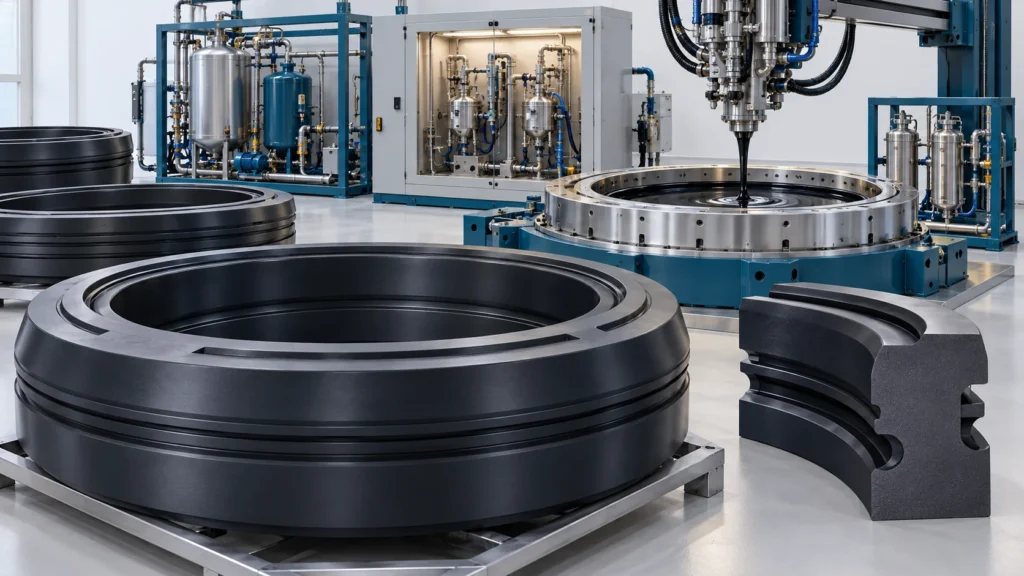
Find answers about Subsea Polyurethane Seal Casting Solution, including material selection, equipment configuration and the information needed to plan a production line.
How are material preparation and RGD qualification separated?
What does magnetic-coupled pump containment change?
How does shot-weight repeatability differ from ratio accuracy?
How are material temperature and seal size requirements confirmed?
Request a Subsea Seal Equipment Proposal
Share the finished part or drawing, material system, target capacity, automation requirements and factory utilities so the equipment and tooling interfaces can be discussed.


