
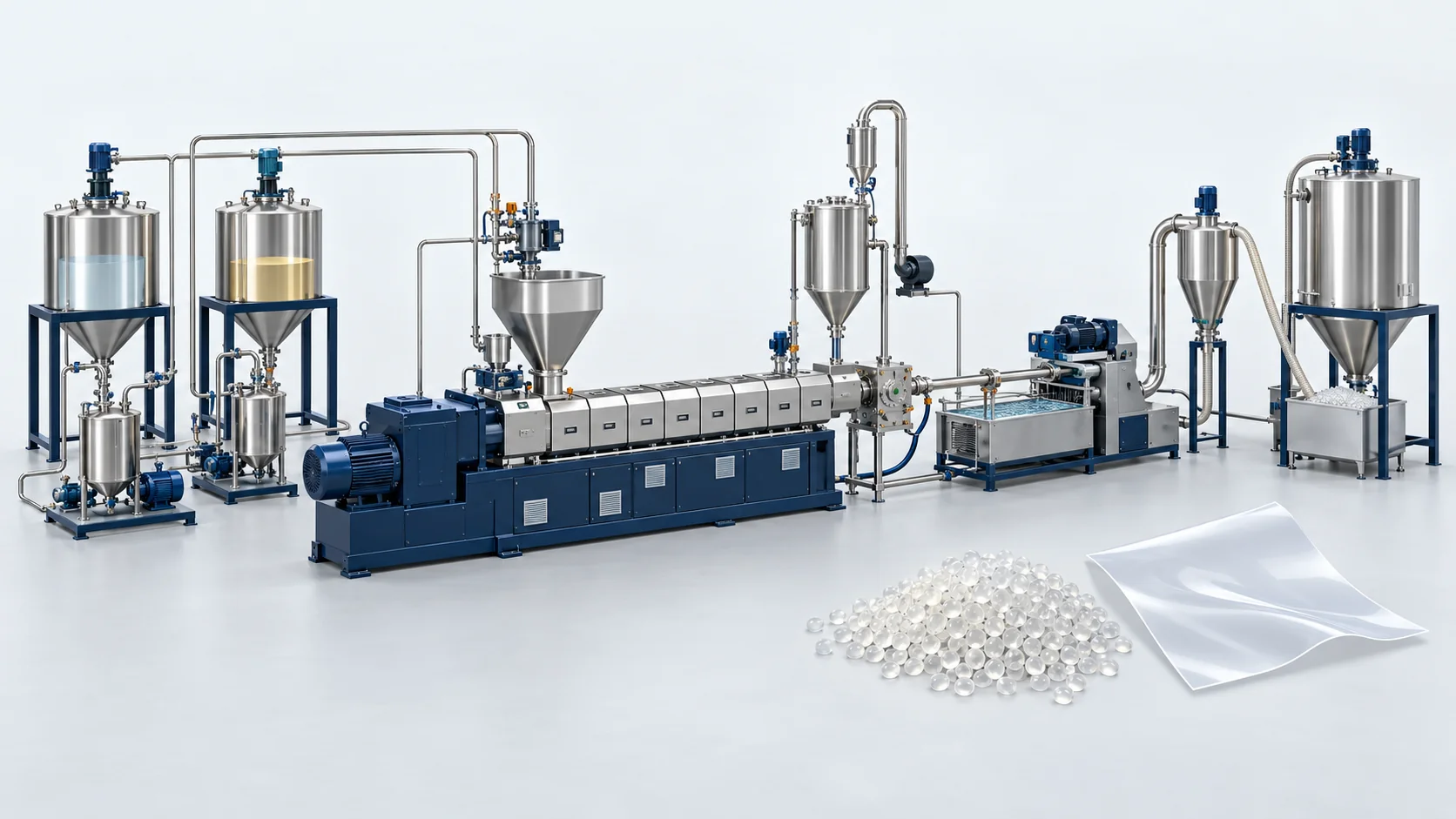
Blown-Film TPU Reactive Extrusion Solution
TPU feed preparation, reactive extrusion and melt stabilization for downstream thin-film processing and grade development.
Extreme Melt Strength for High-Speed Technical Film Blowing
TPU feed preparation, reactive extrusion and melt stabilization for downstream thin-film processing and grade development.
Equipment and process scope
Conditioned liquid feed streams, extruder, melt pump, venting and pelletizing/drying stages. Blown-film tower, formulation and final application qualification are separate interfaces.
Validation and production planning
The document reports 74.5 h uninterrupted operation inside a stated 72 h assessment; reconcile observation duration and aggregation. Melt pressure variation is not a guarantee of downstream bubble stability. MVTR varies with film thickness and method. Medical-use suitability is not established by the equipment brief.
Conditioned liquid feed streams, extruder, melt pump, venting and pelletizing/drying stages. Blown-film tower, formulation and final application qualification are separate interfaces. The document reports 74.5 h uninterrupted operation inside a stated 72 h assessment; reconcile observation duration and aggregation. Melt pressure variation is not a guarantee of downstream bubble stability. MVTR varies with film thickness and method. Medical-use suitability is not established by the equipment brief.Generated concept illustration for process discussion; not a photograph of the specified machine, a customer facility or a delivered project.
Turnkey High-Melt-Strength TPU Synthesis Workflow
Configuration sequence from the supplied brief. Material, tool, pressure/temperature basis and complete line balance require verification. The document reports 74.5 h uninterrupted operation inside a stated 72 h assessment; reconcile observation duration and aggregation. Melt pressure variation is not a guarantee of downstream bubble stability. MVTR varies with film thickness and method. Medical-use suitability is not established by the equipment brief.
Four-Stream Coriolis Mass-Flow Metering
Supplied process reference: Dehydrated PTMEG polyol, pure MDI, BDO, and branching curatives are conditioned under nitrogen and metered with ±0.15% mass precision.
Controlled Long-Chain Branching Reaction
Supplied process reference: Materials advance across an L/D = 58 barrel, where gentle distributive mixing blocks build an ultra-high molecular weight matrix (Mn ≥ 120,000).
Dual-Stage High-Vacuum De-Volatilization
Supplied process reference: Unreacted volatile monomers and moisture are extracted through dual vacuum vents operating down to 0.02 kPa to eliminate film bubbles.
Reference Solution Engineering Envelope
Supplied configuration and validation references; material/component results are separate from equipment ratings.
| Parameter | Value / Unit | Applicable Configuration / Conditions |
|---|---|---|
| Continuous Production Output | 250.0 to 750.0 kg/hour | High-torque twin-screw extruder with melt gear pump; supplied configuration or material target, pending the applicable original records |
| Extruder Screw Geometry | Ø 85 mm, L/D = 58 | Modular low-shear distributive mixing block profile; supplied configuration or material target, pending the applicable original records |
| Minimum Blown Film Thickness | Down to 0.015 mm (15 µm) | Stable bubble formation without sagging or tear; supplied configuration or material target, pending the applicable original records |
| Moisture Vapor Transmission (MVTR) | Greater than or equal to 8,000 g/(m²·24h) | ASTM E96 Inverted Cup method on 25 µm medical film; supplied configuration or material target, pending the applicable original records |
| Melt Pump Pressure Fluctuation | Less than ±0.03 MPa | Oil-jacketed melt gear pump decoupling screw surges; supplied configuration or material target, pending the applicable original records |
| Number-Average Molecular Weight | Mn ≥ 120,000 | Verified via GPC testing on compounded pellets; supplied configuration or material target, pending the applicable original records |
Core Equipment for This Solution
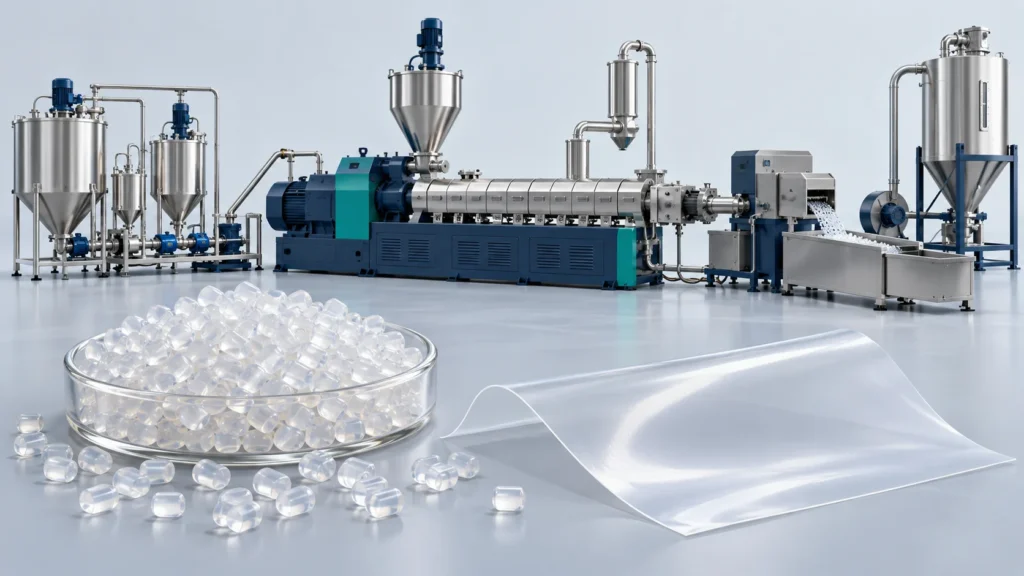
Conditioned liquid feed streams, extruder, melt pump, venting and pelletizing/drying stages. Blown-film tower, formulation and final application qualification are separate interfaces.
Core Advantages of Haifeng Film Systems
Configured equipment functions and interfaces for the selected material and tooling.
15-Micron Ultra-Thin Blowing
Supplied configuration function: High extensional melt strength eliminates bubble sagging, enabling steady continuous blowing down to 0.015 mm. Project-dependent performance requires validation.
72-Hour Zero-Break Stability
Supplied configuration function: Molecular uniformity and low gel levels prevent die build-up, allowing 72 hours of uninterrupted film blowing. Project-dependent performance requires validation.
< 0.05 MPa Pressure Decoupling
Supplied configuration function: Jacketed melt gear pumps absorb extruder surges, holding blown-film thickness variations within ±5%. Project-dependent performance requires validation.
≥ 8,000 g/(m²·24h) Medical Breathability
Supplied configuration function: Continuous polyether domains form high-efficiency moisture-vapor pathways for protective apparel. Project-dependent performance requires validation.
Related Project Draft
An anonymous project brief from the supplied document. Original attribution, dates, acceptance and outcome records require verification before public use.
Frequently Asked Questions
What is melt strength, and why is it critical for thin 0.015 mm blown films?
How does the melt gear pump decouple extruder screw surges?
What maintains medical biocompatibility in this reactive extrusion process?
Can this high-melt-strength resin be processed on three-roll calenders?
Discuss Your Production Goals
Share your product or drawing, material system, target output, automation needs and factory utilities so the equipment and interfaces can be configured.


