
Medical Blown-Film TPU Line Project in China
Review draft: Medical Blown-Film TPU Line Project. Configuration and reported outcomes require original project records.
Project Overview
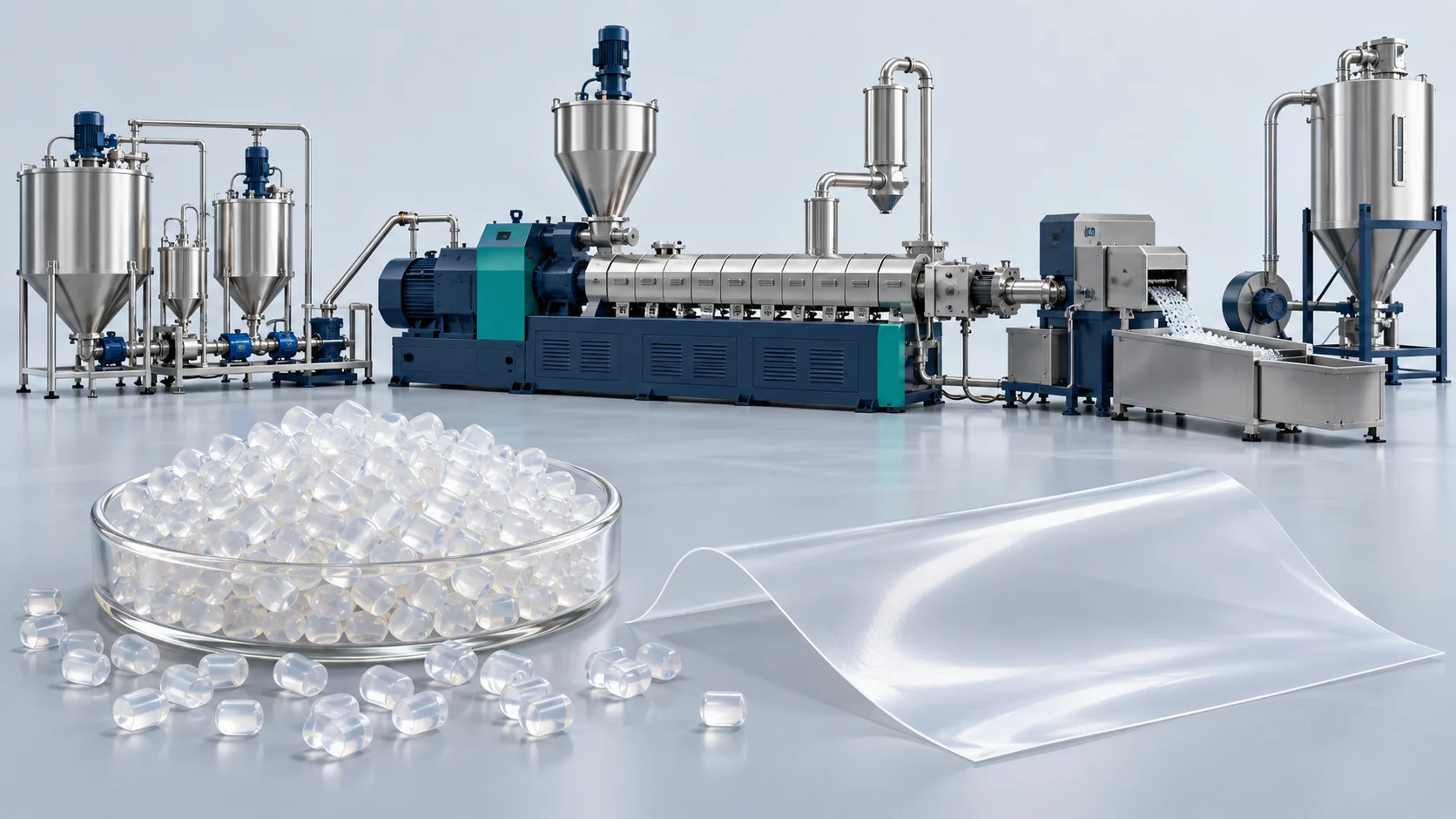
Illustration notice. Process illustrations are not verified photographs of this installation.
Project reference basis. Figures and configuration details are reported in the supplied project brief. They are reference values for the stated application, rather than verified acceptance results or a guarantee for another installation. Confirm the source records, material, tooling, operating schedule and test method when assessing a comparable project.
A leading national technical film and polymer enterprise in Zhejiang deployed Haifeng’s high melt-strength reactive extrusion line. The facility was commissioned to produce ultra-high molecular weight, high-melt-strength thermoplastic polyurethane (TPU) pellets engineered specifically for 15-micron breathable medical surgical drape films.
Prior to this installation, the client relied on standard extrusion-grade TPU resins. Due to low extensional melt viscosities and broad molecular weight distributions (Mn around 70,000), attempts to blow thin 15 µm films resulted in violent bubble oscillation and sagging. Operators suffered frequent bubble ruptures every 6 to 8 hours, causing massive resin scrap. Furthermore, moisture vapor transmission rates (MVTR) plateaued at 4,500 g/(m²·24h), failing export surgical barrier specifications.
Haifeng engineered a turnkey reactive extrusion plant centered on the HF-TPU85-FLM system. Combining four-stream mass flow dosing, an extended L/D = 58 branching twin-screw extruder, and a heavy-duty melt gear pump, the plant synthesized ultra-high molecular weight TPU (Mn ≥ 120,000). The resulting resin ran continuously on downstream blown-film lines for over 72 hours without bubble breaks, producing 15 µm films with an MVTR of 8,250 g/(m²·24h).
Review point: The document reports 74.5 h uninterrupted operation inside a stated 72 h assessment; reconcile observation duration and aggregation. Melt pressure variation is not a guarantee of downstream bubble stability. MVTR varies with film thickness and method. Medical-use suitability is not established by the equipment brief.
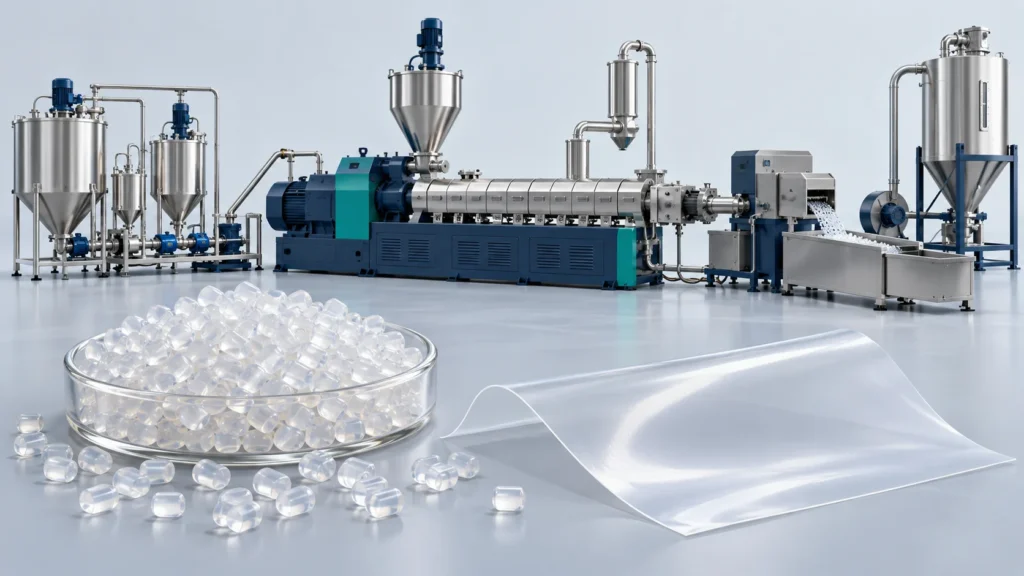
Concept illustration: Generated concept illustration for process discussion; not a photograph of the specified machine, a customer facility or a delivered project.
Solutions Delivery
Configuration reported in the supplied brief.
Haifeng engineered an automated reactive compounding plant optimized for high-molecular-weight synthesis. High-purity hydrophilic polyether polyols, pure molten MDI, 1,4-BDO, and long-chain branching curatives are conditioned in stainless steel day tanks under nitrogen blankets at 80°C.
The components are metered into Zone 1 of an L/D = 58 co-rotating twin-screw extruder using Coriolis-guided servo pumps. Across 14 independently regulated barrel zones, gentle distributive mixing blocks build an ultra-high molecular weight matrix (Mn = 125,000) through controlled branching reactions, holding processing exotherms under tight limits.
An oil-jacketed melt gear pump pulls polymer from screw tips, maintaining steady discharge pressure at 15.2 MPa into a 325-mesh continuous screen changer with pressure drift held within ±0.03 MPa. The melt extrudes through multi-orifice die plates into a tempered water cutting chamber, sliced into uniform spherical pellets by carbide knives. After centrifugal de-watering to < 0.02% moisture, the resin feeds into cleanroom blown-film lines, delivering flawless 15 µm bubble stability across 72 continuous operating hours.
The document reports 74.5 h uninterrupted operation inside a stated 72 h assessment; reconcile observation duration and aggregation. Melt pressure variation is not a guarantee of downstream bubble stability. MVTR varies with film thickness and method. Medical-use suitability is not established by the equipment brief.
| Equipment | Model | Qty | Function |
|---|---|---|---|
| High Melt-Strength TPU Extruder | HF-TPU85-FLM (L/D = 58) | 1 set | Core continuous long-chain branching reaction and 0.02 kPa vacuum de-volatilization. |
| Jacketed High-Torque Melt Gear Pump | HF-MGP-150 | 1 unit | Pressure decoupling holding die discharge fluctuations within ±0.03 MPa. |
| Four-Stream Mass-Flow Dosing Skid | HF-LDS-04M | 1 set | Continuous servo metering with Coriolis mass tracking for branching agents. |
| Enclosed Underwater Pelletizer Skid | HF-UWP-800M | 1 set | Die-face hot cutting, spin drying to < 0.02% moisture, and packaging. |
Reported Results — Original Records Required
Master High Melt-Strength Blown-Film TPU Production
Connect with Haifeng extrusion specialists to deploy high-molecular-weight reactive lines engineered for 15-micron technical blown films.


