
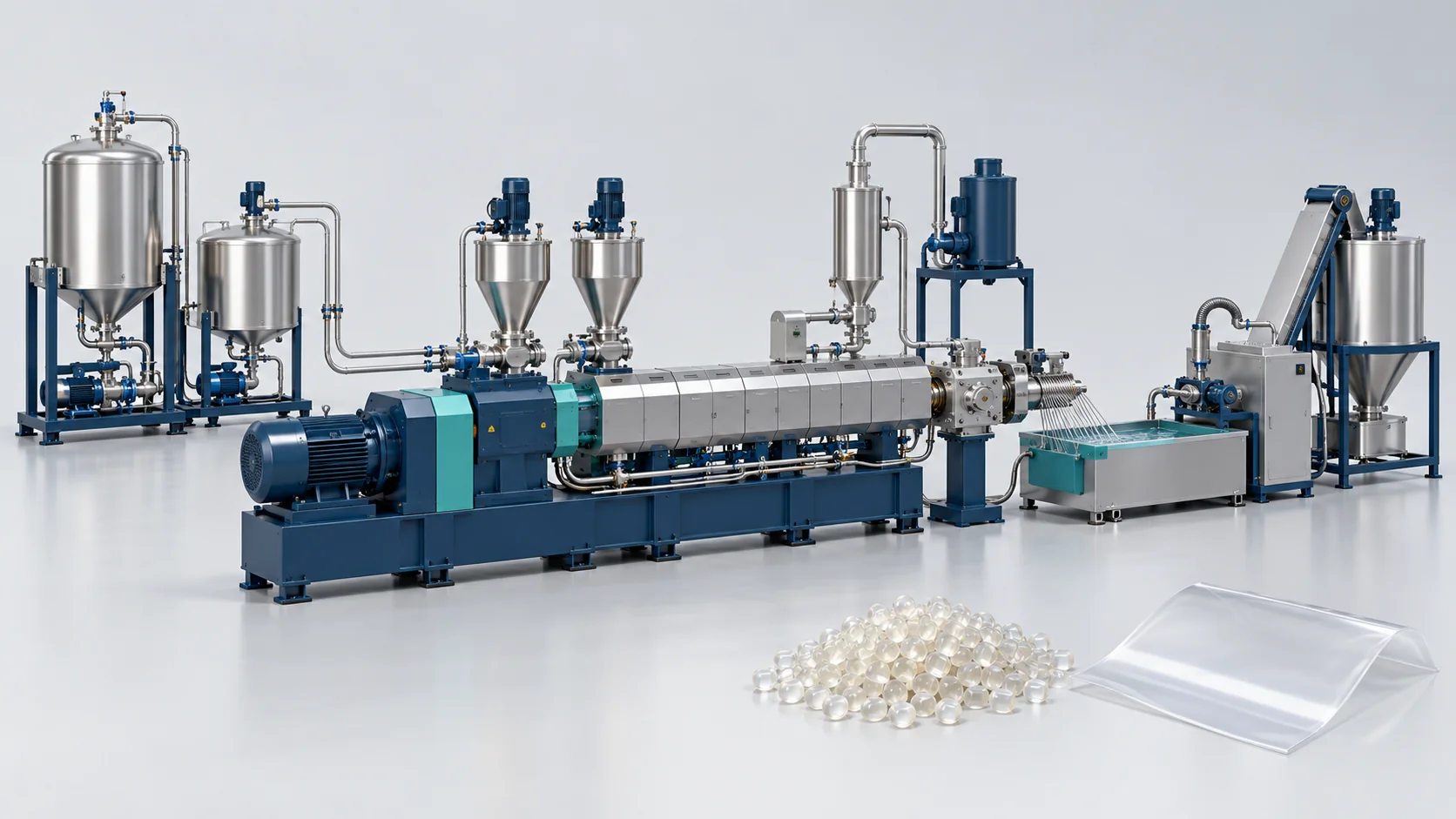
TPU Reactive Extrusion Line | Blown-Film Grades
TPU feed preparation, reactive extrusion and melt stabilization for downstream thin-film processing and grade development.
High Melt-Strength Reactive Synthesis for Technical TPU Films
TPU feed preparation, reactive extrusion and melt stabilization for downstream thin-film processing and grade development.
TPU feed preparation, reactive extrusion and melt stabilization for downstream thin-film processing and grade development.
Conditioned liquid feed streams, extruder, melt pump, venting and pelletizing/drying stages. Blown-film tower, formulation and final application qualification are separate interfaces.
The document reports 74.5 h uninterrupted operation inside a stated 72 h assessment; reconcile observation duration and aggregation. Melt pressure variation is not a guarantee of downstream bubble stability. MVTR varies with film thickness and method. Medical-use suitability is not established by the equipment brief.
Concept illustration: Generated concept illustration for process discussion; not a photograph of the specified machine, a customer facility or a delivered project.
Material Flow and Working Principle
Four-Stream Dehydrated Chemical Metering
High-purity PTMEG polyol, pure MDI, BDO extender, and trifunctional branching curatives are conditioned under nitrogen at 80°C and metered into the throat with mass-flow precision within ±0.15%.
High-Molecular-Weight Twin-Screw Reaction
The formulation advances through an extended L/D = 58 extruder barrel, undergoing controlled chain extension and long-chain branching across 14 zones to achieve number-average molecular weights above 120,000.
High-Torque Melt Pump Pressure Decoupling
An oil-jacketed melt gear pump pulls polymer from screw tips, decoupling extrusion variance and keeping discharge pressure fluctuations below 0.05 MPa into a 325-mesh hydraulic screen changer.
Die-Face Underwater Cutting & Clean Water Slurry
The viscous melt is extruded through multi-orifice die plates into a flooded cutting chamber, where high-speed multi-knife cutters slice uniform spherical pellets in tempered 50°C water.
Centrifugal Spin Dewatering & Dehumidified Storage
The pellet slurry transfers to a high-speed spin dryer dropping moisture below 0.02% (200 ppm), discharging into sealed aluminum-lined storage bags to protect high-melt-strength integrity.
Model and Technical Parameters
Supplied HF-TPU85-FLM configuration references, pending original calibration and acceptance documents. Material, finished-part and project outcomes are separate from equipment ratings. The document reports 74.5 h uninterrupted operation inside a stated 72 h assessment; reconcile observation duration and aggregation. Melt pressure variation is not a guarantee of downstream bubble stability. MVTR varies with film thickness and method. Medical-use suitability is not established by the equipment brief.
| Technical Parameter | HF-TPU85-FLM |
|---|---|
| Components | 4 Liquid Streams (PTMEG Polyol, Pure MDI, BDO, Branching Agent) |
| Output Range (g/s) | 250.0 to 750.0 kg/h (Continuous compound throughput) |
| Mixing Ratio Range | 100:32:8:0.5 to 100:60:18:1.5 (By weight) |
| Ratio Accuracy | ±0.15% (Continuous closed-loop Coriolis feedback) |
| Power Supply | 380V, 3-Phase, 50Hz (Custom 440V/480V 60Hz optional) |
| Working Pressure | 12.0 to 18.0 MPa (Extruder die discharge and pelletizer head) |
| Tank Capacity (L) | Day tanks: 2 x 1,000 L (Stainless steel with thermal jackets) |
| Weight | 17,800 kg (Combined extruder, gear pump, and pelletizer) |
| Dimensions (L×W×H) | 24,500 mm x 3,600 mm x 3,200 mm |
| Minimum Blown Film Thickness | Down to 0.015 mm (15 µm continuous bubble); Downstream blown-film tower; supplied reference pending original configuration or test records |
| Melt Pump Pressure Fluctuation | < ±0.03 MPa (At 15.0 MPa delivery pressure); Oil-jacketed melt gear pump; supplied reference pending original configuration or test records |
| Moisture Vapor Transmission (MVTR) | ≥ 8,000 g/(m²·24h) (25 µm film thickness); ASTM E96 Inverted Cup method; supplied reference pending original configuration or test records |
| Number-Average Molecular Weight | Mn ≥ 120,000 (GPC measurement in THF); Cured polymer pellet sample; supplied reference pending original configuration or test records |
Key Equipment Features
Conditioned liquid feed streams, extruder, melt pump, venting and pelletizing/drying stages. Blown-film tower, formulation and final application qualification are separate interfaces.
0.015 mm Ultra-Thin Blown Film
Supplied configuration reference: High melt strength eliminates bubble sagging, enabling stable continuous blowing down to 15 microns. Actual capability requires material and tooling validation.
< 0.05 MPa Pressure Ripple
Supplied configuration reference: Jacketed melt gear pump decouples screw surges, locking die pressure fluctuations under 0.05 MPa. Actual capability requires material and tooling validation.
72-Hour Continuous Run
Supplied configuration reference: Molecular uniformity prevents die lip drool and fish-eye buildup, supporting 72-hour non-stop film production. Actual capability requires material and tooling validation.
≥ 8,000 g/(m²·24h) Breathability
Supplied configuration reference: Polyether matrix structure delivers extreme moisture vapor permeability for technical outdoor apparel. Actual capability requires material and tooling validation.


