
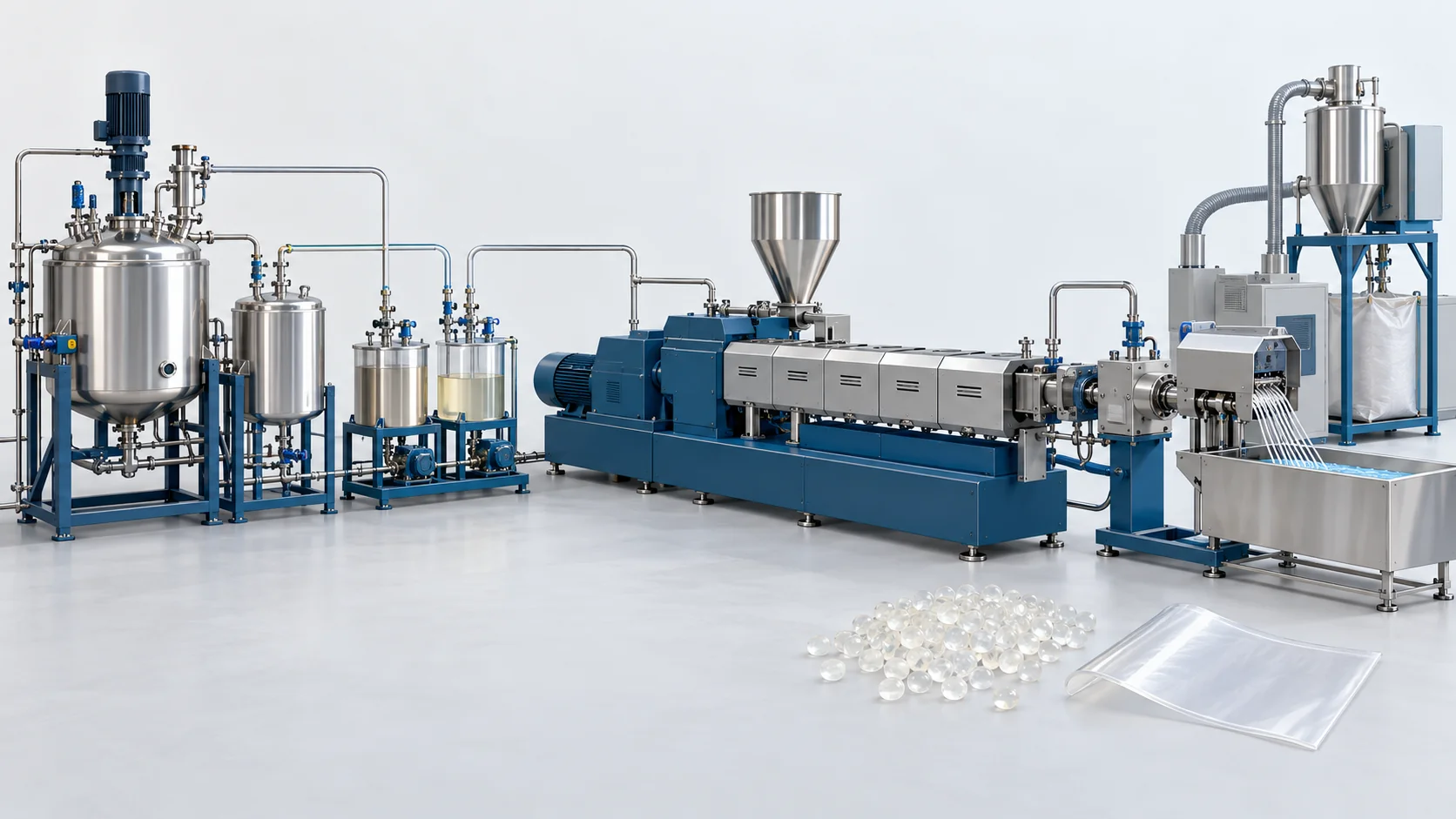
Aliphatic TPU Two-Step Production Solution
A two-stage aliphatic TPU process with prepolymer preparation, reactive extrusion, melt conditioning and pelletizing for film-grade development.
Extreme Purity & Non-Yellowing Optical Precision for PPF Resins
A two-stage aliphatic TPU process with prepolymer preparation, reactive extrusion, melt conditioning and pelletizing for film-grade development.
Equipment and process scope
Selected prepolymer reactor, liquid feed circuits, twin-screw extruder, melt pump, pelletizer and drying interfaces. Film conversion and optical testing are separate downstream processes.
Validation and production planning
CSTR and tubular reactor are different architectures and must be reconciled from the supplied description. Polymerization is not permanent thermoset crosslinking. Optical defect counts are film-conversion results, and ASTM E313 describes color-index calculations rather than the complete weathering exposure. Yellowing method, film thickness and sampling need original records.
Selected prepolymer reactor, liquid feed circuits, twin-screw extruder, melt pump, pelletizer and drying interfaces. Film conversion and optical testing are separate downstream processes. CSTR and tubular reactor are different architectures and must be reconciled from the supplied description. Polymerization is not permanent thermoset crosslinking. Optical defect counts are film-conversion results, and ASTM E313 describes color-index calculations rather than the complete weathering exposure. Yellowing method, film thickness and sampling need original records.Generated concept illustration for process discussion; not a photograph of the specified machine, a customer facility or a delivered project.
Turnkey Two-Step Aliphatic TPU Synthesis Workflow
Configuration sequence from the supplied brief. Material, tool, pressure/temperature basis and complete line balance require verification. CSTR and tubular reactor are different architectures and must be reconciled from the supplied description. Polymerization is not permanent thermoset crosslinking. Optical defect counts are film-conversion results, and ASTM E313 describes color-index calculations rather than the complete weathering exposure. Yellowing method, film thickness and sampling need original records.
Continuous Tubular CSTR Pre-Reaction (Step 1)
Supplied process reference: Dehydrated PCL polyol and pure liquid H12MDI are metered into a jacketed tubular CSTR reactor at 90°C under nitrogen, forming a uniform prepolymer.
High-Torque Mirror Screw Extension (Step 2)
Supplied process reference: Prepolymer enters Zone 1 of the L/D = 60 mirror extruder; micro-nozzles inject BDO extender and bismuth catalysts to complete linear chain growth.
Three-Stage Deep-Vacuum De-Volatilization
Supplied process reference: The reacting melt traverses three vacuum vents operating down to 0.02 kPa, extracting unreacted monomers and micro-moisture to achieve optical clarity.
Reference Solution Engineering Envelope
Supplied configuration and validation references; material/component results are separate from equipment ratings.
| Parameter | Value / Unit | Applicable Configuration / Conditions |
|---|---|---|
| Continuous Production Output | 150.0 to 500.0 kg/hour | High-torque co-rotating twin-screw extruder with CSTR; supplied configuration or material target, pending the applicable original records |
| Extruder Screw Architecture | Ø 65 mm, L/D = 60 | Modular PVD mirror-finish screw elements (Ra ≤ 0.05 µm); supplied configuration or material target, pending the applicable original records |
| Optical Gel Defect Threshold | Less than 2 parts/m² | Verified via automated optical inspection on 150 µm film; supplied configuration or material target, pending the applicable original records |
| Accelerated UV Yellowing Index | Δ YI < 0.8 (CIE Lab) | 1,000 hours QUV-A exposure under ASTM E313; supplied configuration or material target, pending the applicable original records |
| Chemical Dosing Precision | Ratio tolerance within ±0.1% | Four-stream Coriolis mass-flow closed-loop skid; supplied configuration or material target, pending the applicable original records |
| De-Volatilization Vacuum Level | Absolute pressure ≤ 0.02 kPa | Three-stage multi-port vacuum extraction skid with cold traps; supplied configuration or material target, pending the applicable original records |
Core Equipment for This Solution
Selected prepolymer reactor, liquid feed circuits, twin-screw extruder, melt pump, pelletizer and drying interfaces. Film conversion and optical testing are separate downstream processes.
Core Advantages of Haifeng Optical TPU Systems
Configured equipment functions and interfaces for the selected material and tooling.
reported Fish-Eyes < 2 parts/m²
Supplied configuration function: Two-step CSTR prepolymerization eliminates unreacted monomer pockets, ensuring pristine optical film clarity. Project-dependent performance requires validation.
Non-Yellowing Δ YI < 0.8 Stability
Supplied configuration function: Aliphatic H12MDI/PCL molecular architecture and PVD-coated barrels eliminate metallic ion yellowing catalysts. Project-dependent performance requires validation.
Deep 0.02 kPa Vacuum Extraction
Supplied configuration function: Three-stage de-volatilization strips residual monomers and moisture, eliminating film bubble haziness. Project-dependent performance requires validation.
Ultra-Pure Deionized Pelletizing
Supplied configuration function: Cleanroom tempered deionized water cutting prevents surface salt marks and dust contamination on pellets. Project-dependent performance requires validation.
Related Project Draft
An anonymous project brief from the supplied document. Original attribution, dates, acceptance and outcome records require verification before public use.
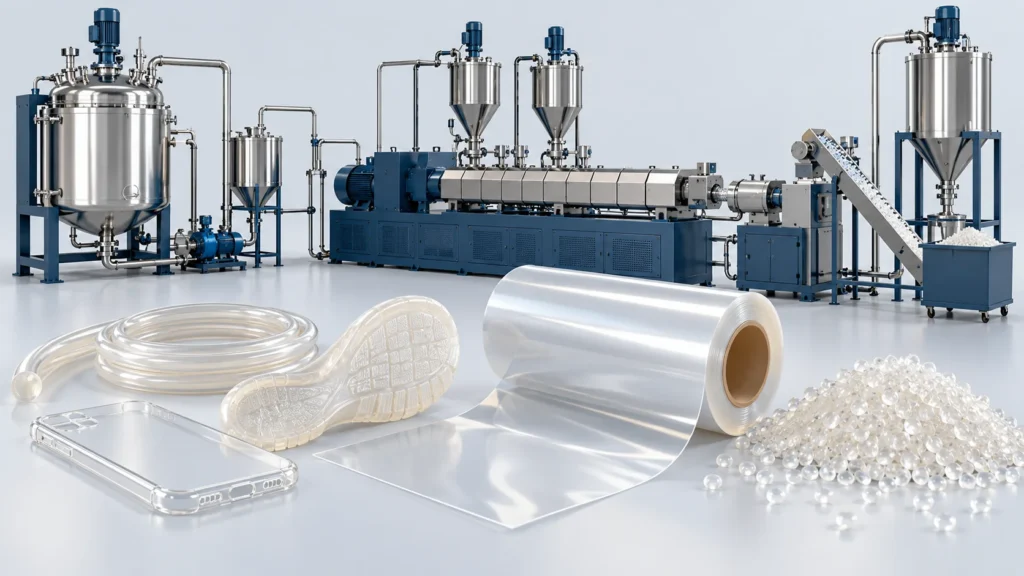
Frequently Asked Questions
How does two-step CSTR prepolymerization prevent film fish-eye gels?
Why is PVD mirror coating necessary on screw elements and barrels?
What prevents the high-purity water pelletizer from picking up dust?
Can this line produce polycaprolactone (PCL) and polycarbonate (PCDL) blends?
Discuss Your Production Goals
Share your product or drawing, material system, target output, automation needs and factory utilities so the equipment and interfaces can be configured.


