
PPF Optical Aliphatic TPU Line Project in China
Review draft: PPF Optical Aliphatic TPU Line Project. Configuration and reported outcomes require original project records.
Project Overview
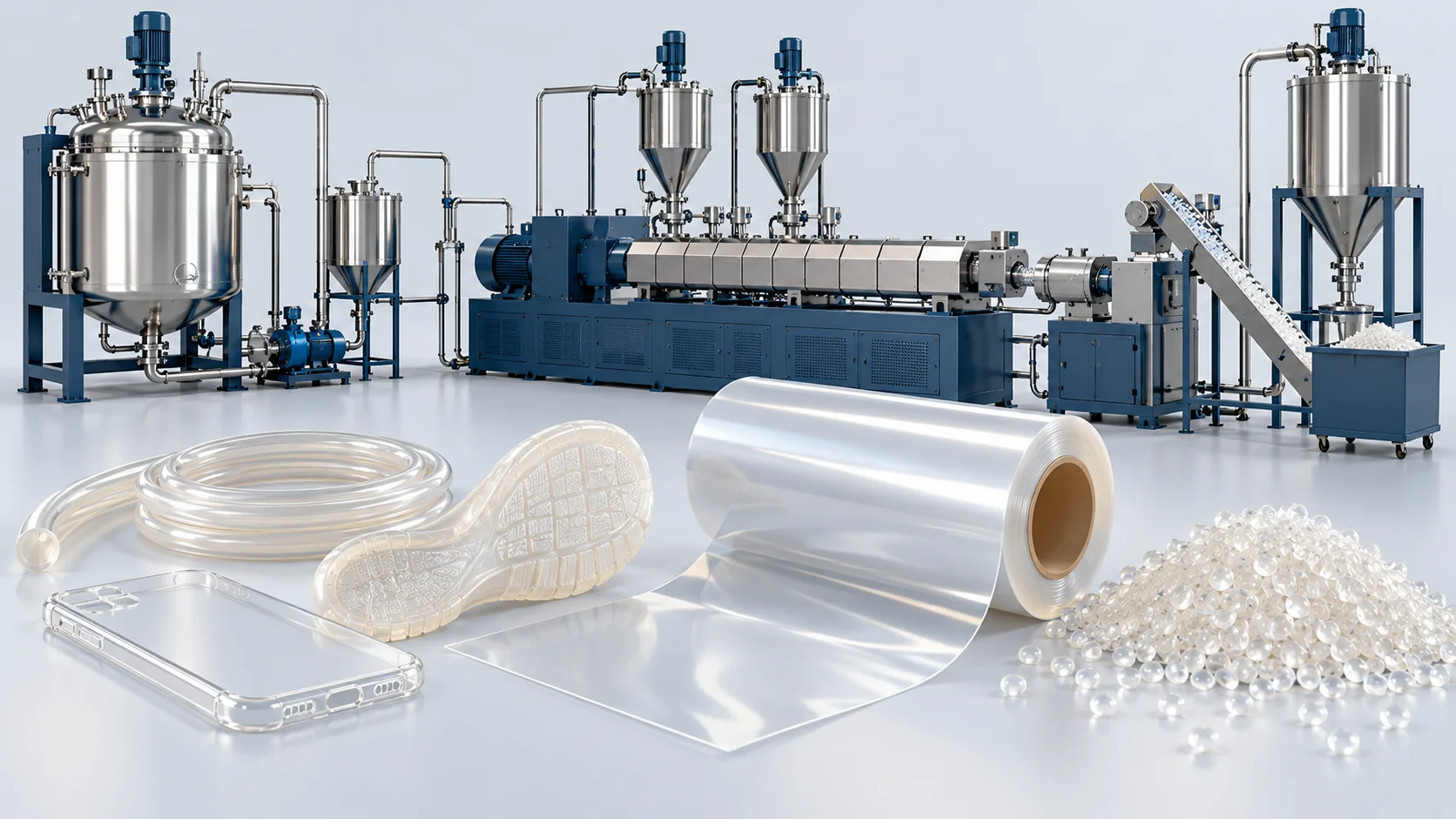
Illustration notice. Process illustrations are not verified photographs of this installation.
Project reference basis. Figures and configuration details are reported in the supplied project brief. They are reference values for the stated application, rather than verified acceptance results or a guarantee for another installation. Confirm the source records, material, tooling, operating schedule and test method when assessing a comparable project.
A leading national petrochemical and specialty polymer corporation in Hunan partnered with Haifeng to establish a greenfield two-step reactive extrusion facility for optical-grade aliphatic thermoplastic polyurethane (TPU). The project was commissioned to manufacture high-purity, non-yellowing pellets used exclusively in cast film lines producing premium automotive paint protection films (PPF).
Prior to this installation, the client struggled with conventional one-shot reactive extrusion platforms. Because aliphatic H12MDI reacts much slower than aromatic isocyanates, improper shear mixing generated unreacted micro-gel agglomerations. When cast into 150 µm PPF films, the material showed excessive fish-eye gel blemishes (averaging 25 to 40 defects per square meter) and optical haziness. Furthermore, trace metallic contamination from standard screw barrels caused severe yellowing under UV radiation (Δ YI > 2.8 over 1,000 hours), disqualifying the resin from luxury automotive supply chains.
Haifeng engineered an ultra-clean two-step reactive compounding plant centered on the HF-TPU65-ALI platform. By pairing a continuous tubular CSTR prepolymer reactor with an extended L/D = 60 mirror-finish twin-screw extruder and deionized water pelletizing, the facility achieved gel-free optical purity (< 2 parts/m²) and reported UV stability of Δ YI = 0.65.
Review point: CSTR and tubular reactor are different architectures and must be reconciled from the supplied description. Polymerization is not permanent thermoset crosslinking. Optical defect counts are film-conversion results, and ASTM E313 describes color-index calculations rather than the complete weathering exposure. Yellowing method, film thickness and sampling need original records.
Concept illustration: Generated concept illustration for process discussion; not a photograph of the specified machine, a customer facility or a delivered project.
Solutions Delivery
Configuration reported in the supplied brief.
Haifeng engineered an ultra-clean, stainless-steel-clad continuous polymerization plant spanning 22 meters. The process initiates in Step 1, where dehydrated polycaprolactone polyol (PCL) and pure liquid H12MDI are metered under Coriolis mass flow measurement into a continuous tubular CSTR reactor at 90°C. This pre-reaction builds a homogeneous prepolymer stream with near-zero free isocyanate monomer variance.
In Step 2, the prepolymer discharges directly into Zone 1 of the mirror-finish twin-screw extruder (L/D = 60). Chain extenders (BDO) and organic bismuth catalysts are injected via high-pressure micro-valves. The reacting polymer advances across 15 independently regulated thermal zones lined with PVD-coated mirror sleeves (Ra ≤ 0.05 µm) that eliminate shear hotspots and metallic ion leaching.
Three progressive vacuum de-volatilization ports operating at 0.02 kPa extract trace monomers and moisture. An oil-jacketed melt gear pump stabilizes discharge pressure through a continuous 325-mesh screen changer into an underwater pelletizer flooded with pure deionized water. The resulting spherical pellets are spin-dried and pneumatically conveyed to cleanroom packaging silos.
CSTR and tubular reactor are different architectures and must be reconciled from the supplied description. Polymerization is not permanent thermoset crosslinking. Optical defect counts are film-conversion results, and ASTM E313 describes color-index calculations rather than the complete weathering exposure. Yellowing method, film thickness and sampling need original records.
| Equipment | Model | Qty | Function |
|---|---|---|---|
| Optical Aliphatic TPU Extruder | HF-TPU65-ALI (L/D = 60) | 1 set | Core L/D 60 mirror-finish reaction, PVD barrel sleeves, and vacuum stripping. |
| Continuous Tubular CSTR Pre-Reactor | HF-CSTR-100 | 1 unit | Conducts Step 1 prepolymerization of H12MDI and PCL to eliminate gels. |
| Deionized Water Underwater Pelletizer | HF-DI-UWP-500 | 1 set | Cleanroom underwater die-face cutting with closed deionized water loop. |
| Three-Stage Ultra-Vacuum Skid | HF-UVS-02 | 1 unit | Multi-port vacuum pumps drawing melt zones down to 0.02 kPa absolute. |
Reported Results — Original Records Required
Master Optical Aliphatic TPU Pellet Production
Connect with Haifeng reactive extrusion specialists to implement two-step CSTR and mirror-finish extrusion lines for optical-grade PPF resin manufacturing.


