
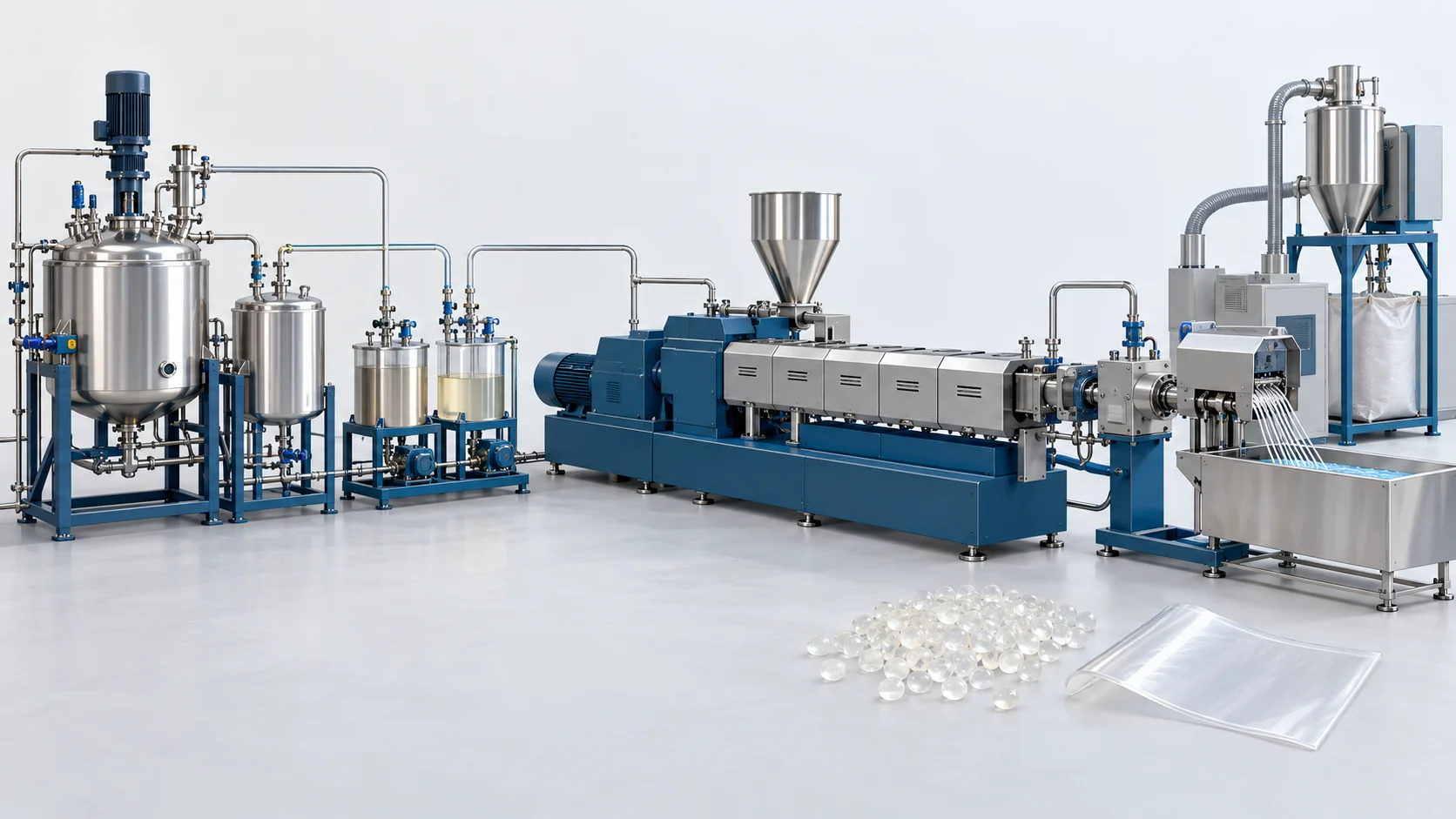
Solución de producción de TPU alifático en dos etapas
Un proceso de TPU alifático en dos etapas con preparación del prepolímero, extrusión reactiva, acondicionamiento de la masa fundida y peletización para el desarrollo de grados para película.
Optical-Grade Aliphatic TPU Process Development
Un proceso de TPU alifático en dos etapas con preparación del prepolímero, extrusión reactiva, acondicionamiento de la masa fundida y peletización para el desarrollo de grados para película.
Equipment and process scope
Selected prepolymer reactor, liquid feed circuits, twin-screw extruder, melt pump, pelletizer and drying interfaces. Film conversion and optical testing are separate downstream processes.
Validation and production planning
The reactor architecture is selected in the project configuration. Optical defect and yellowing results apply to the selected film thickness, conversion process, conditioning and test method.
Define prepolymer preparation, chain-extension extrusion, devolatilization and pellet finishing as separate stages. Optical-film qualification follows downstream sample production; gel counts, yellowing index and color coordinates require distinct methods and specimen conditions.
Turnkey Two-Step Aliphatic TPU Synthesis Workflow
The process sequence and line configuration are defined for the selected material, tooling and production requirements.
Configured Prepolymer Reaction (Step 1)
Dehydrated polyol and the selected aliphatic isocyanate are metered into the specified reactor under controlled temperature and atmosphere. Stirred-tank, tubular or staged architecture is defined in the approved process diagram.
High-Torque Mirror Screw Extension (Step 2)
Supplied process reference: Prepolymer enters Zone 1 of the L/D = 60 mirror extruder; micro-nozzles inject BDO extender and bismuth catalysts to complete linear chain growth.
Three-Stage Deep-Vacuum De-Volatilization
Supplied process reference: The reacting melt traverses three vacuum vents operating down to 0.02 kPa, extracting unreacted monomers and micro-moisture to achieve optical clarity.
Envolvente de ingeniería de la solución de referencia
Supplied configuration and validation references; material/component results are separate from equipment ratings.
| Parámetro | Valor / Unidad | Configuración / Condiciones aplicables |
|---|---|---|
| Producción continua | 150.0 to 500.0 kg/hour | Twin-screw extrusion configuration reference; reactor architecture defined separately in the approved process diagram |
| Extruder Screw Architecture | Ø 65 mm, L/D = 60 | Modular PVD mirror-finish screw elements (Ra ≤ 0.05 µm) |
| Optical Gel Defect Threshold | Less than 2 parts/m² | Verified via automated optical inspection on 150 µm film |
| Yellowness Index (YI) | Acceptance target agreed for the selected film sample | Specify the yellowness-index calculation method, illuminant/observer, film thickness and exposure conditions |
| CIE L*a*b* Color Difference | Reported separately where required | Specify the actual color-difference formula, reference specimen, illuminant/observer and exposure conditions; not a YI result |
| Chemical Dosing Precision | Ratio tolerance within ±0.1% | Skid de circuito cerrado con caudalímetros másicos Coriolis de cuatro líneas |
| De-Volatilization Vacuum Level | Absolute pressure ≤ 0.02 kPa | Three-stage multi-port vacuum extraction skid with cold traps |
Equipos principales de esta solución
The aliphatic extrusion reference needs its actual reactor/feeding boundary, extension barrel, vacuum and pelletizing package confirmed.
Core Advantages of Haifeng Optical TPU Systems
Configured equipment functions and interfaces for the selected material and tooling.
Controlled Prepolymer Preparation
Coordinate feed preparation, pre-reaction and chain extension for the selected material. Film gel content is measured on the specified film thickness and conversion process.
Material-Specific Yellowing Evaluation
Evaluate the selected aliphatic TPU film after the agreed conditioning and exposure. Report yellowness-index change separately from CIE L*a*b* color difference using the stated methods.
Deep 0.02 kPa Vacuum Extraction
Supplied configuration function: Three-stage de-volatilization strips residual monomers and moisture, eliminating film bubble haziness. Project-dependent performance requires validation.
Ultra-Pure Deionized Pelletizing
Supplied configuration function: Cleanroom tempered deionized water cutting prevents surface salt marks and dust contamination on pellets. Project-dependent performance requires validation.
Proyectos relacionados
The PPF-grade project supports its selected resin and film evaluation, not universal compatibility with every aliphatic or polyol family.
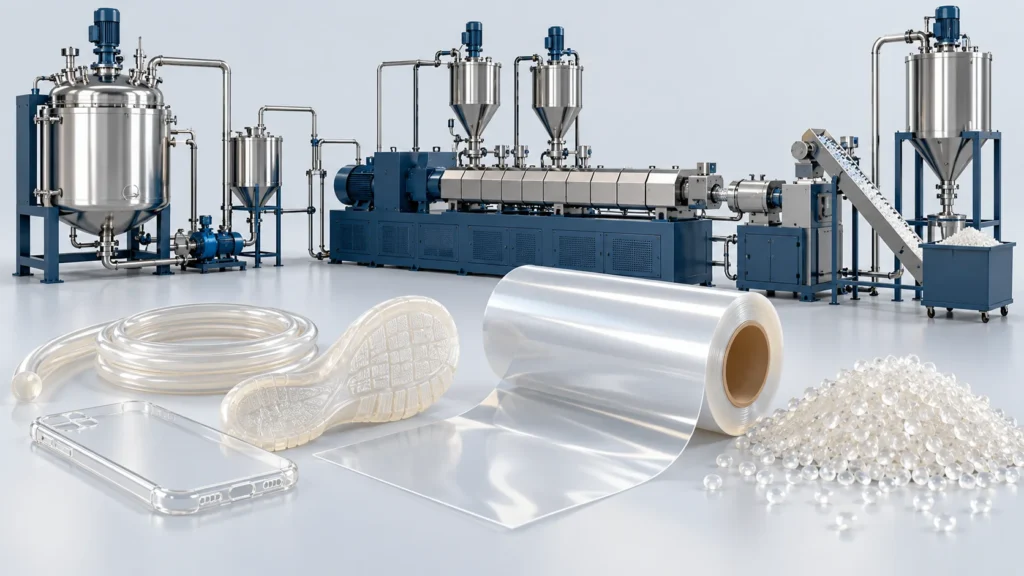
Preguntas frecuentes
How is the prepolymer reactor selected?
Why is PVD mirror coating necessary on screw elements and barrels?
What prevents the high-purity water pelletizer from picking up dust?
Can this line produce polycaprolactone (PCL) and polycarbonate (PCDL) blends?
Are yellowing index and CIE L*a*b* color difference the same result?
¿Qué datos se necesitan para esta configuración?
How should an optical-film gel criterion be specified?
Hablemos de sus objetivos de producción
Share the following for this application: Aliphatic feeds, prepolymer source/target, extruder/barrel, output/changes, pellet purity and optical-film sampling/tests. Our team will reply within one business day. Once requirements are clear, we provide a preliminary proposal within two business days.


