
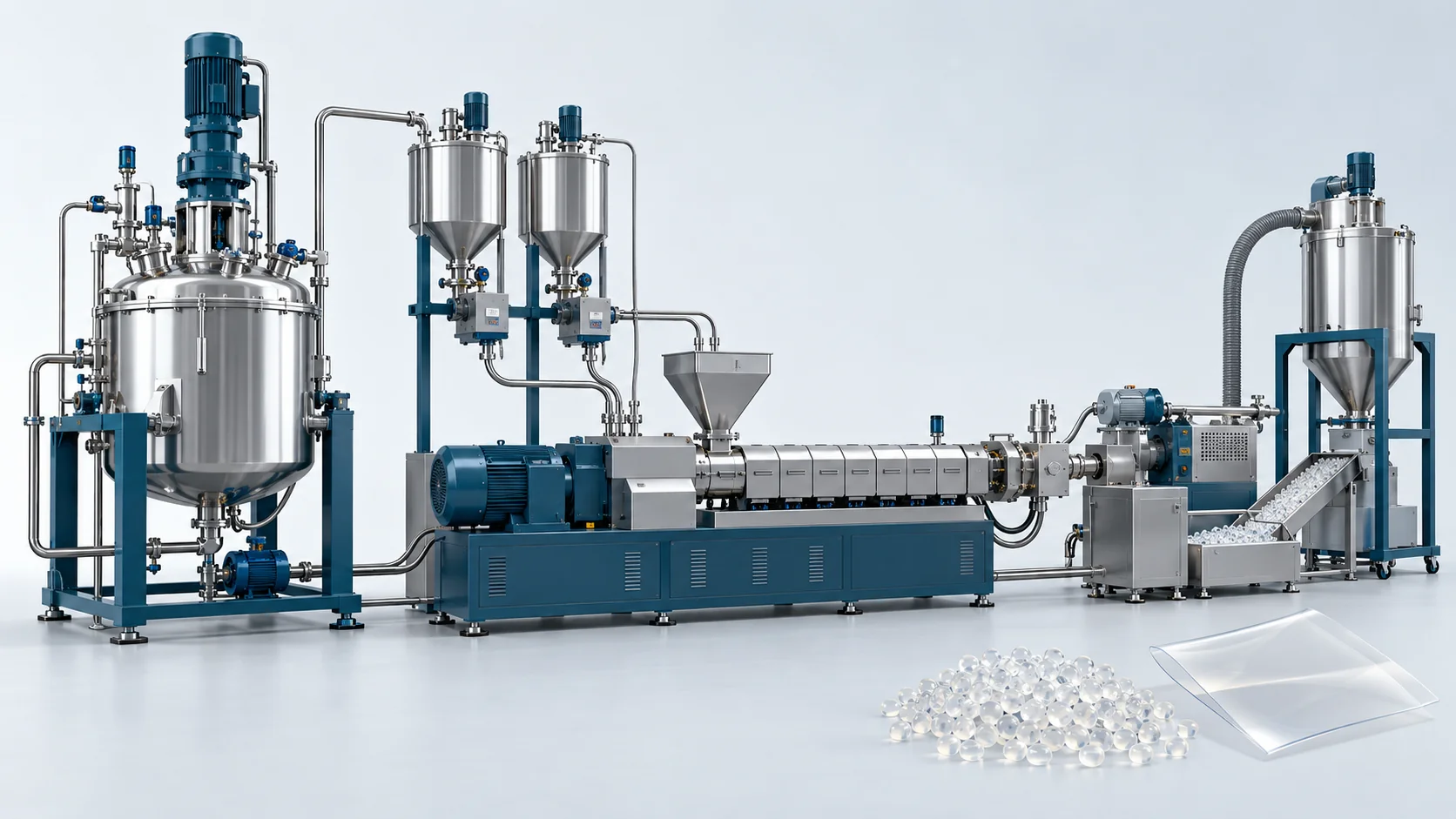
TPU Reactive Extrusion Line | Aliphatic Film Grades
A two-stage aliphatic TPU process with prepolymer preparation, reactive extrusion, melt conditioning and pelletizing for film-grade development.
Continuous Two-Step Reactive Synthesis for Optical-Grade Aliphatic TPU
A two-stage aliphatic TPU process with prepolymer preparation, reactive extrusion, melt conditioning and pelletizing for film-grade development.
A two-stage aliphatic TPU process with prepolymer preparation, reactive extrusion, melt conditioning and pelletizing for film-grade development.
Selected prepolymer reactor, liquid feed circuits, twin-screw extruder, melt pump, pelletizer and drying interfaces. Film conversion and optical testing are separate downstream processes.
CSTR and tubular reactor are different architectures and must be reconciled from the supplied description. Polymerization is not permanent thermoset polymerization. Optical defect counts are film-conversion results, and ASTM E313 describes color-index calculations rather than the complete weathering exposure. Yellowing method, film thickness and sampling need original records.
Concept illustration: Generated concept illustration for process discussion; not a photograph of the specified machine, a customer facility or a delivered project.
Material Flow and Working Principle
Continuous Tubular Prepolymerization (Step 1)
Dehydrated PCL polyol and molten H12MDI are metered via high-precision Coriolis pumps into a jacketed tubular CSTR reactor, forming a homogeneous prepolymer stream with narrow oligomer distribution at 90°C.
High-Torque Twin-Screw Chain Extension (Step 2)
The prepolymer is injected directly into Zone 1 of the twin-screw extruder (L/D = 60) while chain extender (BDO/IPDA) and non-toxic bismuth catalysts enter via high-pressure micro-nozzles, completing polymer chain growth.
Three-Stage High-Vacuum De-Volatilization
The reacting melt traverses three progressive vacuum de-volatilization ports operating down to 0.02 kPa absolute pressure, removing trace volatile monomers, moisture, and micro-bubbles to achieve optical clarity.
Jacketed Melt Pump Pressure Stabilization
An oil-jacketed melt gear pump maintains continuous discharge pressure fluctuations below 0.03 MPa, passing the melt through a 325-mesh continuous hydraulic screen changer without thermal degradation.
Deionized Water Underwater Pelletizing & Spin Drying
The melt is extruded through micro-hole die plates into a closed cutting chamber flooded with tempered deionized water; multi-knife heads cut uniform spherical pellets that are dried centrifugally within seconds.
Model and Technical Parameters
Supplied HF-TPU65-ALI configuration references, pending original calibration and acceptance documents. Material, finished-part and project outcomes are separate from equipment ratings. CSTR and tubular reactor are different architectures and must be reconciled from the supplied description. Polymerization is not permanent thermoset polymerization. Optical defect counts are film-conversion results, and ASTM E313 describes color-index calculations rather than the complete weathering exposure. Yellowing method, film thickness and sampling need original records.
| Technical Parameter | HF-TPU65-ALI |
|---|---|
| Components | 4 Liquid Streams (PCL Polyol, H12MDI, Extender BDO, Catalyst/HALS) |
| Output Range (g/s) | 150.0 to 500.0 kg/h (Continuous optical pellet production) |
| Mixing Ratio Range | 100:30:6 to 100:60:15 (Precision recipe tracking) |
| Ratio Accuracy | ±0.1% (Coriolis mass flow continuous tracking) |
| Power Supply | 380V, 3-Phase, 50Hz (Custom 440V/480V 60Hz optional) |
| Working Pressure | 10.0 to 16.0 MPa (Extruder die discharge and melt pump) |
| Tank Capacity (L) | Day tanks: 2 x 600 L (Stainless 316L mirror polished) |
| Weight | 14,800 kg (Combined CSTR reactor, extruder, and pelletizer skid) |
| Dimensions (L×W×H) | 22,000 mm x 3,200 mm x 2,800 mm |
| Optical Gel Count (Fish-Eyes) | < 2 parts/m² (Film thickness 150 µm); Online laser camera inspection; supplied reference pending original configuration or test records |
| Accelerated UV Yellowing Index | Δ YI < 0.8 (1,000 hours QUV-A exposure); ASTM E313 / ASTM D1925; supplied reference pending original configuration or test records |
| Screw Diameter & Process Length | Ø 65 mm, L/D = 60 (Mirror-finish PVD coating); Extruder reaction barrel; supplied reference pending original configuration or test records |
| Three-Stage Vacuum Degree | ≤ 0.02 kPa (Absolute pressure); De-volatilization melt zones; supplied reference pending original configuration or test records |
Key Equipment Features
Selected prepolymer reactor, liquid feed circuits, twin-screw extruder, melt pump, pelletizer and drying interfaces. Film conversion and optical testing are separate downstream processes.
Fish-Eye Gel Level < 2 parts/m²
Supplied configuration reference: Two-step CSTR and L/D 60 mirror-finish screw design eliminate dead zones, driving optical gels below 2 parts/m². Actual capability requires material and tooling validation.
UV Yellowing Stability (Δ YI < 0.8)
Supplied configuration reference: Aliphatic H12MDI/PCL molecular architecture has a supplied non-yellowing reference target under 1,000 hours of accelerated UV exposure. Actual capability requires material and tooling validation.
0.02 kPa Three-Stage Vacuum Stripping
Supplied configuration reference: Multi-port high-vacuum de-volatilization extracts unreacted monomers, ensuring crystal-clear haze-free transparency. Actual capability requires material and tooling validation.
Deionized Water Closed Cutting
Supplied configuration reference: Tempered pure deionized water circulation prevents mineral surface contamination on freshly cut micro-beads. Actual capability requires material and tooling validation.


