
Water-Borne Microfiber Leather Base Line Project in China
Review draft: Water-Borne Microfiber Leather Base Line. Configuration and reported outcomes require original project records.
Project Overview
Illustration notice. Process illustrations are not verified photographs of this installation.
Project reference basis. Figures and configuration details are reported in the supplied project brief. They are reference values for the stated application, rather than verified acceptance results or a guarantee for another installation. Confirm the source records, material, tooling, operating schedule and test method when assessing a comparable project.
A leading publicly listed synthetic leather enterprise in Anhui deployed Haifeng’s water-borne polyurethane mechanical foaming line across its flagship eco-material manufacturing campus. The project was commissioned to supply zero-solvent, highly breathable microfiber leather bases for global athletic footwear and sustainable automotive seating.
Prior to this installation, the manufacturer operated conventional wet-process coagulation lines using dimethylformamide (DMF). This legacy process required massive steam boilers for solvent distillation, produced hazardous wastewater, and left trace solvent residues inside finished leather that breached international Zero Discharge of Hazardous Chemicals (ZDHC) standards. Attempts with chemical blowing agents caused excessive toxic formamide decomposition residues, failing customer brand audits.
Haifeng engineered a complete physical mechanical foaming cell centered on the HF-WPF160-MF system. By whipping compressed air directly into water-borne polyurethane dispersions and stabilizing the cellular structure via infrared flash gelation, the line eliminated solvents and chemical blowing agents entirely, delivering breathable bases reaching 1,520 g/(m²·24h) breathability and cutting utility thermal energy by 45%.
Review point: This route mechanically disperses gas in a water-borne dispersion; it differs from reactive chemical blowing. Wet-foam gas ratio and final dry density are distinct. MVTR, odor and steam savings need specimen, method and full-line energy boundaries; water-borne chemistry alone does not establish zero emissions.
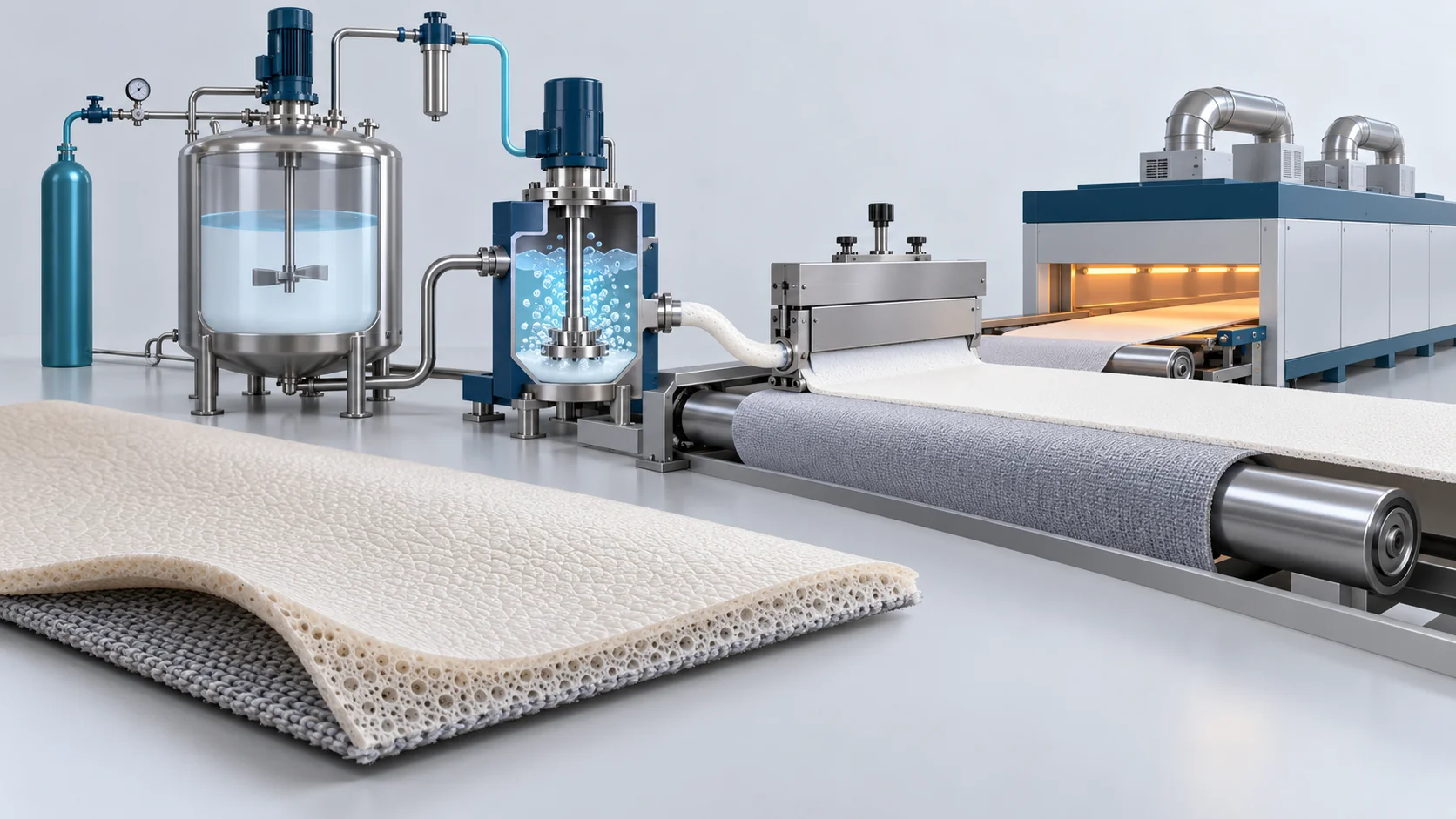
Concept illustration: Generated concept illustration for process discussion; not a photograph of the specified machine, a customer facility or a delivered project.
Solutions Delivery
Configuration reported in the supplied brief.
Haifeng engineered an automated roll-to-roll mechanical foaming line spanning 32 meters in length. Nonwoven microfiber fleece substrates are unwound through tension-isolated accumulators and pass through a corona surface-activation station to ensure coating anchor strength.
Water-borne polyurethane dispersion (52% solids) blended with silicone foam stabilizers is fed via progressive cavity pumps into an axial multi-tooth stator-rotor foaming head running at 850 RPM. Filtered dry compressed air is injected via mass flow controllers, expanding the resin into a dense 3.5x liquid foam with micro-pore diameters of 15 to 25 µm.
The foam is distributed across a precision floating-knife coater, applying a uniform 0.8 mm layer across the 1,480 mm web width. The wet profile immediately passes under short-wave infrared quartz lamps that flash-skin the foam surface within 8 seconds, preventing pore collapse. The coated web then traverses a 24-meter five-zone convection drying tunnel (85°C to 135°C), evaporating moisture progressively to yield a flexible, fully crosslinked leather base before edge-trimming and automated rewinding.
This route mechanically disperses gas in a water-borne dispersion; it differs from reactive chemical blowing. Wet-foam gas ratio and final dry density are distinct. MVTR, odor and steam savings need specimen, method and full-line energy boundaries; water-borne chemistry alone does not establish zero emissions.
| Equipment | Model | Qty | Function |
|---|---|---|---|
| Water-Borne Mechanical Foaming Generator | HF-WPF160-MF | 1 set | Core gas-liquid mass dosing and high-shear stator-rotor mechanical foaming. |
| Precision Floating-Knife Coating Station | HF-FKC-1600 | 1 unit | High-precision micrometric knife spreading foam across 1,480 mm web. |
| Infrared Rapid Flash Pre-Gelation Tunnel | HF-IRG-06 | 1 set | Short-wave quartz lamps flash-skinning foam within 8s to prevent collapse. |
| 24-Meter 5-Zone Convection Drying Tunnel | HF-CDT-24M | 1 complete line | Step-down hot air tunnel evaporating water progressively up to 135°C. |
Reported Results — Original Records Required
Transition to Zero-Emission Water-Borne Leather Bases
Connect with Haifeng eco-leather specialists to deploy continuous physical mechanical foaming lines engineered for high-breathability leather bases.


