
Water-Borne PU Mechanical Foaming Solution
Mechanical gas dispersion into water-borne PU, followed by configured coating and drying for synthetic-leather layers.
Zero-Emission Microcellular Engineering for Eco-Friendly Leather Bases
Mechanical gas dispersion into water-borne PU, followed by configured coating and drying for synthetic-leather layers.
Equipment and process scope
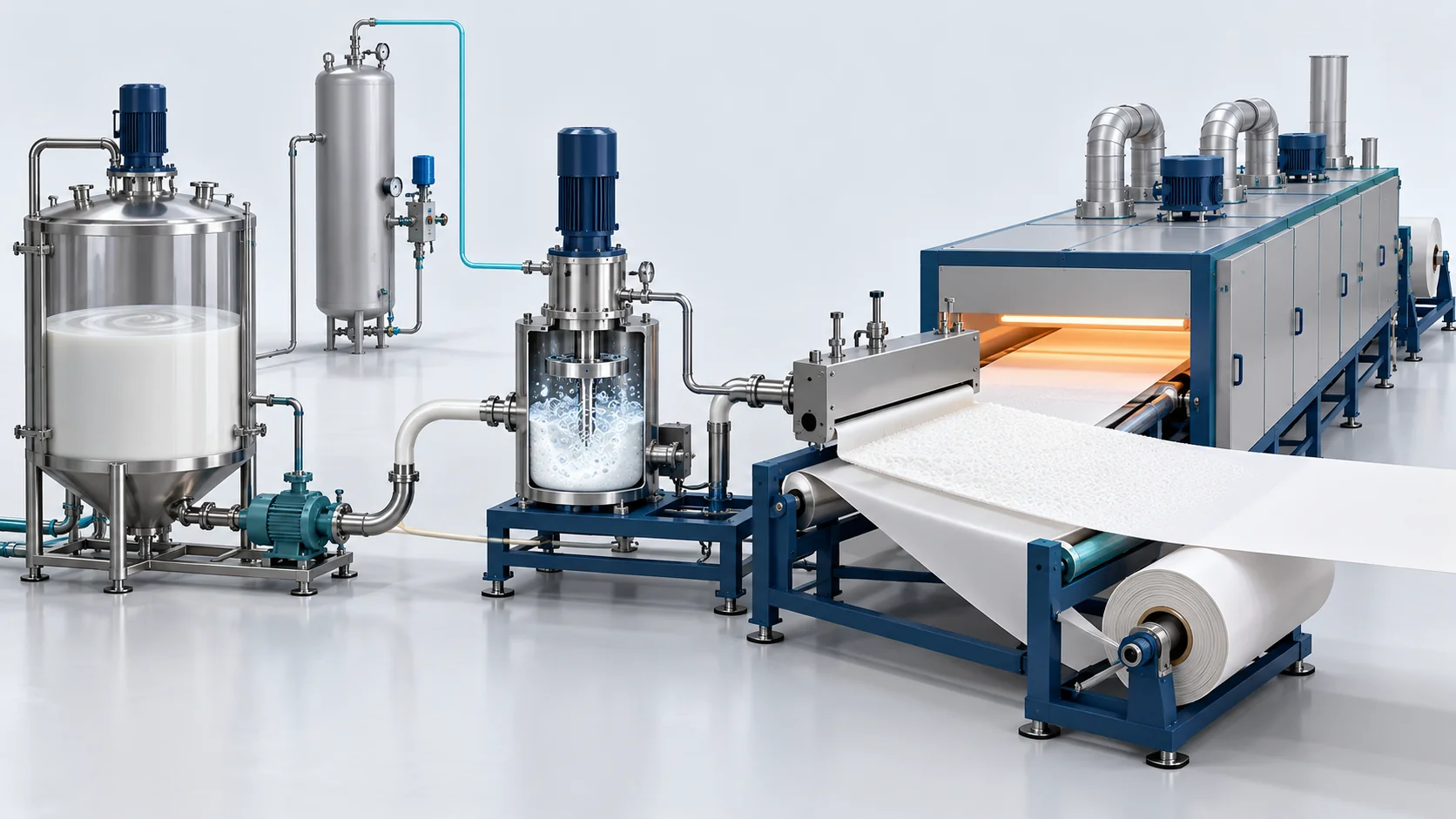
PUD preparation, controlled gas/liquid feed, foam generator, coating interface and the specified dryer; chemistry, backing web, dryer energy and exhaust are agreed interfaces.
Validation and production planning
This route mechanically disperses gas in a water-borne dispersion; it differs from reactive chemical blowing. Wet-foam gas ratio and final dry density are distinct. MVTR, odor and steam savings need specimen, method and full-line energy boundaries; water-borne chemistry alone does not establish zero emissions.
PUD preparation, controlled gas/liquid feed, foam generator, coating interface and the specified dryer; chemistry, backing web, dryer energy and exhaust are agreed interfaces. This route mechanically disperses gas in a water-borne dispersion; it differs from reactive chemical blowing. Wet-foam gas ratio and final dry density are distinct. MVTR, odor and steam savings need specimen, method and full-line energy boundaries; water-borne chemistry alone does not establish zero emissions.Generated concept illustration for process discussion; not a photograph of the specified machine, a customer facility or a delivered project.
Turnkey Water-Borne Mechanical Foaming Workflow
Configuration sequence from the supplied brief. Material, tool, pressure/temperature basis and complete line balance require verification. This route mechanically disperses gas in a water-borne dispersion; it differs from reactive chemical blowing. Wet-foam gas ratio and final dry density are distinct. MVTR, odor and steam savings need specimen, method and full-line energy boundaries; water-borne chemistry alone does not establish zero emissions.
Nonwoven Substrate Infeed & Surface Activation
Supplied process reference: Microfiber fleece substrates unwind through tension accumulators and pass through corona treaters to ensure coating anchor bonding.
Closed-Loop PUD & Gas Mass Metering
Supplied process reference: Progressive cavity pumps meter PUD (52% solids) while mass flow controllers inject compressed nitrogen into the pressurized head.
High-Shear Stator-Rotor Mechanical Foaming
Supplied process reference: Intermeshing rotor-stator teeth running at 850 RPM whip the mixture into a creamy 3.5x foam with 10–30 µm micro-pores without exotherm.
Reference Solution Engineering Envelope
Supplied configuration and validation references; material/component results are separate from equipment ratings.
| Parameter | Value / Unit | Applicable Configuration / Conditions |
|---|---|---|
| Continuous Wet Foam Throughput | 50.0 to 300.0 kg/hour | Progressive cavity feed pump with stator-rotor generator; supplied configuration or material target, pending the applicable original records |
| Foam Density Expansion Range | 2.0 to 6.0 Times (Adjustable) | Continuous gas-to-liquid mass flow ratio regulation; supplied configuration or material target, pending the applicable original records |
| Cured Moisture Vapor Transmission | Greater than or equal to 1,500 g/(m²·24h) | ASTM E96 Inverted Cup method on finished leather base; supplied configuration or material target, pending the applicable original records |
| Working Coating Web Width | Up to 1,600 mm | Micrometric floating knife coater on precision bed; supplied configuration or material target, pending the applicable original records |
| Hazardous Chemical Emissions | Project-specific assessment and original documentation required | Installed scope, material emissions and applicable acceptance methods must be established separately; the supplied brief is not a certificate |
| Synchronized Production Line Speed | 4.0 to 20.0 m/min | Five-zone progressive convective drying tunnel; supplied configuration or material target, pending the applicable original records |
Core Equipment for This Solution
PUD preparation, controlled gas/liquid feed, foam generator, coating interface and the specified dryer; chemistry, backing web, dryer energy and exhaust are agreed interfaces.
Core Advantages of Haifeng Water-Borne Systems
Configured equipment functions and interfaces for the selected material and tooling.
Zero DMF & Zero Formamide
Supplied configuration function: Completely replaces wet coagulation lines, eliminating hazardous solvents and chemical blowing agent residues. Project-dependent performance requires validation.
Natural-Leather Breathability
Supplied configuration function: Interconnected 10–30 µm micro-pores deliver 1,500 g/(m²·24h) moisture vapor transmission for cool comfort. Project-dependent performance requires validation.
45% Thermal Energy Savings
Supplied configuration function: Removing large steam distillation towers and wastewater treatment plants slashes factory energy bills by 45%. Project-dependent performance requires validation.
Agile Density Control
Supplied configuration function: Gas mass controllers allow instant expansion adjustments from 2x to 6x on the fly without stopping production. Project-dependent performance requires validation.
Related Project Draft
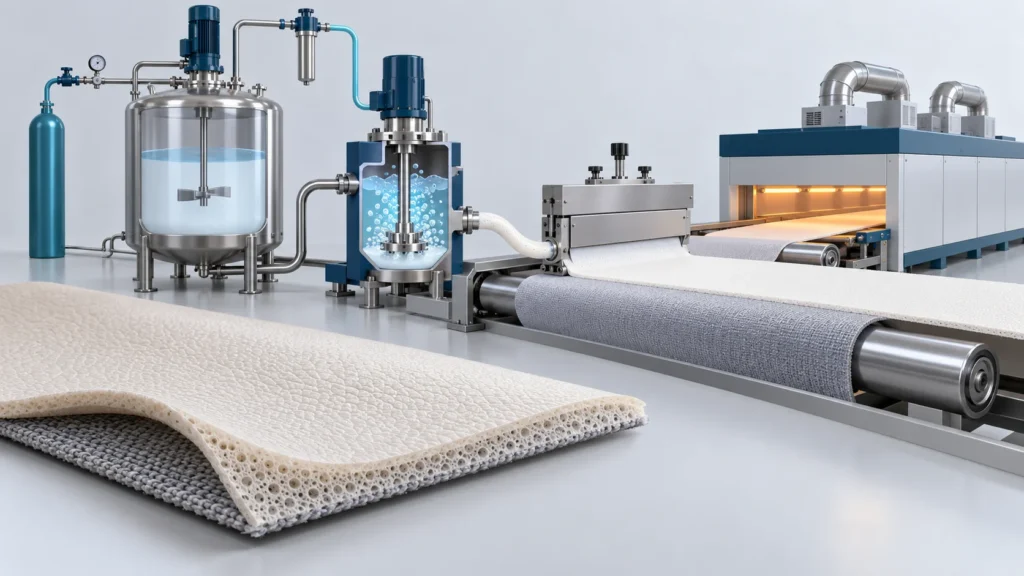
An anonymous project brief from the supplied document. Original attribution, dates, acceptance and outcome records require verification before public use.
Frequently Asked Questions
How does physical foaming compare to chemical blowing agents in leather bases?
Can this solution coat dense microfiber nonwoven substrates uniformly?
What maintains foam stability before water evaporates in the convection oven?
How does the equipment handle cleaning between different production batches?
Discuss Your Production Goals
Share your product or drawing, material system, target output, automation needs and factory utilities so the equipment and interfaces can be configured.


