
Mechanical PU Foaming Machine | Water-Borne Leather
Mechanical gas dispersion into water-borne PU, followed by configured coating and drying for synthetic-leather layers.
Continuous Physical Mechanical Foaming for Water-Borne Leather Bases
Mechanical gas dispersion into water-borne PU, followed by configured coating and drying for synthetic-leather layers.
Mechanical gas dispersion into water-borne PU, followed by configured coating and drying for synthetic-leather layers.
PUD preparation, controlled gas/liquid feed, foam generator, coating interface and the specified dryer; chemistry, backing web, dryer energy and exhaust are agreed interfaces.
This route mechanically disperses gas in a water-borne dispersion; it differs from reactive chemical blowing. Wet-foam gas ratio and final dry density are distinct. MVTR, odor and steam savings need specimen, method and full-line energy boundaries; water-borne chemistry alone does not establish zero emissions.
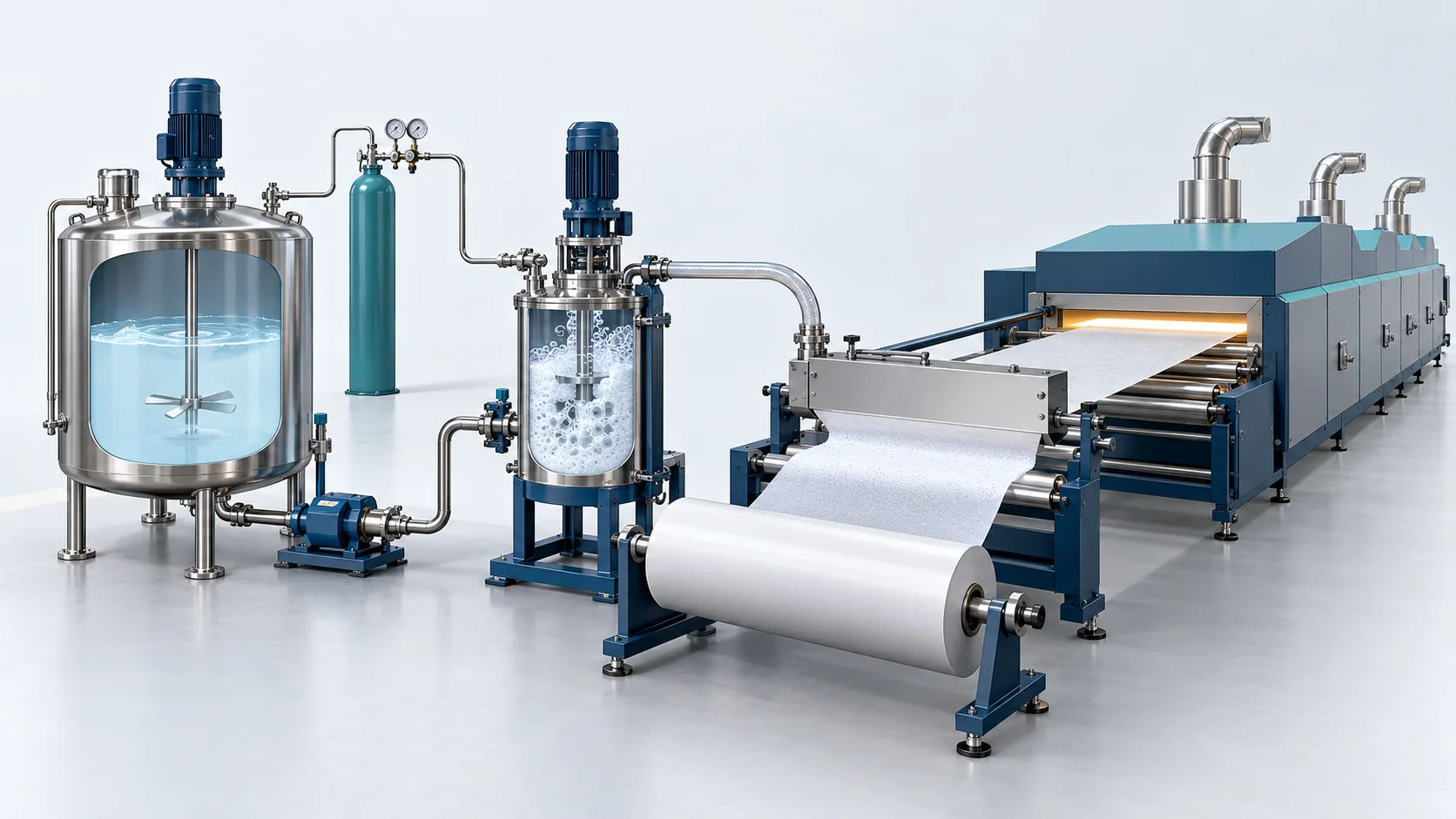
Concept illustration: Generated concept illustration for process discussion; not a photograph of the specified machine, a customer facility or a delivered project.
Material Flow and Working Principle
Dispersed PUD Metering & Gas Pressure Regulation
Water-borne polyurethane dispersion (PUD, 50% solids) and foam stabilizers are displaced by a servo progressive cavity pump while filtered nitrogen/air is metered via a mass flow controller into the mixing chamber.
High-Shear Stator-Rotor Mechanical Foaming
The gas-liquid mixture enters the water-jacketed stator-rotor foaming head, where intermeshing pins running at 300 to 1,200 RPM beat the gas into fine micro-bubbles (10–30 µm) with expansion ratios between 2x and 6x.
Precision Floating-Knife Coating
The dense foam discharges directly onto advancing release paper or textile base fabrics via an automated distribution manifold; a micrometric floating knife coats a level layer from 0.2 to 1.5 mm thickness.
Short-Wave Infrared Surface Gelation
The wet foam layer passes under short-wave infrared lamps, rapidly setting the bubble walls and flash-skinning the surface before bubble collapse can occur.
Step-Down Convection Evaporation & Winding
The material travels through a 24-meter multi-zone hot air convection tunnel (80°C to 140°C), progressively evaporating water to yield a dry, highly breathable microfiber base before automated edge-trimming and rewinding.
Model and Technical Parameters
Supplied HF-WPF160-MF configuration references, pending original calibration and acceptance documents. Material, finished-part and project outcomes are separate from equipment ratings. This route mechanically disperses gas in a water-borne dispersion; it differs from reactive chemical blowing. Wet-foam gas ratio and final dry density are distinct. MVTR, odor and steam savings need specimen, method and full-line energy boundaries; water-borne chemistry alone does not establish zero emissions.
| Technical Parameter | HF-WPF160-MF |
|---|---|
| Components | 1 Liquid Stream (PUD Masterbatch) + 1 Gas Stream (Air/N2) |
| Output Range (g/s) | 50.0 to 300.0 kg/h (Continuous wet foam throughput) |
| Mixing Ratio Range | Expansion Ratio 2.0 to 6.0 : 1 (Gas-to-liquid volumetric ratio) |
| Ratio Accuracy | ±0.5% (Mass flow controller closed-loop gas tracking) |
| Power Supply | 380V, 3-Phase, 50Hz (Custom 440V/480V 60Hz optional) |
| Working Pressure | 0.3 to 0.6 MPa (Foaming head backpressure) |
| Tank Capacity (L) | Day tank: 1 x 500 L (Stainless steel with slow anchor agitator) |
| Weight | 8,200 kg (Foaming generator, coating head, and gantry) |
| Dimensions (L×W×H) | 32,000 mm x 3,400 mm x 2,800 mm (Including 24m oven) |
| Foam Expansion Ratio | 2.0 to 6.0x (Continuously adjustable); PUD with 2.5% silicone surfactant; supplied reference pending original configuration or test records |
| Moisture Vapor Transmission (MVTR) | ≥ 1,500 g/(m²·24h); ASTM E96 Inverted Cup method; supplied reference pending original configuration or test records |
| Coating Web Width | Up to 1,600 mm (Substrate or release paper); Continuous roll-to-roll operation; supplied reference pending original configuration or test records |
| Operating Line Speed | 4.0 to 20.0 m/min (Line-speed synchronized); Steady production run; supplied reference pending original configuration or test records |
Key Equipment Features
PUD preparation, controlled gas/liquid feed, foam generator, coating interface and the specified dryer; chemistry, backing web, dryer energy and exhaust are agreed interfaces.
2–6x Adjustable Physical Expansion
Supplied configuration reference: Precision gas-to-liquid ratio control produces microcellular foam density adjustable from 0.25 to 0.60 g/cm³. Actual capability requires material and tooling validation.
Zero Chemical Blowing Agents
Supplied configuration reference: Eliminates hazardous azodicarbonamide (AC), guaranteeing compliance with OEKO-TEX and material-dependent emission control standards. Actual capability requires material and tooling validation.
1,500 g/(m²·24h) Breathable Comfort
Supplied configuration reference: Microcellular open/semi-closed pores provide superior moisture-vapor transmission matching natural leather. Actual capability requires material and tooling validation.
Step-Down Infrared Flash Gelation
Supplied configuration reference: Rapid infrared surface skinning locks pore geometry in 10 seconds, preventing bubble burst and skin collapse. Actual capability requires material and tooling validation.


