
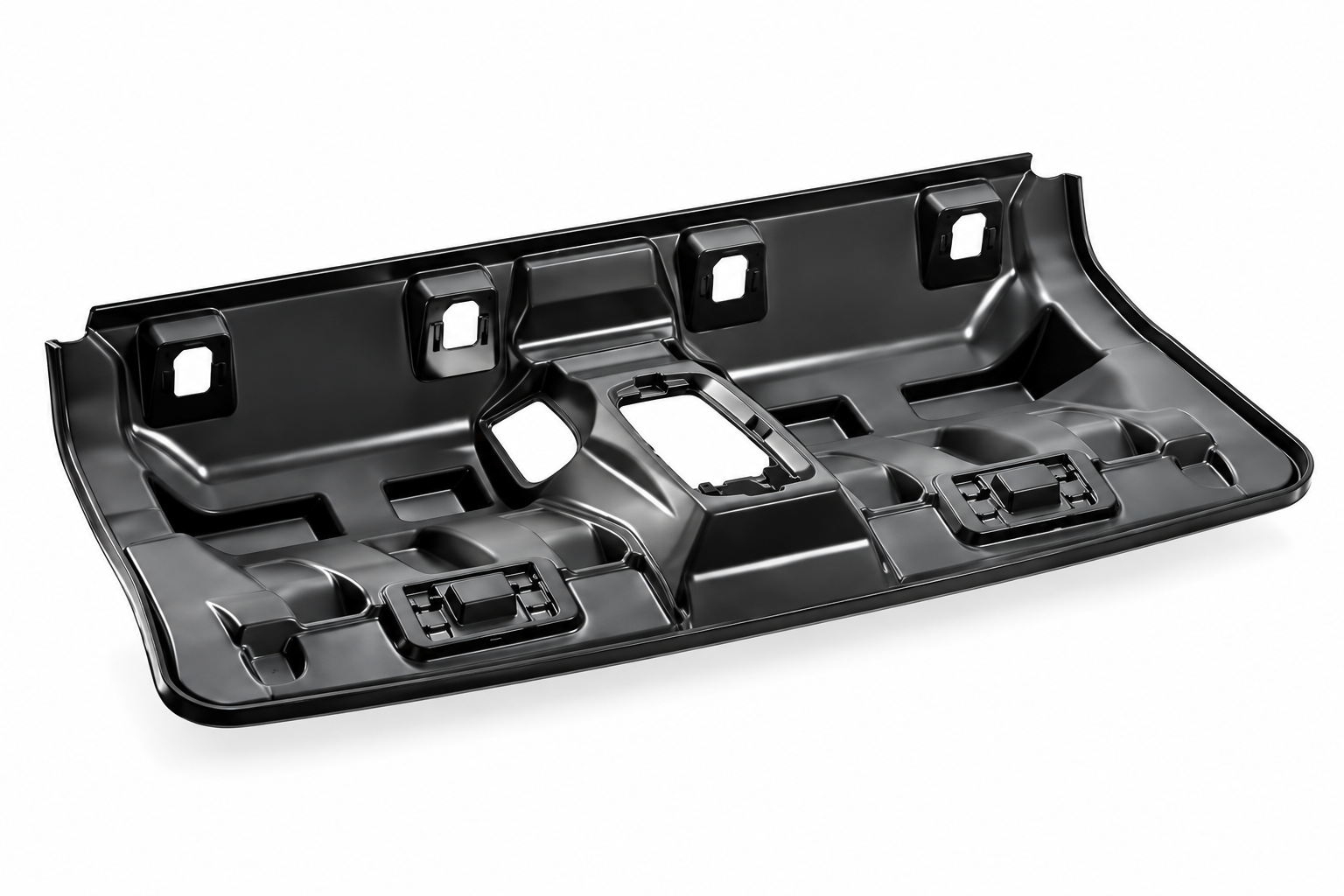
Automotive Door Panel RIM Molding Solution
Turnkey reaction injection molding systems engineered for lightweight automotive door substrates, delivering sink-mark-free structural ribs and rapid 120s cycles.
Precision Microcellular RIM Solutions for Structural Door Panels
Modern automotive cockpits demand lightweight door carriers that integrate structural mounting points without compromising aesthetic surface quality. Conventional injection-molded plastics (PP/ABS) frequently suffer from sink marks, warpage, and elevated residual stresses at complex rib junctions where thicknesses shift rapidly. Haifeng’s microcellular Polyurethane Reaction Injection Molding (PU-RIM) solution resolves these challenges by utilizing low-cavity-pressure in-situ foaming expansion, ensuring flat, rigid, and acoustically optimized substrates ready for leather or fabric wrapping.
Rib Transition Process Engineering
In-situ microcellular foaming generates uniform internal cavity pressure, completely eliminating surface sink marks across functional speaker bosses and heavy load-bearing ribs (2.5mm–5.0mm).
Strict Automotive Cabin Air Compliance
Engineered for modern low-emission and amine-free polyurethane systems, ensuring full compliance with VDA 278 and global Vehicle Interior Air Quality (VIAQ) standards.
Haifeng delivers complete processing capabilities—from closed-loop ratio dosing and mold thermal conditioning to optional hydraulic clamping presses and tooling—tailored to the mass production requirements of automotive Tier-1 interior suppliers.
Microcellular Door Panel RIM Manufacturing Sequence
A synchronized four-stage workflow delivering continuous, stress-free interior substrate panels with tight dimensional repeatability.
Raw Precursor Conditioning
Polyol and isocyanate are maintained in temperature-controlled tanks. Dual dynamic heat exchangers stabilize viscosities within ±0.5°C to ensure uniform cell nucleation.
High-Pressure Impingement Dispensing
High-pressure axial piston pumps meter components at high velocity into an L-shaped self-cleaning mixing head, achieving molecular impingement mixing before laminar low-pressure mold filling.
Low-Pressure Expansion & Curing
Liquid reaction mass expands within the closed heated mold. The internal microcellular pressure fills wide-span sections without high clamping force, solidifying into a solid-skinned microcellular core.
Engineering Specifications & Technical Parameters
Standard operational values for the Haifeng automotive door panel RIM production system.
| Technical Parameter | Standard Specification / Value | Engineering Context & Verification |
|---|---|---|
| Target Application | Automotive Door Interior Substrates & Carriers | Structural module integration & acoustic barrier |
| Material Formulation | Microcellular Structural Polyurethane Matrix | Low-density structural rigid foam system |
| Metering Output Capacity | 20 – 60 kg/min (Customizable) | Servo axial piston pumps with closed-loop Ratio Lock |
| Stoichiometric Ratio Accuracy | ±0.5% | Continuous digital flowmeter feedback |
| Mold Temperature Range | 55°C – 70°C | Multi-zone dynamic water TCU regulation |
| Demolding Cycle Time | 100 – 140 seconds (Standard 120 s) | Optimized for high-volume automated assembly |
| Weight Reduction | ~30% vs. Solid Injection PP/ABS | Verified across mass-production passenger vehicle doors |
| Cavity Clamping Force | Low-Pressure (50T – 150T Clamping) | Compatible with cost-effective aluminum tooling |
| Scope of Supply | Turnkey (RIM Dosing Skid, TCU, Master PLC + Optional Press/Tooling) | Full equipment integration or retrofit to existing press |
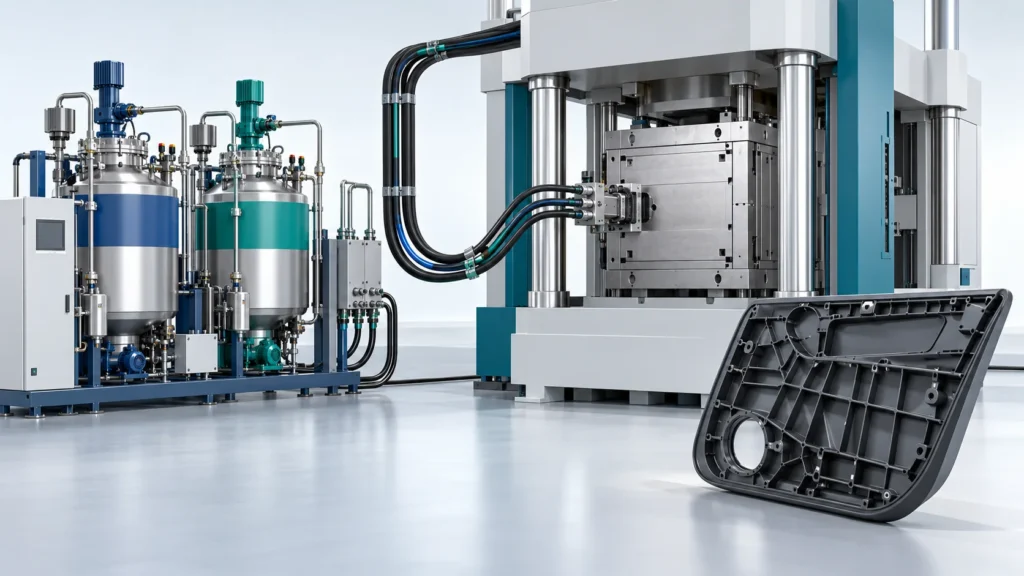
Precision Equipment for Automotive Door Panels
High-pressure dosing units, temperature control skids, and press interfaces engineered for microcellular interior systems.
Key Engineering Advantages
Proven advantages of Haifeng microcellular RIM systems over conventional thermoplastic injection molding.
30% Substrate Weight Reduction
The microcellular cellular structure significantly lowers density while preserving structural flexural modulus, directly cutting vehicle body mass.
Zero Surface Sink Marks
In-situ microcellular expansion maintains positive internal pressure against mold walls, completely preventing sink depressions across variable 2.5mm–5.0mm rib zones.
Stress-Free Dimensional Stability
Low-pressure cavity filling eliminates molded-in orientation stresses, preventing high-temperature warping in automotive cabins under extreme summer conditions.
Integrated Acoustic Damping
The viscoelastic polyurethane cell structure dampens door slamming vibrations and blocks road resonance more effectively than solid plastics.
Proven Manufacturing Project
Discover how a premier Chinese Tier-1 supplier implemented Haifeng's RIM dosing system to manufacture door substrates with project-specific inspection criteria.
Frequently Asked Questions
Engineering and purchasing questions about this polyurethane production route.
Why is RIM preferred over thermoplastic injection molding for door panels?
Can this system run ultra-low VOC and amine-free polyurethane systems?
Can Haifeng retrofit this system to our existing hydraulic clamping press?
Does Haifeng provide complete turnkey lines including presses and molds?
What is the typical installation and commissioning timeline on-site?
Discuss Your Door Panel RIM Project with Haifeng
Contact our engineering team for technical layouts, recipe feasibility evaluations, and turnkey equipment quotations.


