
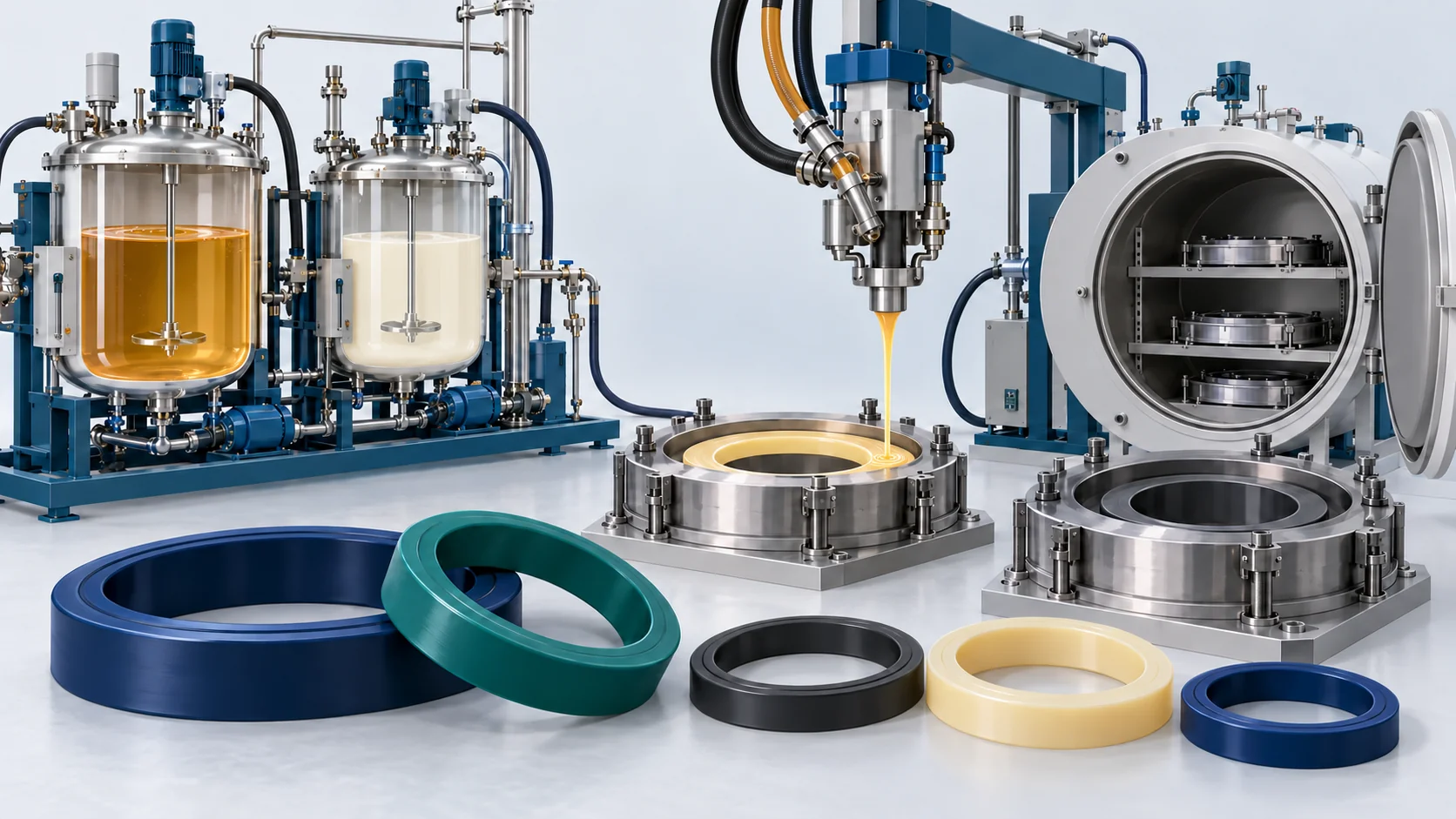
Vacuum PU Casting Machine | Subsea Seals
Enclosed material preparation, magnetic-coupled metering and balanced dispensing for cast polyurethane seal components. Finished-seal qualification is a separate material and component test requirement.
Hyper-Vacuum Bubble-Free Casting for Subsea Critical Seals
Enclosed material preparation, magnetic-coupled metering and balanced dispensing for cast polyurethane seal components. Finished-seal qualification is a separate material and component test requirement.
Enclosed material preparation, magnetic-coupled metering and balanced dispensing for cast polyurethane seal components. Finished-seal qualification is a separate material and component test requirement.
The package covers falling-film material preparation, magnetic-coupled metering, balanced dynamic mixing, dry nitrogen interfaces and controls. Vacuum tooling and step-treatment baths are optional. Prepolymer and curatives are supplied by the selected chemical supplier; nitrogen and site power are customer interfaces. Equipment delivery does not by itself establish RGD or subsea component qualification.
Material Flow and Working Principle
Three-Stage Falling-Film Hyper-Vacuum Degassing
TODI/PCL prepolymer flows in a 0.5 mm thin film down heated spiral internal baffles at 120°C under 0.01 kPa absolute pressure, stripping residual moisture below 10 ppm and removing entrained micro-air.
Hermetic Magnetically Coupled Metering
High-viscosity prepolymers and chain extenders are displaced by precision gear pumps isolated by hermetic magnetic drive shells, eliminating packing gland leakage and air migration.
Zero-Differential Self-Balancing Dynamic Mixing
Streams enter the mixing head where high-speed titanium-coated rotors achieve laminar dynamic shearing; internal bypass valves maintain identical backpressures during recirculation and dispensing to eliminate startup pressure spikes.
Direct Precision Cavity Metering
Reactive melt is dispensed into preheated vacuum-clamped seal molds (125°C) with a repeatable shot weight accuracy of ±0.15 g on shots up to 5,000 g, preventing flow surge marks.
Controlled Step-Curing & Secondary Maturation
Molded seals undergo isothermal green curing before automated transfer to multi-stage step-down annealing ovens for complete crosslinking and post-crystallization stress relief.
Model and Technical Parameters
Configuration values from the supplied HF-CPU100-HV brief. Final performance is confirmed for the chemical formulation, tool, operating conditions and original calibration records. Casting-circuit pressure is distinct from finished-component service or qualification pressure.
| Technical Parameter | HF-CPU100-HV |
|---|---|
| Components | 2 Primary Streams (A: Prepolymer, B: Curative) + 1 Color Stream |
| Output Range (g/s) | 1.0 to 12.0 kg/min (Continuous adjustable) |
| Mixing Ratio Range | 100:10 to 100:35 (By weight) |
| Ratio Accuracy | ±0.15% (Closed-loop Coriolis continuous feedback) |
| Power Supply | 380V, 3-Phase, 50Hz (Custom 440V/480V 60Hz optional) |
| Working Pressure | 0.3 to 0.5 MPa (Metering lines and mixing chamber) |
| Tank Capacity (L) | Tank A: 100 L (Hyper-vacuum), Tank B: 60 L (Stainless steel) |
| Weight | 2,900 kg (Main casting unit skid) |
| Dimensions (L×W×H) | 2600 mm x 1850 mm x 2550 mm |
| Degassing Vacuum Degree | ≤ 0.01 kPa (Absolute pressure); Three-stage falling-film tower |
| Moisture Content Post-Degas | < 10 ppm (Water content in TODI); Karl Fischer titration |
| Maximum Process Temperature | Up to 140°C (Circulating thermal oil jacket); All fluid passages and valves |
| Shot Weight Repeatability | ±0.15 g (At 4,500 g target shot weight); Analytical balance verification |
Key Equipment Features
The package covers falling-film material preparation, magnetic-coupled metering, balanced dynamic mixing, dry nitrogen interfaces and controls. Vacuum tooling and step-treatment baths are optional. Prepolymer and curatives are supplied by the selected chemical supplier; nitrogen and site power are customer interfaces. Equipment delivery does not by itself establish RGD or subsea component qualification.
Vacuum Material Preparation
The specified preparation stage conditions the prepolymer; residual water and gas content require original measurements.
Magnetic-Coupled Metering
The specified pump containment arrangement removes the conventional rotating shaft-seal interface; integrity is verified for the configuration.
Balanced Mixing Interface
Recirculation and shot-opening controls are configured to limit pressure transients; shot repeatability requires separate testing.
Qualification Interfaces
Casting equipment supports material processing; RGD, gas compatibility and finished-seal performance require documented qualification.


