
Three-Component PU Casting Machine | Cryogenic Insulation
Three-stream PU metering and dynamic mixing for cryogenic insulation development, with separate additive control and material qualification.
Deep-Cryogenic Low-Exotherm Polyurethane Casting for LNG Carriers
Three-stream PU metering and dynamic mixing for cryogenic insulation development, with separate additive control and material qualification.
Three-stream PU metering and dynamic mixing for cryogenic insulation development, with separate additive control and material qualification.
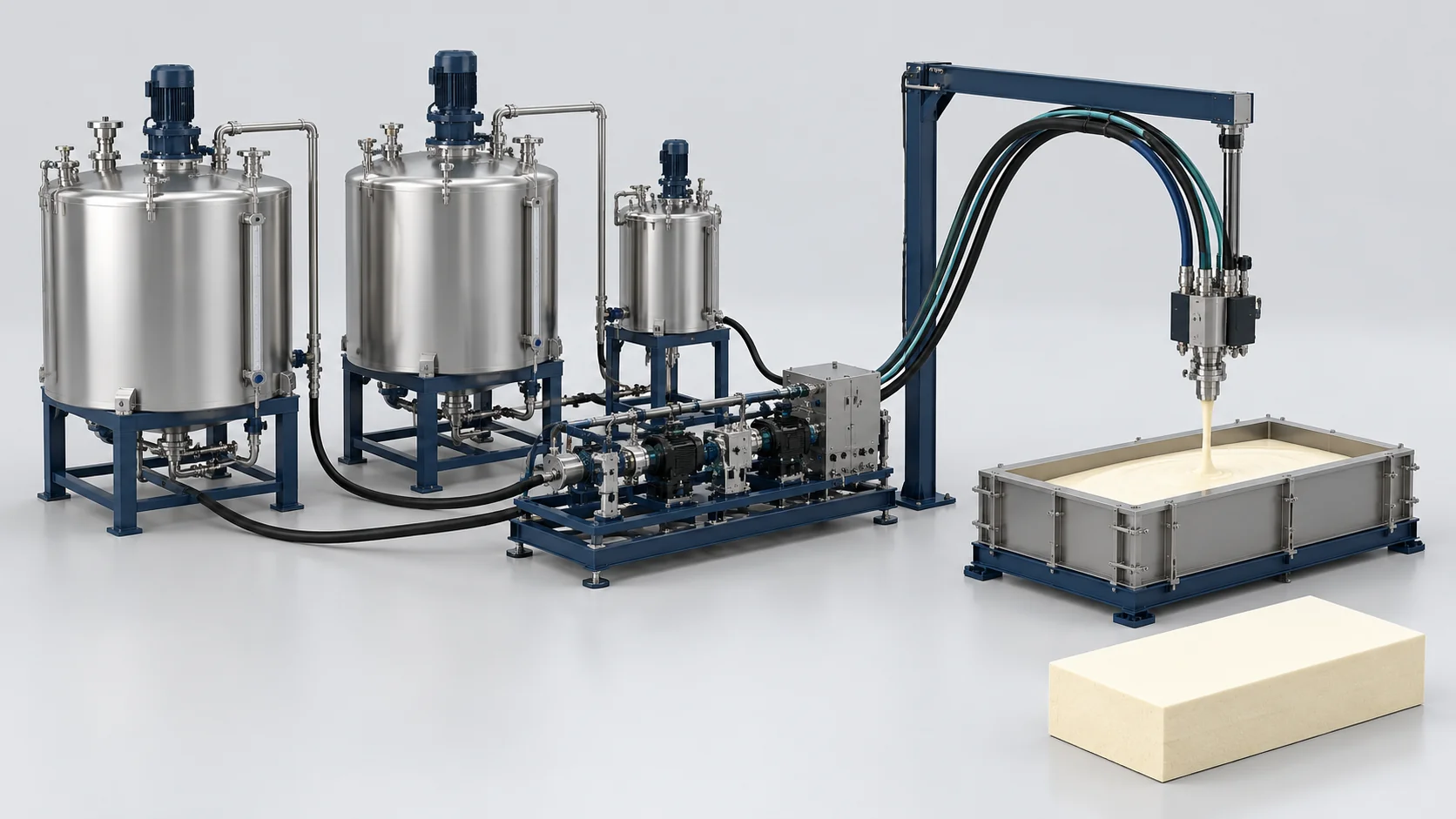
Conditioned primary streams, an independent additive feed, dynamic head and controls; molds, curing equipment, approved chemical formulation and final insulation qualification are separate interfaces.
Cryogenic crack resistance, exotherm and thermal conductivity are formulation/specimen results. A liquid-nitrogen thermal-shock test does not independently establish long-term LNG service, GTT approval or class-society certification. Primary stream ratio and the third additive stream require distinct calibration.
Concept illustration: Generated concept illustration for process discussion; not a photograph of the specified machine, a customer facility or a delivered project.
Material Flow and Working Principle
Cryogenic Additive Dispersion & Thermal Conditioning
Base polyols, isocyanates, and cryogenic elastomeric tougheners are conditioned in stainless steel tanks under closed dry nitrogen blankets at 25°C ± 0.5°C, degassed below 0.05 kPa to extract micro-bubbles.
Wear-Resistant Three-Stream Servo Metering
High-precision rotary gear pumps meter the three reactive streams through temperature-regulated lines, with dual Coriolis mass flow meters holding mix ratios within ±0.2%.
Low-Exotherm Dynamic Homogenization
The components enter a water-jacketed dynamic mixing chamber equipped with a low-shear helical rotor operating at 3,000 RPM, achieving thorough homogenization without triggering premature exotherms.
Low-Stress In-Mold Cavity Pouring
The liquid mixture is poured directly into preheated plywood/composite insulation box molds (40°C), self-leveling smoothly across internal structural reinforcements without voids.
Controlled Step-Annealing & Cryogenic Thermal Audit
The block cures isothermally with reaction heat strictly controlled below 95°C, followed by step-down annealing and -196°C liquid nitrogen thermal shock testing.
Model and Technical Parameters
Supplied HF-LNG163-3K configuration references, pending original calibration and acceptance documents. Material, finished-part and project outcomes are separate from equipment ratings. Cryogenic crack resistance, exotherm and thermal conductivity are formulation/specimen results. A liquid-nitrogen thermal-shock test does not independently establish long-term LNG service, GTT approval or class-society certification. Primary stream ratio and the third additive stream require distinct calibration.
| Technical Parameter | HF-LNG163-3K |
|---|---|
| Components | 3 Streams (A: Base Polyol, B: Polymeric MDI, C: Toughener/Additive) |
| Output Range (g/s) | 5.0 to 45.0 kg/min (Continuous adjustable) |
| Mixing Ratio Range | 100:110:5 to 100:150:20 (By weight) |
| Ratio Accuracy | ±0.2% (Under continuous Coriolis mass flow tracking) |
| Power Supply | 380V, 3-Phase, 50Hz (Custom 440V/480V 60Hz optional) |
| Working Pressure | 0.3 to 0.6 MPa (Metering lines and dynamic mixing head) |
| Tank Capacity (L) | Tank A: 150 L, Tank B: 150 L, Tank C: 50 L (Stainless 316L) |
| Weight | 3,850 kg (Main proportioning skid and mixing station) |
| Dimensions (L×W×H) | 3600 mm x 2200 mm x 2450 mm |
| Operating Temperature Range | -163°C to -196°C (Liquid methane to liquid nitrogen); Cryogenic insulation envelope; supplied reference pending original configuration or test records |
| Cured Foam Compressive Modulus | 120 to 150 MPa (At -163°C cryogenic condition); Cryogenic compression test; supplied reference pending original configuration or test records |
| Peak Exotherm Temperature | < 95°C (In-situ chemical reaction); Thermocouple embedded in core; supplied reference pending original configuration or test records |
| Cryogenic Dimensional Contraction | < 0.2% (From 20°C down to -163°C); Linear thermal expansion test; supplied reference pending original configuration or test records |
Key Equipment Features
Conditioned primary streams, an independent additive feed, dynamic head and controls; molds, curing equipment, approved chemical formulation and final insulation qualification are separate interfaces.
-196°C Liquid Nitrogen Shock Survival
Supplied configuration reference: Cured foam survives thermal shock immersion in liquid nitrogen (-196°C) without micro-fissuring. Actual capability requires material and tooling validation.
Low-Exotherm Reaction Control
Supplied configuration reference: Specialized formulation and low-shear mixing keep peak core cure exotherms under 95°C to avoid thermal stress. Actual capability requires material and tooling validation.
3-Component Precision Metering
Supplied configuration reference: Auxiliary third stream delivers precise micro-dosing of elastomeric tougheners and hollow micro-spheres. Actual capability requires material and tooling validation.
Marine Classification Qualification
Supplied configuration reference: reported to meet strict GTT membrane cargo containment and international DNV/ABS/CCS rules. Actual capability requires material and tooling validation.


