
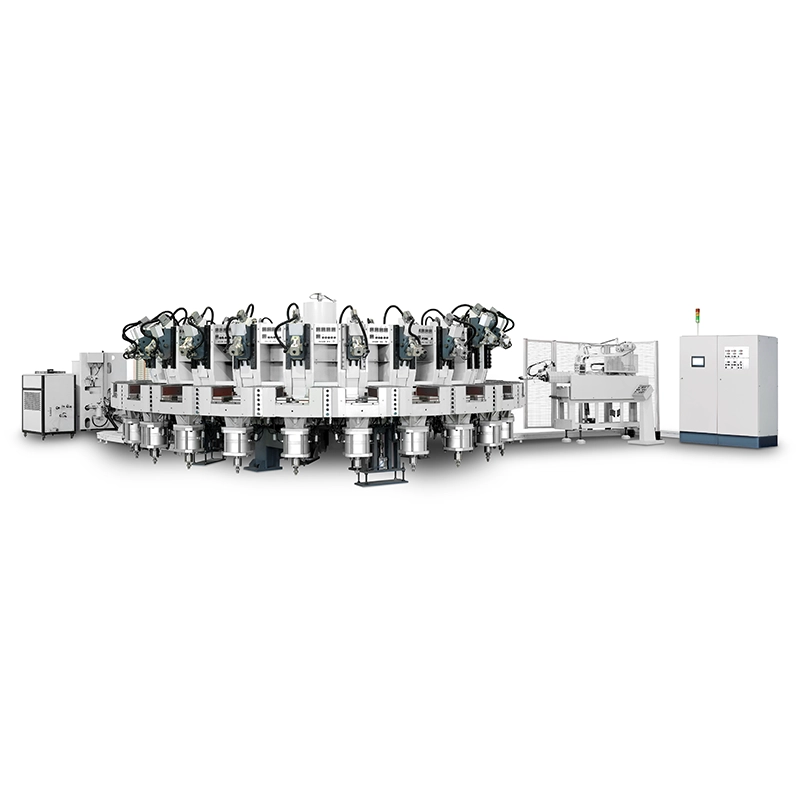
Rotary Rubber Injection Machine | Shoe Soles
Review the JG116/RU-RU rotary rubber shoe injection machine with 24 or 30 stations, mold frame dimensions and 26 cm³/s plasticizing capacity for sole projects.
Product, Application and Configuration
Review the JG116/RU-RU rotary rubber shoe injection machine with 24 or 30 stations, mold frame dimensions and 26 cm³/s plasticizing capacity for sole projects.
Product Overview
The JG116/RU-RU rotary rubber shoe injection machine feeds rubber compound into molds to form footwear soles. It has 24 or 30 station options and a rubber plasticizing capacity of 26 cm³/s. Select the station configuration around the compound, mold and vulcanization requirements. The plasticizing rate does not establish shot volume or hourly output.
Applications
- Rubber sole production for footwear projects.
- Rubber-bottom footwear requiring a defined compound and mold arrangement.
- New rubber sole capacity or equipment selection for an existing sole design.
Specify slip resistance or heat resistance as finished-product validation targets where required. Such performance depends on the actual compound, sole design and test results.
Configuration and Selection
Start with the compound specification and a sole sample or drawing. Check mold dimensions, cavity count, interfaces and venting before assessing plasticizing capacity and clamping requirements. For existing molds, verify installation compatibility before planning reuse.
Compare the 24 and 30 station options using the target vulcanization time, indexing time, operating sequence and output per mold. Station count alone cannot establish hourly production. Include loading, unloading and any manual auxiliary operations in the production review.
Use the target compound and mold for acceptance trials. Agree on continuous production duration, product weight variation, appearance and recorded output, with numerical limits in the project specification.
Discuss Your Project
Share the rubber compound specification, sole sample or drawing, target weight, mold information and output per shift. Add available floor space and any robotic operation requirements to review the station configuration, molding sequence and acceptance criteria for the project.
Technical Specifications
The two mold frame sizes are alternatives; their relationship to station count is not established. Clamping force and screw dimensions require technical confirmation.
| Technical Parameter | JG116/RU-RU |
|---|---|
| Station options | 24 or 30 |
| Mold frame dimensions | 200 × 400 mm / 200 × 430 mm; confirm the applicable configuration |
| Rubber plasticizing capacity | 26 cm³/s; a volumetric rate, not shot volume |
Key Features
Review these functions against the selected material, tooling and operating scope.
Rotary station options
Rotary station configurations: compare 24 and 30 stations against vulcanization, indexing and operating times.
Injection stroke measurement
Injection stroke measurement: monitor injection movement and assess metering repeatability through consecutive trial shots.
Proportional hydraulics
Proportional hydraulics: review pressure and flow adjustment ranges for the intended compound and mold.
PID temperature control
PID temperature control: define the temperature range and control accuracy in the technical configuration.
Optional robotic integration
Optional robotic integration: roughing and release-agent spraying require a stated scope for robots, tooling and programs.


