
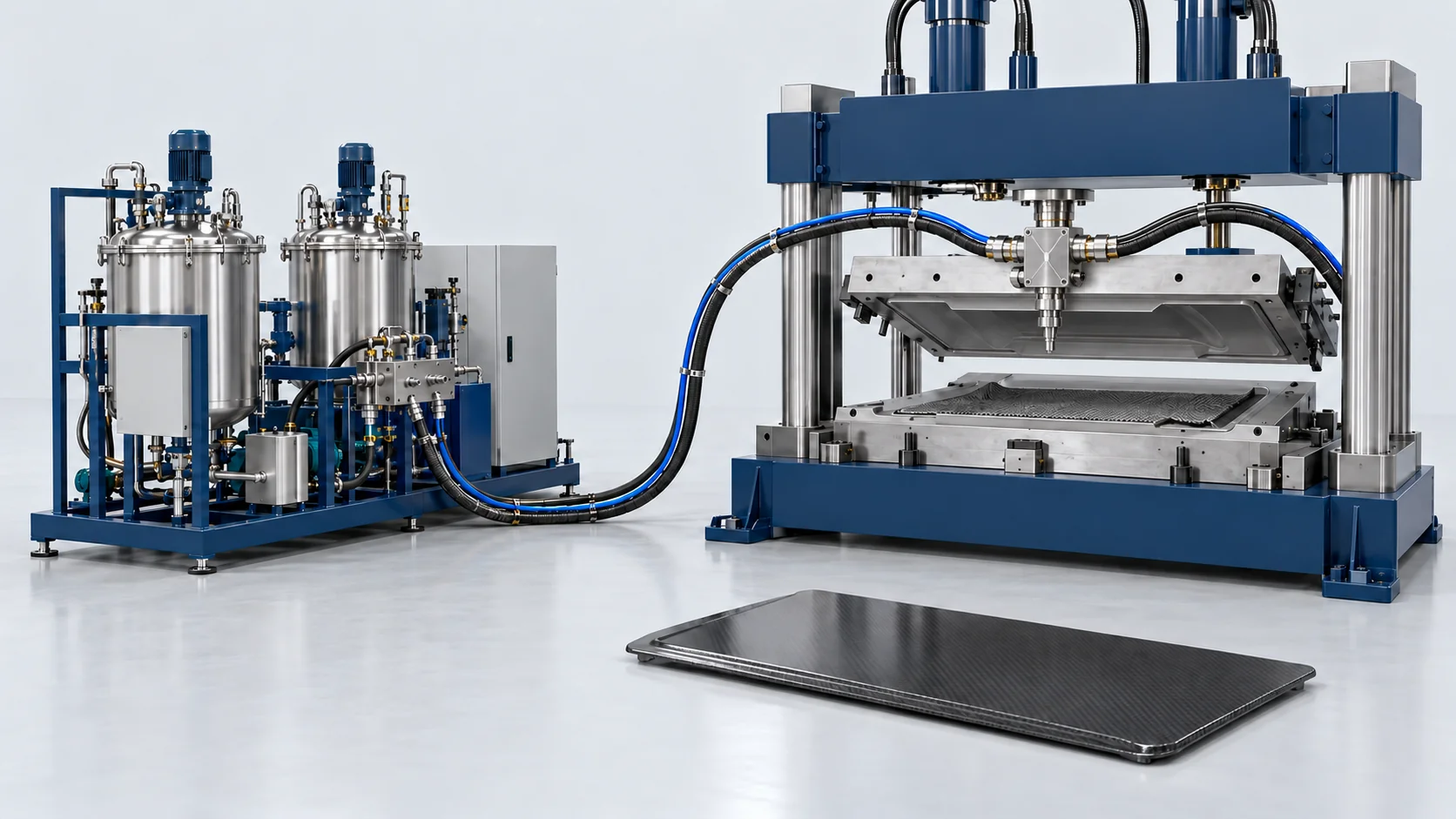
HP-CRTM Resin Injection System | Composite Panels
High-pressure resin metering and surface injection coordinated with compression-RTM tooling and press movement.
Fast-Cycle High-Pressure Compression RTM for Large Structural Panels
High-pressure resin metering and surface injection coordinated with compression-RTM tooling and press movement.
High-pressure resin metering and surface injection coordinated with compression-RTM tooling and press movement.
Resin preparation, metering/mixing skid, tool injection interfaces and coordinated controls. Press, preform handling, mold and material validation are agreed external scope.
The stated 12–20 MPa is the metering/impingement circuit, distinct from cavity pressure. Press approach, pressing stroke, resin wet-out and the complete molding cycle are specified separately for the chosen resin, preform and tool.
Concept illustration: Generated concept illustration for process discussion; not a photograph of the specified machine, a customer facility or a delivered project.
Material Flow and Working Principle
Continuous Preform Positioning & Deep Cavity Evacuation
The multi-axial carbon fiber preform is loaded onto the heated bottom mold; the press closes to a calibrated 1.0 mm micro-gap while vacuum skids draw cavity pressure down to 0.05 kPa.
Micro-Gap Low-Resistance Resin Injection
The high-pressure impingement mixing head dispenses fast-curing epoxy at 18.0 MPa, spreading liquid resin rapidly across the open surface of the carbon fabric without fiber distortion.
High-Speed Vertical Compaction (HP-CRTM)
As injection terminates, the press executes rapid downward clamping at 300 mm/s under 3,000 tons of force, driving the resin through the thickness direction across the 3.5 m² surface.
Isothermal High-Pressure Curing
The part cures in-mold at 130°C under continuous 15 MPa hydraulic pressure for 90 seconds, with integrated dielectric sensors monitoring resin conversion in real time.
Robotic Demolding & Shuttle Transfer
Hydraulic cylinders crack the mold; automated end-effectors lift the hot composite tray, transferring it to edge-trimming fixtures every 120 seconds.
Model and Technical Parameters
Supplied HF-CRTM300-PRO configuration references for the selected material, tooling and operating conditions. The stated 12–20 MPa is the metering/impingement circuit, distinct from cavity pressure. Press approach, pressing stroke, resin wet-out and the complete molding cycle are specified separately for the chosen resin, preform and tool.
| Technical Parameter | HF-CRTM300-PRO |
|---|---|
| Components | 2 Components (A: Resin, B: Hardener) + Optional Release Agent |
| Output Range (g/s) | 20.0 to 300.0 g/s (Instantaneous adjustable injection output) |
| Mixing Ratio Range | 100:18 to 100:40 (By weight) |
| Ratio Accuracy | ±0.2% (Continuous closed-loop Coriolis mass feedback) |
| Power Supply | 380V, 3-Phase, 50Hz (Custom 440V/480V 60Hz optional) |
| Working Pressure | 12.0 to 20.0 MPa (High-pressure metering and impingement lines) |
| Tank Capacity (L) | Day tanks: 2 x 100 L (Stainless steel with vacuum/oil jacket) |
| Weight | 3,800 kg (Injection unit skid) |
| Dimensions (L×W×H) | 2800 mm x 1950 mm x 2300 mm |
| Press Downward Compaction Speed | Up to 300 mm/s (Servo-hydraulic fast close); Integrated hydraulic press; configuration-specific reference |
| Micro-Gap Control Precision | 0.5 to 2.0 mm (Tolerance within ±0.02 mm); Linear optical encoder feedback; configuration-specific reference |
| Molding Surface Area Capability | Up to 3.5 m² (Continuous structural panel); Finished carbon composite tray; configuration-specific reference |
| Part Cycle Tact Time | ≤ 120 seconds (Including preform infeed and demold); Fast-curing epoxy at 130°C; configuration-specific reference |
Key Equipment Features
Resin preparation, metering/mixing skid, tool injection interfaces and coordinated controls. Press, preform handling, mold and material validation are agreed external scope.
Through-Thickness Penetration
Micro-gap surface distribution and through-thickness compaction are coordinated for the selected preform and tool. Fiber displacement is inspected on the part; zero fiber wash is not guaranteed.
300 mm/s Fast Press Compaction
The supplied 300 mm/s press-compaction reference is an agreed press interface. A sub-120-second complete cycle additionally depends on resin cure, handling and line balance.
3.5 m² Large-Area Scalability
Supplied configuration reference: Capable of producing oversized battery trays (2.2 m× 1.6 m) with uniform thickness within ±0.1 mm. Actual capability requires material and tooling validation.
35% Weight Reduction vs Aluminum
Supplied configuration reference: Consolidates continuous carbon fabrics into structural shells replacing heavy aluminum die-castings. Actual capability requires material and tooling validation.


