

A mixed polyurethane material may become too viscous to fill or wet the intended part before it develops the properties needed for demold. Pot life and cure time describe different endpoints and should be measured using procedures appropriate to the material and process.
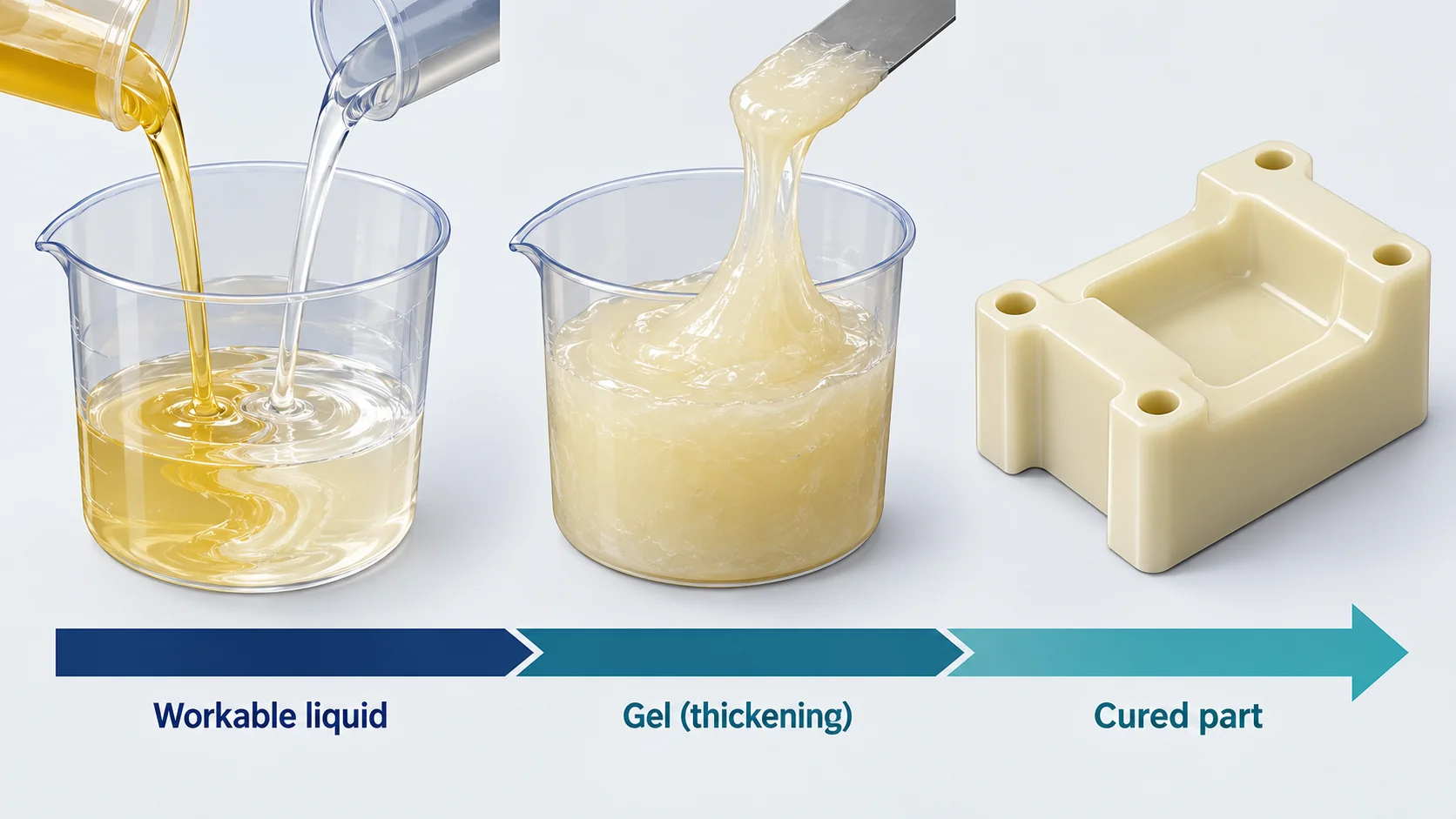
Pot life is the liquid-phase working window. Cure time is the solid-phase property window. Confusing the two leads to incomplete mold fill, trapped air, weak knit lines, or parts that demold with soft centers.
What Pot Life Actually Measures
Pot life, or working time, is the interval after the reactive components are mixed during which the material still meets a defined processing criterion, such as viscosity, flow or wetting. State material temperature, sample mass, mixing procedure and the endpoint. ASTM D7487 provides foam cup-test endpoints; it does not define one universal pot-life criterion for every polyurethane system.
Pot life is not a fixed data-sheet value. It shifts with component temperature, mixing efficiency, water content, catalyst level, and shot size [4]. Higher material temperature shortens the working window. Lower temperature may extend pot life enough to hide poor mixing if the components have not reached their required processing temperature.
A shot that drags past pot life usually looks acceptable for a few seconds and then shows flow marks, knit lines, or poor surface fill in the mold. How To Calculate Shot Weight In Polyurethane covers how shot size interacts with dispensing time in exactly these pours.
What Cure Time Actually Measures
Cure time is the elapsed time required for the mixed system to reach a defined degree of polymerization: gelation, green strength, demold, stack, or fully developed properties. In thermosetting systems, gelation is the point at which the liquid network first resists flow [3]. Cure continues after gelation, often with significant exotherm.
Cure time is strongly influenced by mold temperature, part mass, cross-section thickness, chain extender, and whether post-curing is used. A large mass may cure faster at the core while the outer surface stays green, or the reverse, depending on thermal transfer through the mold.
The shift from liquid handling to solid-part conversion is where cure time becomes a production constraint rather than a laboratory note. How Polyurethane Rollers Are Made From Casting To Cure covers how staged curing controls the final part.

Working Window vs. Property Development
| Factor | Pot life | Cure time |
|---|---|---|
| Measures | Liquid processability after mixing | Time to demold or specified property |
| Main concern | Viscosity rise, wetting, pumpability | Crosslink conversion and green strength |
| Timing horizon | Usually minutes for many castable systems [1] | Minutes to hours or days depending on system [3] |
| Most affected by | Temperature, catalyst, mixing ratio | Mold mass, part thickness, temperature, post-cure |
| Failure if missed | Poor fill, air entrapment, weak knit lines | Deformation, longer cycle, incomplete properties |
Pot life is always part of the early cure timeline, but it is not the same endpoint. Pot life ends because polymerization has advanced; cure time ends because polymerization has reached a specified state. A system can have short pot life and still need many hours for full cure, or a long pot life and a fast high-temperature demold cycle.
The same chemistry that ends pot life is the chemistry that builds cure—early viscosity rise is polymerization entering the reaction profile. The Role Of Rise Time In Polyurethane Foaming covers how reaction timing changes what the operator observes in the mold.
Why This Line Matters in Production
On a casting line, the practical question is whether every shot can be dispensed before the working window closes. The slowest cycle across the shift, including the largest mold, the coldest day, and the least experienced operator, determines the exposure. If shot size is increased without recalculating dispensing time, a process that was safe can drift past pot life.
Cure time mismanagement shows up later: the mold opens at the wrong time, the part deforms during demolding, or dimensions move during post-cure. A part may leave the mold successfully and still be under-cured.
Need an engineer’s read on your process window? Send your material system, current pot-life measurement, mold mass, and target demold time to Info@chinahaifeng.com or WhatsApp 86 13566296633. The next step is usually a short timing review, not a machine purchase.
Choosing Equipment Around the Time Line
Equipment does not change the chemistry of pot life, but it changes whether that chemistry is observed and controlled. Metering accuracy, component temperature control, and recirculation determine whether material reaches the mixing head in the same condition every shot. A machine that doses a shot quickly and repeatably reduces the amount of pot life consumed before the mold is closed.
Before selecting or upgrading equipment, compare the following:
- Measured pot life at production temperature
- Longest shot time on the line
- Temperature control accuracy of the A and B tanks
- Whether the mixing head can be purged or cleaned within the working window
- Actual cure time to demold, not a generic supplier value
Need Help Timing Your Polyurethane Process?
To get a practical timing review, have these ready:
- Material type and target hardness or density
- Measured pot life and cure-to-demold time at production temperature
- Mold temperature, part weight, and largest shot volume
- Manual, low-pressure, or high-pressure process
Email Info@chinahaifeng.com or WhatsApp 86 13566296633 with those four items. The discussion stays on process parameters until the timing constraint is clear.
Frequently Asked Questions
Can pot life and cure time be measured on the same sample?
They are usually measured at different points with different methods. Pot life focuses on viscosity or flow after mixing [1], while cure time focuses on gelation, hardness, or mechanical strength [3]. The same mixed batch can feed both tests, but the procedures are not interchangeable.
Why does pot life shorten in summer?
Warmer material and mold surfaces accelerate the reaction rate. If the A and B tanks are hotter, the viscosity climb arrives earlier, and the safe pour window closes sooner [4].
Does increasing catalyst shorten cure time only, or both?
Catalyst generally shortens both pot life and cure time, but not equally. A catalyst may advance gelation more than final property development, so the balance must be checked for the specific formulation [3].
How much safety margin should I leave below pot life?
Use the longest observed cycle on the line and leave enough reserve for temperature drift, slow operator starts, and the largest mold. The margin should come from your own process data, not from a different factory’s experience.
Is demold time the same as cure time?
Not necessarily. Demold time is one point on the cure curve at which the part has enough green strength to be handled. Full cure may continue for hours or days, especially in cast elastomers or thick sections.
References
[1] ASTM D7487-24 — Standard Practice for Polyurethane Raw Materials: Polyurethane Foam Cup Test. Its foam reaction-time and density endpoints are not a universal pot-life method for adhesives, coatings or CPU casting systems.
[2] ISO 9514:2019, Paints and varnishes — Determination of the pot life of multicomponent coating systems, International Organization for Standardization, Geneva, 2019.
[3] ASTM D2471-99(2019), Standard Test Method for Gel Time and Peak Exothermic Temperature of Reacting Thermosetting Resins, ASTM International, West Conshohocken, PA, 2019.
[4] ISO 291:2008, Plastics — Standard atmospheres for conditioning and testing, International Organization for Standardization, Geneva, 2008.
If you’re interested, check out these related articles:
SRIM Explained Structural Reaction Injection Molding Basics
What Is Semi Rigid Polyurethane Foam





