

A plant that already runs two-roll mills and compression presses does not need to buy a pouring machine every time a drawing calls for polyurethane on a high-wear roller or seal. Millable polyurethane exists for exactly that situation. It is a solid, rubber-like gum that can be compounded and cured on conventional rubber-processing equipment, yet it delivers much of the abrasion resistance, tear strength, and oil resistance that make polyurethane attractive in the first place. Confusing it with cast polyurethane, however, leads to the wrong equipment decision in either direction.
What Is Millable Polyurethane (MPU)?
Millable polyurethane, commonly shortened to MPU, is a solid, high-molecular-weight polyurethane gum supplied in sheets or strips. It belongs to the broader polyurethane elastomer family [1], but unlike castable polyurethane it arrives as a fully polymerized, essentially linear rubber that a fabricator compounds and crosslinks on site. The chains are built from a polyol — polyester or polyether — reacted with a diisocyanate such as MDI or TDI and a short-chain glycol extender.
To make the gum curable with peroxide, manufacturers incorporate a controlled level of unsaturation into the backbone. Without that unsaturation, a saturated urethane chain resists the free-radical crosslinking that gives MPU its final thermoset network. Some grades are designed for sulfur cure, but peroxide cure is the more common route because it avoids sulfur-related bloom and gives better heat aging in many formulations.
The term “millable” is literal. The gum softens under mill shear and accepts fillers, plasticizers, antioxidants, and curatives the way nitrile or natural rubber does. That is the dividing line between MPU and the liquid castable systems used on pouring machines: one is processed like rubber, the other like a reactive liquid.
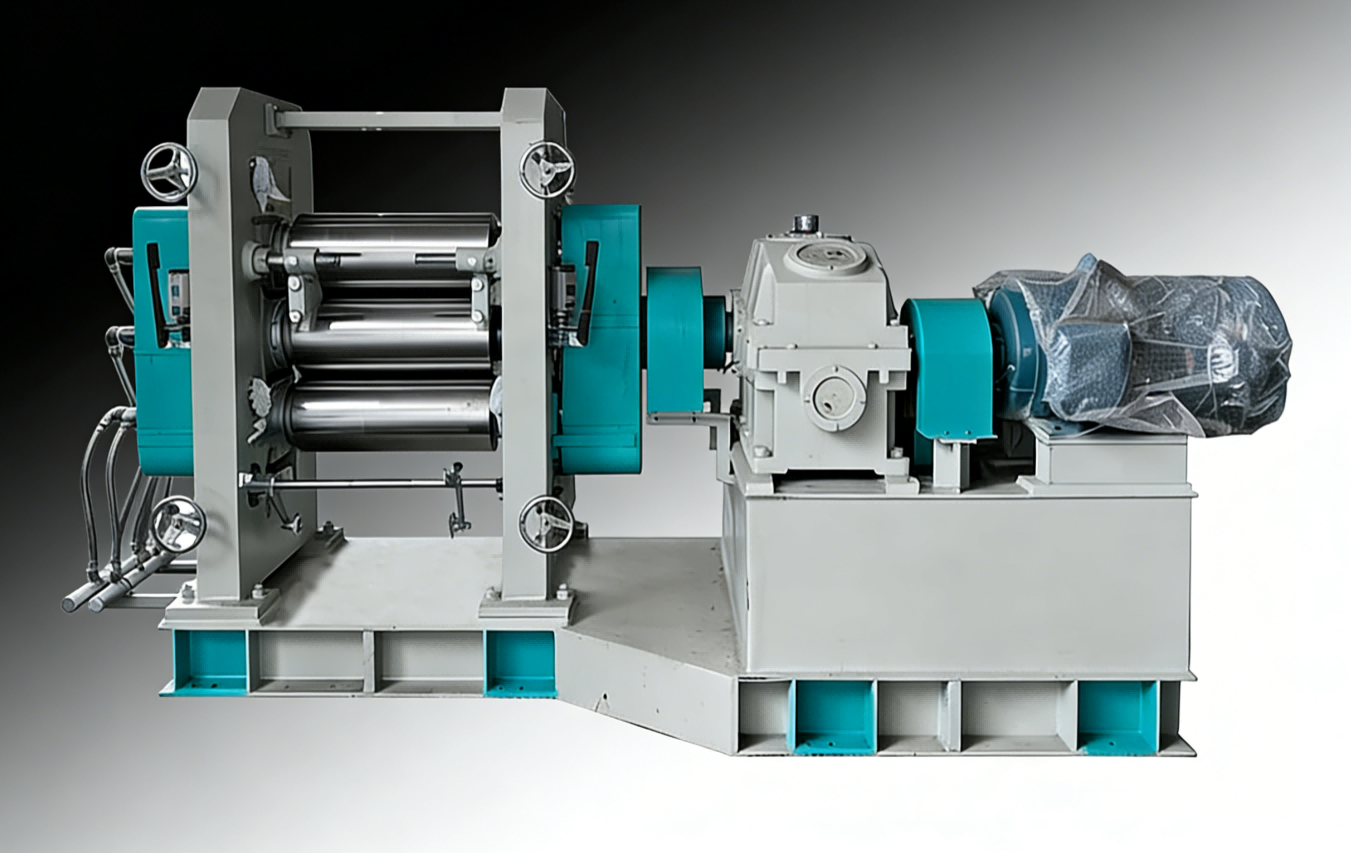
How MPU Is Processed on Conventional Rubber Equipment
Processing starts on a two-roll mill or in an internal mixer. Mill roll temperatures are kept low enough to avoid premature crosslinking. For dicumyl peroxide (DCP) compounds, mixing is normally held below roughly 120 °C because heat history near the peroxide decomposition range shortens the safe processing window.
Fillers such as carbon black or silica are added early for dispersion. The peroxide is added last to limit heat exposure. Compounded stock then has a limited shelf life and should be stored cool before forming, because slow crosslinking at room temperature can raise viscosity, hurt mold flow, and roughen surfaces.
Shaping follows conventional rubber routes: calendering into sheets, extrusion into preforms, or direct compression and transfer molding. Cure happens under heat and pressure, typically in the 150–170 °C range for DCP-cured compounds, with dwell time scaled to part thickness. After demolding, many MPU parts benefit from a post-cure step to complete the network and lower compression set.

Key MPU Properties and Typical Applications
Property ranges depend heavily on the backbone. Polyester-based MPU gives higher tensile and tear values and better oil and solvent resistance. Polyether-based MPU trades some mechanical strength for improved hydrolysis resistance and low-temperature flexibility. Hardness is usually reported on the Shore A scale [2], and commercial MPU compounds span roughly 40–95 Shore A, with most grades between 55 and 90.
Hardness alone does not separate millable gum from castable systems; both can hit the same durometer window, but cure state and test method shift the reading. Shore A Vs Shore D Hardness In Polyurethane covers how A-scale and D-scale measurements behave across solid polyurethane grades.
Abrasion resistance is the headline property. In rotating-drum abrasion tests such as the ISO 4649 method [3], well-compounded MPU typically outperforms general-purpose hydrocarbon rubbers by a wide margin. That is why the material appears wherever sliding wear, wet abrasion, or particle impingement dominates.
Typical parts include mill and industrial rollers, oil seals, hydraulic seals, diaphragms, couplings, caster wheels, wiper blades, pump linings, mining screens, pads, and conveyor components. In each case the part needs long wear life and can be made inside a shop that already has rubber mixing and molding capability.
Roller shops weighing mill-mixed gum against castable liquid systems are usually comparing the same hardness and rebound targets under different tooling rules. How Polyurethane Rollers Are Made From Casting To Cure covers the castable route from material conditioning through cure.

Millable vs. Castable vs. Thermoplastic: Choosing the Right Form
All three polyurethane forms can serve wear parts, but they are processed differently and reach different property ceilings.
| Factor | Millable (MPU) | Castable PU | Thermoplastic PU (TPU) |
|---|---|---|---|
| Supplied form | Solid gum sheets or strips | Two-component liquid | Pellets or granules |
| Processing route | Mill or mixer, then calendering, extrusion, or molding | Metering unit, mixing head, open or closed mold | Extrusion or injection molding |
| Cure | Heat plus peroxide or sulfur crosslinking | Chemical cure in mold, heat-accelerated | None; melt solidifies |
| Typical hardness | About 40–95 Shore A | About 20 Shore A to 75 Shore D | About 60 Shore A to 75 Shore D |
| Peak mechanical properties | High, slightly below the best cast systems | Highest of the three | Moderate to high |
| Part complexity | Simpler, uniform cross-sections | Good for thick-to-thin sections, inserts, complex geometry | Good for high-volume complex parts |
| Equipment investment | Uses existing rubber plant equipment | Requires casting and metering machinery | Requires thermoplastic processing lines |
| Batch flexibility | Strong for custom compounds and short runs | Strong, but pot life limits open time | Best for long, stable runs |
In practice the decision usually comes down to equipment, geometry, and volume. If a shop already owns mills and presses and needs several thousand wear parts a year with simple cross-sections, MPU is often the lowest-cost route because tooling stays in-house. If the part is thick, contains metal inserts, or must reach the highest tensile and cut-growth values, liquid castable polyurethane becomes the better technical choice. TPU wins where melt processing, fast cycles, recyclability, or welding matter more than the last increment of abrasion life. If the drawing ties the part to a classification system such as ASTM D2000 [4], that callout usually fixes hardness and baseline properties and helps settle the form decision.
Formulation, Cure Variables, and the Limits of Millable Gum
Formulation controls more of the final part than the base gum choice does. Peroxide level sets crosslink density and therefore hardness, modulus, and compression set. Too little peroxide leaves the part undercured and soft; too much drives up modulus but can reduce elongation and tear. The unsaturation built into the gum determines how efficiently the peroxide crosslinks, so changing gum grade without adjusting curative loading changes the cure state. Fillers raise hardness and lower cost but reduce resilience unless chosen and dispersed carefully. Antioxidants and plasticizers shift heat aging and low-temperature behavior.
Storage and scorch deserve as much attention as the recipe. Compounded stock stored warm can begin to crosslink before molding, which shows up as higher viscosity, poor mold flow, and surface roughness. Moisture picked up in storage can create porosity during cure. Polyester grades are more sensitive to humid storage than polyether grades because ester linkages hydrolyze over time, so polyester compounds should be kept dry and cool.
MPU also has practical limits. Complex geometries with deep ribs, bosses, or large thickness changes are difficult to fill by transfer or compression molding because the gum flows less readily than a liquid castable. When precision and volume both rise, it is often more economical to move the part to a metered casting machine, where the component ratio is controlled dynamically and shot size is set numerically rather than by hand-batched curative. Percent-level shifts in the curative ratio change hardness, modulus, and wear life more than most operators expect, which is why the cost logic often flips from “we already own the mills” to “metering accuracy now pays back” as a part family grows.
Once a part leaves the mill room and enters a metering line, the operator stops weighing batch curatives and starts setting shot size. How To Calculate Shot Weight In Polyurethane covers the shot-weight math behind castable production.
If you are deciding whether a specific part should stay on mills or move to metered casting, send the target hardness, required parts per shift, and current equipment list to Info@chinahaifeng.com or reach our engineering team on WhatsApp at +86 13566296633. A short process review usually shows whether the gum route is practical or whether a metering unit will pay back on that part family.
Work Through the Mill-vs.-Cast Decision With Our Engineers
If you are specifying or producing a polyurethane part and want a second read on whether millable gum, castable PU, or another route fits your operation, our team can review the case without pushing you toward machinery you do not need. When you reach out, include:
- Target hardness and the load, speed, and chemical environment
- Parts per shift and the number of mold cavities
- Your current mixing and molding equipment
- Any customer specification, standard, or inspection requirement the finished part must meet
Email: Info@chinahaifeng.com
WhatsApp: +86 13566296633
Frequently Asked Questions
Is millable polyurethane the same as cast polyurethane?
No. Millable polyurethane is a solid gum that is crosslinked with peroxide or sulfur on conventional rubber equipment, while cast polyurethane starts as a two-component liquid that chemically cures in a mold. They share a polyurethane backbone but differ in molecular weight, processing route, and how much of the final network is built before the part is formed.
What hardness range can millable polyurethane reach?
Commercial MPU compounds commonly span roughly 40–95 Shore A, with most applications between 55 and 90 Shore A. Hardness is adjusted through crosslink density, filler loading, and backbone choice rather than by switching to a different material family.
Can MPU be processed on standard rubber mills?
Yes. That is the defining advantage. MPU mixes on two-roll mills and internal mixers, calenders, and extrudes on standard rubber equipment, then cures in compression, transfer, or injection presses. The main change is tighter temperature control to prevent scorch.
Does millable polyurethane need post-curing?
Most grades benefit from a post-cure step after initial molding. Post-curing completes crosslinking and lowers compression set, which matters in seals, pads, and rollers that must hold dimensions and load over time. The exact time and temperature depend on the gum grade and peroxide loading.
How does MPU compare with conventional rubbers like nitrile or natural rubber?
MPU typically offers higher abrasion resistance and tear strength than general-purpose hydrocarbon rubbers, along with good oil resistance in polyester grades. It generally costs more and requires tighter processing control, so it is justified where wear life extends service intervals or reduces downtime, not as a drop-in replacement for low-cost rubber.
When should a manufacturer choose castable PU instead of millable gum?
Choose castable PU when the part has complex geometry, thick-to-thin transitions, or embedded inserts; when volumes justify automated metering; or when the application demands the highest tensile, cut-growth, and rebound values. Choose MPU when existing rubber equipment can do the job and the part is a simpler cross-section made in moderate quantities.
References
[1] C. Hepburn, Polyurethane Elastomers, 2nd ed. London: Elsevier Applied Science, 1992.
[2] ASTM D2240-15e1, “Standard Test Method for Rubber Property—Durometer Hardness,” ASTM International, West Conshohocken, PA, 2015.
[3] ISO 4649:2017, “Rubber, vulcanized or thermoplastic — Determination of abrasion resistance using a rotating cylindrical drum device,” International Organization for Standardization, Geneva, 2017.
[4] ASTM D2000-18, “Standard Classification System for Rubber Products in Automotive Applications,” ASTM International, West Conshohocken, PA, 2018.
If you’re interested, check out these related articles:
Shore A Vs Shore D Hardness In Polyurethane
How To Calculate Shot Weight In Polyurethane
What Is Semi Rigid Polyurethane Foam





