

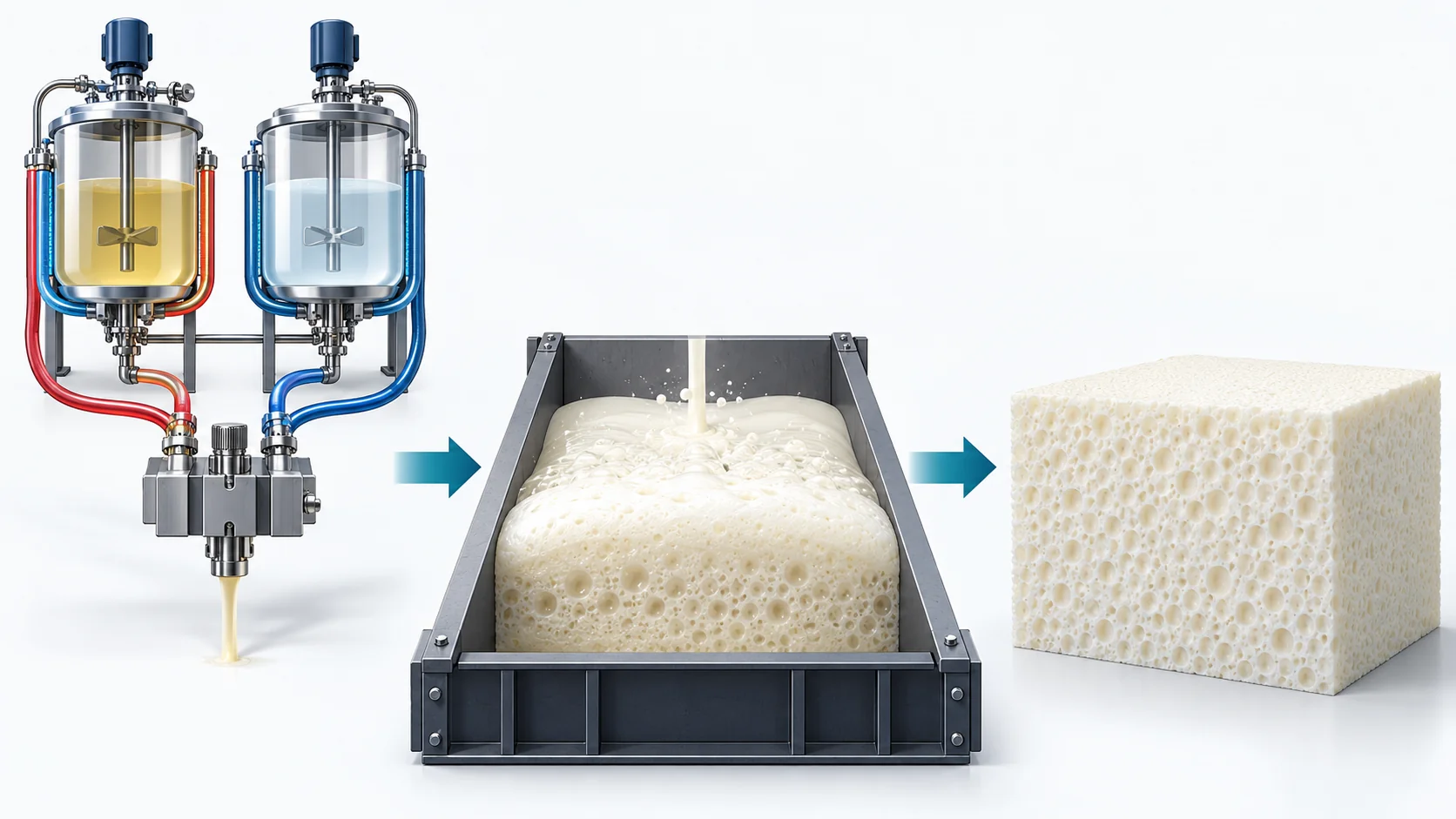
Ask a production manager why two water-blown batches with the same molded density differ in hardness, and the answer usually sits in the metering loop, the index calculation, or the moisture level in the B-side tank. Water is not simply an additive. It is a reactive blowing agent, and small changes in water content move in two directions at once: more gas for density and more urea for hardness.
The Water–Isocyanate Reaction Behind the Foam
Water blowing is a chemical process, not the vaporization of a separate blowing agent. The isocyanate group reacts with water to form an unstable carbamic acid intermediate, which decomposes into an amine and carbon dioxide [1][2]. The amine then reacts with another isocyanate group to form a urea linkage.
That sequence carries two practical consequences. First, carbon dioxide does most of the expansion work. By simple stoichiometry, one mole of water generates one mole of carbon dioxide; at standard conditions, one gram of water produces roughly 1.2 L of gas, and more at the actual reacting temperature [1]. Second, water changes the polymer itself. The urea groups act as hard segments, so raising water can increase firmness and load-bearing even when the overall part is lighter [2].
Because the gas is generated inside the reacting liquid, cell structure depends on how quickly and uniformly the blowing reaction releases gas relative to how fast the growing polymer can hold it. That is different from physically blown systems, where boiling point, solubility, and vapor pressure of the added agent dominate.
<img src="https://www.chinahaifeng.com/wp-content/uploads/2026/09/a98_20260904_104624.hf-lossless-eb25033bf001.webp" alt="a98" style="max-width: 600px; height: auto; display: block; margin: 20px auto;" />
From Liquid to Foam: Cream, Rise, and Gel
Once the metered components meet in the mixing head, the first visible event is cream time: the mixture turns cloudy as CO2 begins to nucleate. Small bubbles form, gas enters the bubbles, and the material starts to expand. Rise time then measures how long the foam continues growing before the cell walls gain enough strength to stop expanding.
Water creates a natural tension between blowing and gelling. The water reaction releases heat and forms urea, which increases early viscosity and encourages gelation. But the CO2 it releases also tries to expand the liquid. If gelation advances too quickly, the foam can underfill or trap closed cells. If blowing outruns viscosity, cells can coalesce, and the foam may settle or collapse.
Rise time defines the window in which the blowing reaction expands the foam before gelation locks the cell walls. The Role Of Rise Time In Polyurethane Foaming covers what rise time means and how it shapes final density.
Formulation Variables Water Introduces
Water level is normally expressed in parts per hundred polyol, and it must be calculated into the isocyanate index. The water reaction consumes isocyanate in addition to the polyol reaction. As a practical reference, one part of water consumes roughly 10 parts of TDI or roughly 14 parts of MDI by weight, although the exact value depends on the isocyanate equivalent weight [1].
If water increases and the isocyanate charge is not recalculated, the effective index drops. The result is often a softer, weaker foam than the formulation intended. If water decreases, less CO2 is available, density rises, and the urea contribution to hardness falls.
| Water level change | Typical effect | Process dial to check |
|---|---|---|
| Raise water, same isocyanate | Lower density but lower effective index | Recalculate isocyanate to restore index |
| Lower water, same isocyanate | Higher density, less urea hardening | Confirm wet fill and demold time |
| Moisture pickup in humid weather | Unplanned density drop, variable cells | Check B-side tank sealing and dry-air pad |
| Poorly mixed water in polyol | Localized coarse or dense areas | Verify polyol blend homogeneity before charging |
<img src="https://www.chinahaifeng.com/wp-content/uploads/2026/09/a80_20260904_104500.hf-lossless-5954dc78f632.webp" alt="a80" style="max-width: 600px; height: auto; display: block; margin: 20px auto;" />
Machine Control for Water-Blown Systems
Water-blown production puts unusual pressure on the metering side. Because water is usually part of the polyol blend and is used in small amounts, any error in B-side delivery shows up as an amplified change in CO2 volume. On well-tuned production lines, full-range metering accuracy around ±0.3% is a practical reference point for keeping shot-to-shot density variation under control.
Temperature control matters more than many plants expect. CO2 solubility and reaction rate both shift with material temperature. If the polyol/water blend runs cold, nucleation can be sluggish; if it runs hot, the reaction can accelerate before the mold is fully filled. A dry-air or nitrogen pad on the day tank is basic insurance against water-blend pickup from humid shop air.
Mixer quality is the second lever. Water-blown systems need enough shear to distribute the water-containing blend and the isocyanate uniformly before the blowing reaction takes off. Poor mixing often appears as hard and soft patches within the same part, not as a complete failure.
If you are running water-blown parts and density keeps moving with ambient humidity, do not keep compensating with index alone. Send your water level, polyol batch, and current metering data to Info@chinahaifeng.com or WhatsApp 86 13566296633 to trace whether the fault is in the formulation or the metering loop.
<img src="https://www.chinahaifeng.com/wp-content/uploads/2026/09/a63_20260904_104307.hf-lossless-051f7b99ecd9.webp" alt="a63" style="max-width: 600px; height: auto; display: block; margin: 20px auto;" />
Troubleshooting Common Water-Blown Defects
Shrinkage after demold usually means the foam lost gas before the polymer network was strong enough to resist the pressure drop. Open-cell content, isocyanate index, and demold time are the first variables to inspect.
Coarse cells typically point to weak nucleation or early coalescence. In water-blown systems, added nucleation air, mixer speed, and viscosity at the start of rise all influence whether the CO2 forms many small cells or a few large ones.
Collapse or splits often come from an imbalance between blowing and gelling. If the material rises quickly but does not build enough wall strength, the surface can settle or tear. Index adjustment alone may not fix the problem; catalyst balance and material temperature usually matter just as much.
Hardness drift without a density change is a signal that water level or index drifted while total fill stayed constant. That is why both variables belong on the line log, not just density.
Shrinkage in water-blown molded foam is usually a race between gas loss and polymer strength development. Causes Of Shrinkage In Polyurethane Foam How To Control It covers the mechanisms and the levers that reduce it.
<img src="https://www.chinahaifeng.com/wp-content/uploads/2026/09/a120_20260904_104909.hf-lossless-6469ff9d4b4d.webp" alt="a120" style="max-width: 600px; height: auto; display: block; margin: 20px auto;" />
A Practical Pre-Batch Checklist
Before charging a water-blown run, record the polyol blend temperature, shop humidity, water level, and calculated index. Confirm the B-side tank seal and dry-air system are functioning. Check the target shot weight against the mold volume and allow for the additional CO2 expansion in the mold cavity.
After the first shot, measure cream time, rise time, and gel time against the last stable run. Record free-rise density and molded density using a repeatable test method such as ISO 845 [4]. Check cell structure at the gate and in the thickest section, and test resilience after any water change using a consistent procedure such as ISO 8307 [5].
Density is only part of the story; water level changes cell openness and urea content, so resilience can shift even when molded density looks unchanged. Measuring Polyurethane Foam Resilience A Practical Test Guide covers bench and production test methods.
Process support for water-blown lines — If you are moving a part from a physical blowing agent to water, send the target density, water level, index, mold temperature, and shot weight to Info@chinahaifeng.com or WhatsApp 86 13566296633. Include one or two photos of the defect if you are troubleshooting.
Frequently Asked Questions About Water-Blown Polyurethane
Why does water-blown foam sometimes feel harder than its density suggests?
Water increases the urea content of the polymer even as it lowers density. Those urea hard segments can raise firmness and load-bearing, especially in flexible foams where the hardness is not controlled by density alone [2].
How much water is used in a typical flexible water-blown foam?
There is no single correct water level. Lower-water systems generally produce denser, finer-celled foam, while higher-water systems produce lower-density foam with more urea. The right level depends on the target density, hardness, and processing window.
Does ambient humidity affect water-blown production?
It can. If the polyol/water blend picks up moisture from humid air, the effective water level rises, CO2 output increases, and density drifts downward. Dry-air or nitrogen blanketing on the day tank and seasonal blend corrections are common countermeasures.
What should I check first when water-blown parts shrink after demold?
Check the actual index at the recorded water level, then look at demold time, mold temperature, and cell structure. Shrinkage is usually not solved by one dial alone; it is a race between gas loss and polymer strength development.
References
[1] G. Oertel, Ed., Polyurethane Handbook, 2nd ed. Munich, Germany: Hanser Publishers, 1994.
[2] M. F. Sonnenschein, Polyurethanes: Science, Technology, Markets, and Trends, 2nd ed. Hoboken, NJ, USA: Wiley, 2021.
[4] Cellular Plastics and Rubbers—Determination of Apparent Density, ISO 845:2006, International Organization for Standardization, Geneva, Switzerland, 2006.
[5] Flexible Cellular Polymeric Materials—Determination of Resilience by Ball Rebound, ISO 8307:2018, International Organization for Standardization, Geneva, Switzerland, 2018.
If you’re interested, check out these related articles:
How Polyurethane Rollers Are Made From Casting To Cure
What Is Semi Rigid Polyurethane Foam
RRIM Vs RIM Which Process Suits Your Structural Part





